


Content Menu
● Why Metal Contamination in Food Is So Dangerous
● Magnetic Separation vs Metal Detection: How They Work Together
● Where Magnetic Separation Adds the Most Value in Food Processing
● Key Technologies: Powder and Permanent Magnetic Separators
>> Powder Magnetic Separators for Dry, Fine Materials
>> Permanent Magnetic Separators for Robust, Low‑Maintenance Protection
● Designing a Magnet and Metal Detector Layout: A Practical Framework
● Real‑World Example: Building a Safer Powder Ingredient Line
● How Advanced Systems Support Global Standards and Customer Audits
● Where Magnetic Separation Fits in a Modern Foreign‑Object Strategy
● How Foshan Wandaye Supports Food and Powder Processors
● Practical Steps to Upgrade Your Metal Control Program
>> 1. Why can’t we rely only on metal detectors in food processing?
>> 2. How do powder magnetic separators improve food safety?
>> 3. What documentation do auditors expect for magnets and metal detectors?
>> 5. When should we add x‑ray or other foreign‑object technologies on top of magnets and detectors?
As a food safety consultant who has walked through dozens of flour mills, spice plants, and snack factories, I have learned one thing the hard way: metal contamination is never just a quality issue – it is a business survival issue. In modern food processing, advanced magnetic separation combined with high‑performance metal detection has become one of the most reliable ways to protect consumers, brands, and production equipment. [buntingmagnetics]
Why Metal Contamination in Food Is So Dangerous
Metal contamination is one of the most common reasons for food recalls worldwide, and every recall leaves a trace on brand reputation that is hard to erase. From my work with processors, I see three major risk areas: [buntingmagnetics]
– Consumer injury and legal liability from sharp fragments such as wire, blades, or broken machine parts. [linkedin]
– Production downtime and unplanned maintenance when nuts, bolts, or tools damage grinders, mills, or packaging equipment. [youtube]
– Regulatory and customer compliance failures, especially under HACCP, GFSI schemes, and retailer Codes of Practice that explicitly require effective foreign‑matter control. [wdymagnetic]
In practice, even well‑managed plants still generate metallic fines through abrasion, component wear, and accidental damage, so relying only on good maintenance is not enough. [buntingmagnetics]
Magnetic Separation vs Metal Detection: How They Work Together
In every effective food safety line I design or audit, magnetic separation and metal detection are treated as complementary, not competing technologies. [buntingmagnetics]
– Magnetic separators use strong magnetic fields to attract and retain ferrous metals and weakly magnetic particles from powders, slurries, and bulk solids. [buntingmagnetics]
– Metal detectors sense all types of metal (ferrous, non‑ferrous, and stainless steel) in free‑fall, conveyor, or pipeline configurations and trigger automatic rejection or line stops. [youtube]
From an engineering perspective, the most robust system is a layered “defence in depth” design:
1. Upstream magnets remove the bulk of ferrous contamination before grinding, mixing, or blending. [wdymagnetic]
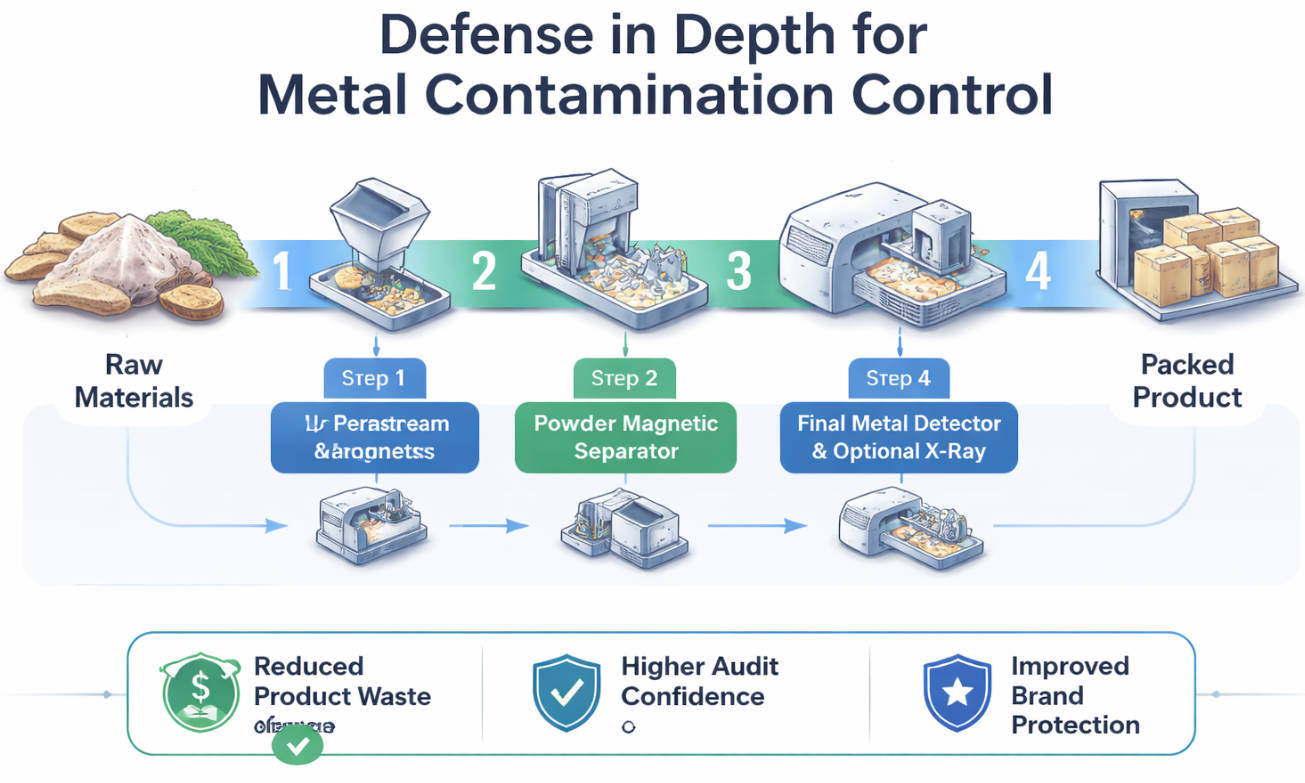
2. Intermediate magnets and detectors protect critical equipment such as mills and slicers. [buntingmagnetics]
3. Final metal detection (and, when necessary, x‑ray) checks finished or packed product as a last safeguard. [detectamet]
This staged approach reduces waste, minimizes false rejects, and creates a clear audit trail across the entire process. [detectamet]
Where Magnetic Separation Adds the Most Value in Food Processing
In real plants, metal risk is not uniform; it peaks at specific stages. Correct placement of magnets and detectors is just as important as their sensitivity. [wdymagnetic]
Typical high‑risk zones include:
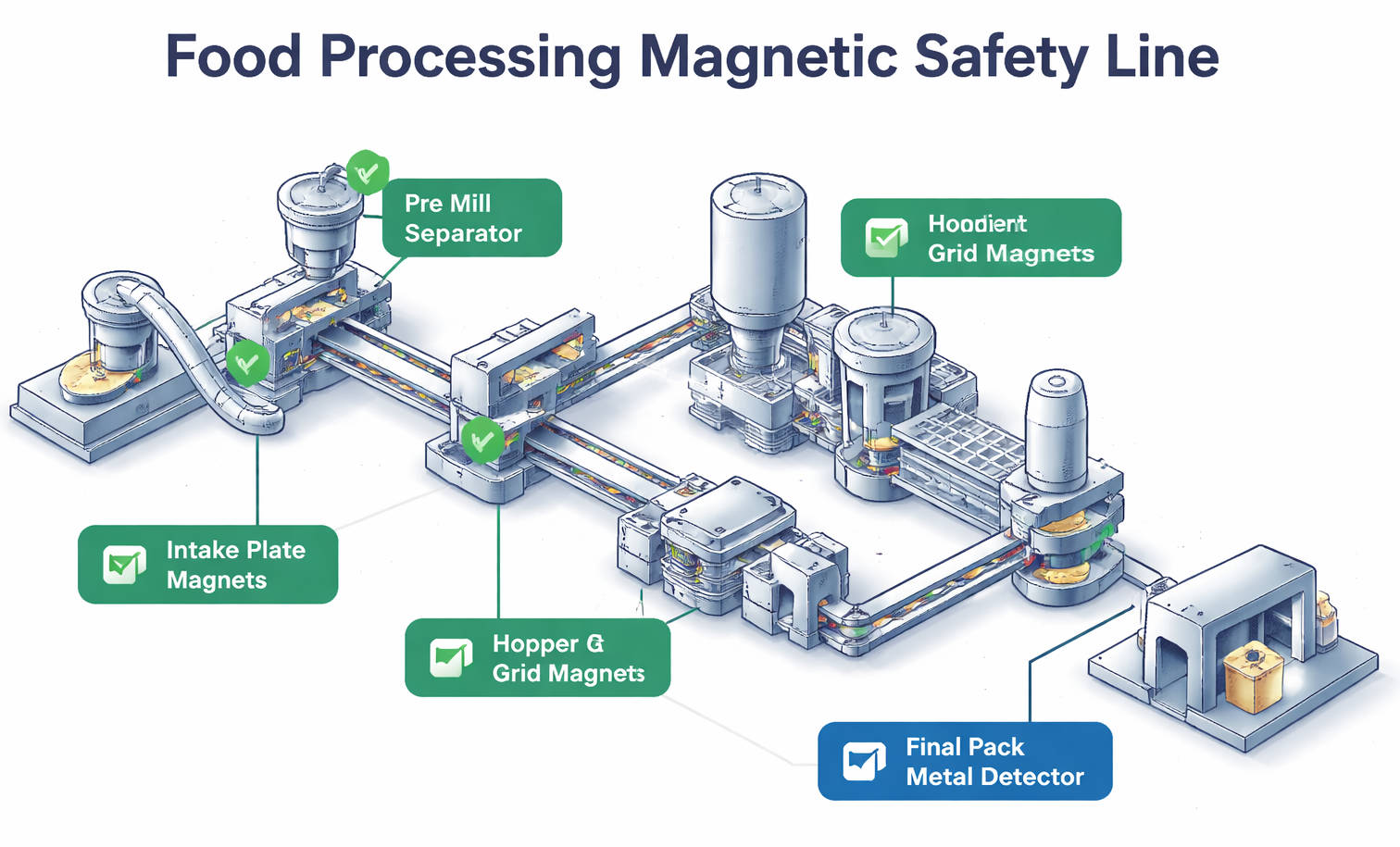
– Raw material intake: Grain, sugar, salt, and powdered ingredients can carry nails, wire, or tramp iron from harvesting and transport. [buntingmagnetics]
– Pre‑grinding and milling: Abraded parts from mills and conveyors often generate fine ferrous and stainless particles. [youtube]
– Cutting, dicing, and slicing: Knives and blades are a frequent contamination source when they chip or fracture. [youtube]
– Packaging and final handling: Stainless steel fragments or non‑ferrous pieces may appear from equipment wear, falling tools, or damaged fasteners. [buntingmagnetics]
Modern powder magnetic separators and permanent magnetic separators are particularly valuable for fine powders and bulk solids, where traditional screens or sieves cannot reliably remove tiny metallic fines. [wdymagnetic]
Key Technologies: Powder and Permanent Magnetic Separators
From an equipment engineering viewpoint, not all magnets are equal. When I work with food plants handling flour, starches, seasonings, or functional powders, I focus on two technology families:
Powder Magnetic Separators for Dry, Fine Materials
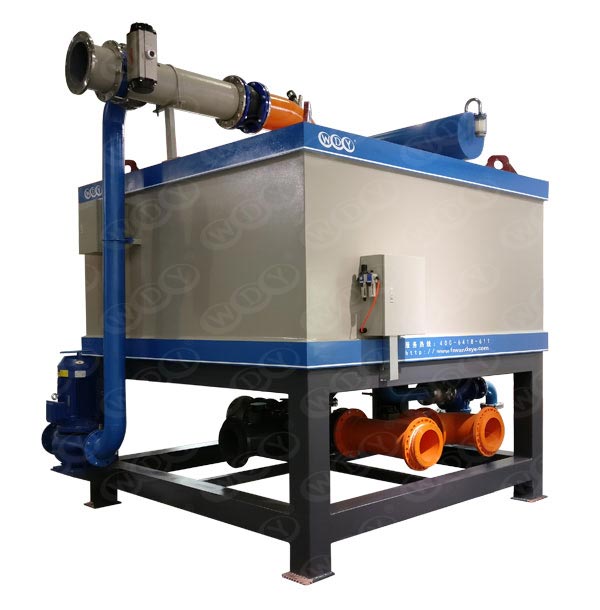
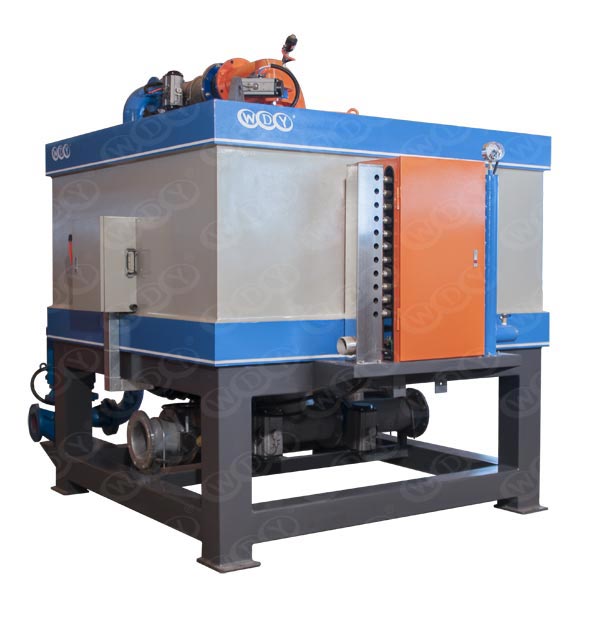
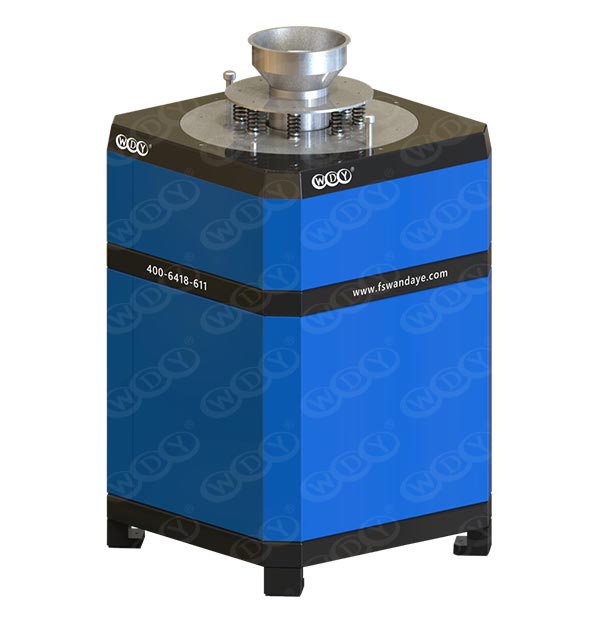
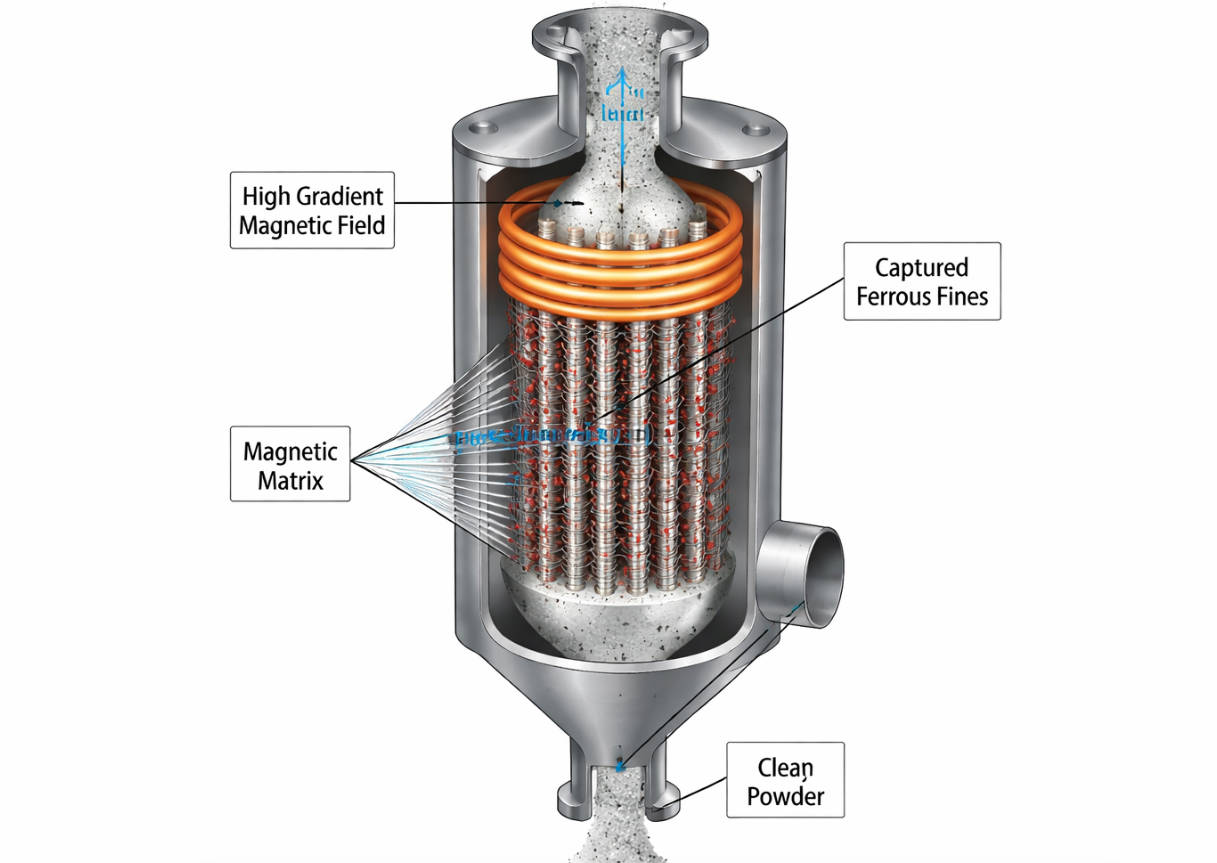
Powder magnetic separators are designed for high‑efficiency removal of ferrous contamination from dry, free‑flowing powders. Advanced designs use: [wdymagnetic]
– High‑gradient electromagnetic circuits to capture extremely fine iron and weakly magnetic particles.
– Water‑ and oil‑cooled systems to maintain stable performance under continuous operation. [wdymagnetic]
– Optimized magnetic media to improve separation efficiency while keeping product flow stable. [wdymagnetic]
For example, Foshan Wandaye Technology provides electromagnetic dried‑powder separators that integrate intelligent control, enabling consistent magnetic field strength without constant manual adjustment. These systems are widely applied in food‑adjacent sectors such as ceramics, glass, and battery powders, but the same design principles translate effectively into food and ingredient processing lines. [en.fswandaye]
Permanent Magnetic Separators for Robust, Low‑Maintenance Protection
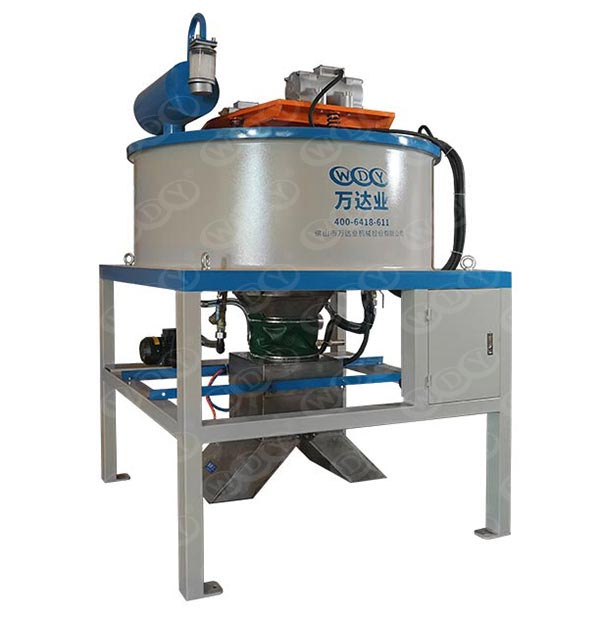
Permanent magnetic separators use high‑energy rare‑earth magnets to deliver strong, long‑term magnetic fields without external power. In food applications, processors frequently use: [buntingmagnetics]
– Magnetic plates and grids above chutes and within hoppers for bulk solids and powders. [buntingmagnetics]
– Magnetic rods and frames inside sifters and bins to capture tramp metal in confined spaces. [wdymagnetic]
– Drawer‑type separators for inline powder and granule handling.
Suppliers such as Foshan Wandaye combine permanent magnetic separators with system‑level services – from R&D and engineering design to on‑site installation and commissioning – to ensure that magnets are correctly sized and located for each product and line layout. [wdymagnetic]
Designing a Magnet and Metal Detector Layout: A Practical Framework
When I advise a new or expanding food plant, I use a simple but rigorous design framework to build a defensible metal control program. [detectamet]
1. Map the process and identify hazards
– Document every transfer point, grinder, mixer, and packaging line.
– Identify where foreign‑object risks are highest based on mechanical stress, ingredient history, and previous incidents. [wdymagnetic]
2. Define critical control points and performance targets
– Decide which magnets and detectors will be treated as CCPs under HACCP.
– Set measurable performance limits (for example, “capture ≥ 95% of 0.5 mm ferrous particles” or “detect 1.5 mm stainless steel in packed snacks”). [detectamet]
3. Select and position equipment
– Use high‑gradient powder magnetic separators before milling, blending, or packing of powders. [wdymagnetic]
– Install permanent plate, grid, or rod magnets at gravity‑fed and transfer points with sufficient dwell time and low turbulence. [buntingmagnetics]
– Place free‑fall or tunnel metal detectors after magnets and before final packing or case packing. [buntingmagnetics]
4. Validate, document, and train
– Perform installation qualification (IQ), operational qualification (OQ), and performance qualification (PQ) checks using test pieces. [wdymagnetic]
– Document corrective actions, verification schedules, and maintenance plans to support audits and certifications. [detectamet]
From my experience, plants that treat this as a living system — updated when products, suppliers, or equipment change — see far fewer incidents and smoother third‑party audits.
Real‑World Example: Building a Safer Powder Ingredient Line
In a recent project with a powder ingredient manufacturer supplying bakeries and beverage brands, we implemented a combined magnetic separation and metal detection system inspired by best‑practice guidelines. The plant handled high‑value, fine powders that had to meet strict retailer specifications. [wdymagnetic]
The final configuration included:
– Upstream permanent magnetic plates at raw material intake to remove large tramp metal.
– Electromagnetic dried‑powder separators before blending to capture very fine ferrous and weakly magnetic contamination. [wdymagnetic]
– Grid magnets in intermediate hoppers to protect screw conveyors.
– High‑sensitivity tunnel metal detectors after packing, tuned for stainless steel detection at low millimetre levels. [youtube]
Within months, recorded metal incidents dropped sharply, and metal‑related customer complaints and rework events were significantly reduced. The plant also reported smoother certification audits, because they could present clear magnet performance records and detector validation results. [wdymagnetic]
How Advanced Systems Support Global Standards and Customer Audits

Retailers, brand owners, and certification schemes are steadily raising expectations for foreign‑matter control. A modern magnetic separation and metal detection system is no longer a competitive advantage; it is a minimum requirement for serious food manufacturers. [wdymagnetic]
Best‑in‑class systems support:
– HACCP and GFSI compliance by providing clear hazard analyses, critical limits, and monitoring records for each magnet and detector. [wdymagnetic]
– Retailer Codes of Practice, which often specify minimum magnet strengths, test frequencies, and detection limits for different product categories. [detectamet]
– Customer audits and specifications, which increasingly demand documented capture and detection capabilities, equipment certificates, and traceable maintenance records. [wdymagnetic]
Suppliers like Foshan Wandaye, focused on R&D and engineering design, can help processors align system configuration with these evolving standards while also addressing sector‑specific needs such as battery materials, ceramics, or glass where similar metal‑control logic applies. [en.fswandaye]
Where Magnetic Separation Fits in a Modern Foreign‑Object Strategy
While magnets and metal detectors are vital, they are part of a broader foreign‑object detection strategy alongside sieves, filters, x‑ray systems, and even AI‑assisted vision inspection. A well‑balanced strategy uses each technology for what it does best: [detectamet]
– Magnetic separation: Highly effective against ferrous and some weakly magnetic contamination in powders, slurries, and bulk flows. [buntingmagnetics]
– Metal detection: Versatile detection of all metals in unpacked and packed products. [buntingmagnetics]
– X‑ray: Detection of dense non‑metallic foreign bodies such as glass, stones, and some plastics. [buntingmagnetics]
– Mechanical separation: Sieves and filters to remove large foreign bodies based on size rather than composition. [detectamet]
Combining these technologies allows processors to address not only metallic hazards but a broader range of foreign materials that can trigger recalls and reputational damage. [buntingmagnetics]
How Foshan Wandaye Supports Food and Powder Processors
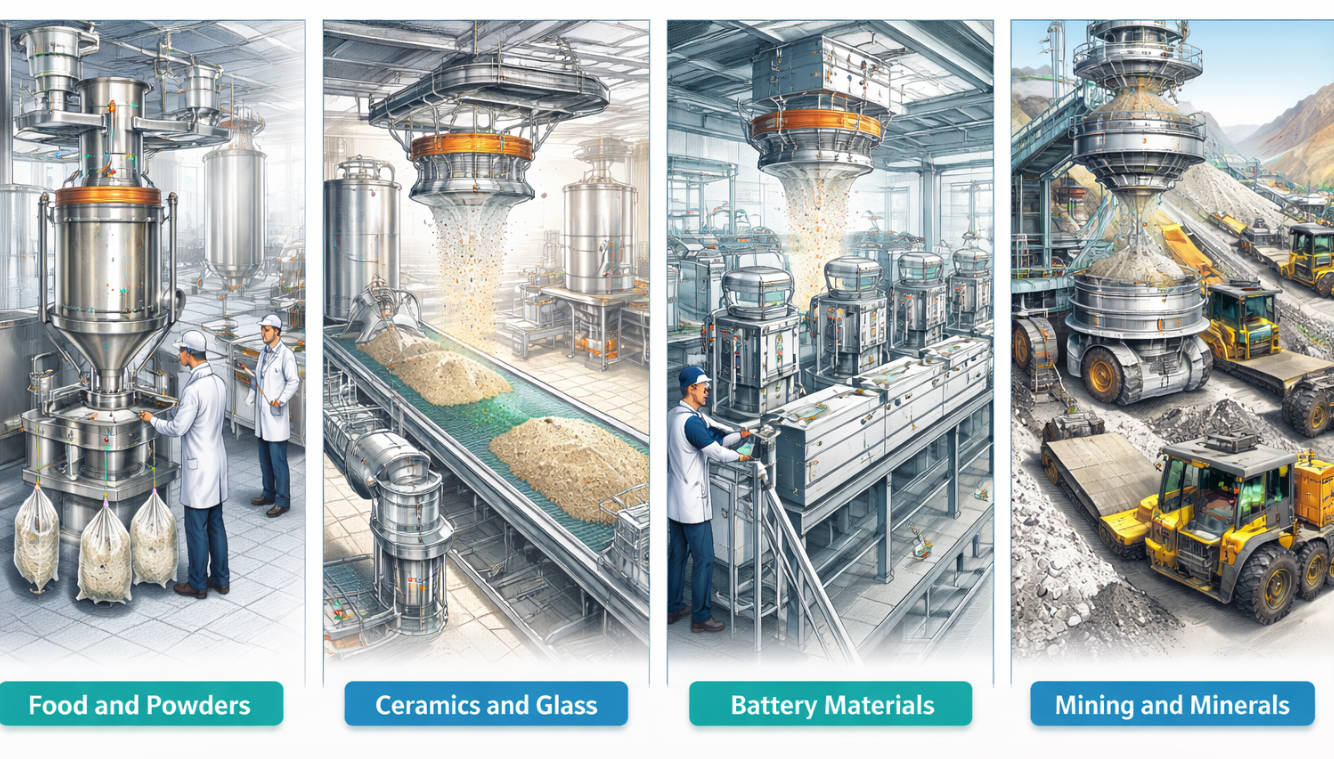
Foshan Wandaye Technology Co., Ltd. is recognized in China and internationally as a specialized magnetic separation equipment manufacturer integrating R&D, engineering design, production‑line installation, and commissioning. While its portfolio covers mining, ceramics, power, building materials, glass, environmental protection, rubber, plastics, pharmaceuticals, and battery materials, the same technologies play a crucial role in food and food‑adjacent powder safety. [en.fswandaye]
Key capabilities include:
– High‑gradient electromagnetic slurry and powder separators for fine, high‑purity applications.
– Permanent magnetic separators, plates, rods, and iron‑removal cabinets for gravity and pipeline installations. [wdymagnetic]
– Full‑line engineering services, from system design and modeling to on‑site installation, debugging, and performance optimization. [en.fswandaye]
For food processors, working with an engineering‑driven partner makes it easier to translate standards and customer requirements into a robust, documented metal control system.
Practical Steps to Upgrade Your Metal Control Program
If you are evaluating your current foreign‑object control, here is a concise action plan I often recommend to operations and quality leaders:
1. Audit your current coverage
– List all existing magnets, metal detectors, and sieves, including their locations and specifications.
– Compare their detection and capture capabilities with your customer and certification requirements. [wdymagnetic]
2. Identify high‑risk gaps
– Look for unprotected transfer points, high‑wear equipment, or new product lines where metal risk is higher. [wdymagnetic]
– Review past metal incidents, near‑misses, and complaints to spot patterns.
3. Engage an expert equipment partner
– Share product specifications, process diagrams, and target detection limits with a specialized magnetic separation manufacturer such as Foshan Wandaye. [wdymagnetic]
– Request proposals that include magnet strength, detector sensitivity, layout drawings, and validation plans.
4. Plan phased implementation
– Prioritize installations that protect consumers and critical equipment first.
– Build in training, documentation templates, and a regular verification schedule.
Plants that take this structured approach not only improve food safety but also gain better line efficiency, fewer unplanned stops, and more confident responses during customer audits.
Strong Call to Action
If you are responsible for quality, production, or engineering in a food or powder processing facility, now is the time to review whether your magnetic separation and metal detection systems truly match your risk, your customer specifications, and your growth plans.
Contact Foshan Wandaye Technology Co., Ltd. to discuss your ingredients, process layout, and audit requirements, and receive a tailored magnetic separation solution that strengthens your metal control program from raw material intake to final packaging. [en.fswandaye]
Frequently Asked Questions
1. Why can’t we rely only on metal detectors in food processing?
Metal detectors are essential, but they work best as a final safeguard, not a single line of defence. Without upstream magnets, detectors may face high metal loads, leading to more false rejects, unnecessary waste, and unplanned downtime. Magnets remove most ferrous contamination earlier in the process, enabling more stable and efficient detector performance. [buntingmagnetics]
2. How do powder magnetic separators improve food safety?
Powder magnetic separators capture extremely fine ferrous and weakly magnetic particles that screens and basic magnets often miss, especially in dry powders like flour, starch, or spices. By stabilizing magnetic field strength and optimizing media design, advanced systems maintain high capture rates under continuous, high‑throughput conditions. This directly reduces the risk of metal reaching consumers and supports compliance with strict retailer and certification limits. [wdymagnetic]
3. What documentation do auditors expect for magnets and metal detectors?
Auditors typically expect a documented hazard analysis, equipment specifications, critical limits, and defined monitoring and corrective‑action procedures for each magnet and detector. They also look for records of magnet pull‑tests, metal detector validation tests, maintenance, and investigations of any incidents or customer complaints. Having this documentation organized and up‑to‑date greatly simplifies HACCP, GFSI, and customer audits. [detectamet]
4. Can the same magnetic separation technologies be used outside food, such as in ceramics or battery materials?
Yes. The core physics of magnetic separation is the same whether you are purifying ceramic glazes, glass sand, battery powders, or food ingredients. Suppliers like Foshan Wandaye apply similar high‑gradient electromagnetic and permanent magnetic technologies across ceramics, glass, mining, environmental protection, rubber, plastics, and battery cathode and anode materials. Food processors can benefit from these cross‑industry innovations, especially when handling functional powders and additives. [wdymagnetic]
5. When should we add x‑ray or other foreign‑object technologies on top of magnets and detectors?
You should consider x‑ray or advanced vision systems when your risk assessment shows significant non‑metallic hazards (such as glass, stones, or dense plastics) or when customers require more comprehensive foreign‑object detection. In such cases, magnets remove ferrous contamination, metal detectors or x‑ray systems detect residual metals, and x‑ray or other technologies target dense non‑metallic foreign bodies. This layered approach offers stronger protection and a more defensible food safety program. [buntingmagnetics]
References
1. Bunting. “Improve Food Processing with Bunting Metal Detection and Magnetic Separation.”
https://buntingmagnetics.com/blog/improve-food-processing-with-bunting-metal-detection-and-magnetic-separation [buntingmagnetics]
2. Bunting. “Metal Contaminated UK Food Recalls 2024.”
https://buntingmagnetics.com/blog/metal-contaminated-uk-food-recalls-2024 [buntingmagnetics]
3. Bunting. “Getting Metal Out of Processed Vegetables – Magnetic Separation and Metal Detection.”
https://buntingmagnetics.com/blog/getting-metal-out-of-processed-vegetables-magnetic-separation-and-metal-detection [buntingmagnetics]
4. Bunting. “Metal Detectors for the Food Industry – YouTube Video.”
https://www.youtube.com/watch?v=skPxVG0gHrQ [youtube]
5. Bunting. “Protection Against Metal Contamination at Interpack 2023.”
https://buntingmagnetics.com/blog/protection-against-metal-contamination-at-interpack-2023 [buntingmagnetics]
6. Detectamet. “Beyond Metal – A Comprehensive Guide to Foreign Object Detection in Food Manufacturing.”
https://detectamet.com/latest-news/beyond-metal-a-comprehensive-guide-to-foreign-object-detection-in-food-manufacturing [detectamet]
7. Foshan Wandaye Technology Co., Ltd. “Magnetic Separator | Magnetic Separation Equipment | Iron Removal.”
http://en.fswandaye.com [en.fswandaye]
8. Foshan Wandaye Technology Co., Ltd. “Electromagnetic Dried‑Powder Separator Series.”
https://www.wdymagnetic.com/products/electromagnetic_dried-powder_separator_series [wdymagnetic]
9. Foshan Wandaye Technology Co., Ltd. “Top 10 Magnetic Separation in Food Industry Manufacturers in China.”
https://www.wdymagnetic.com/top-10-magnetic-separation-in-food-industry-manufacturers-in-china.html [wdymagnetic]
10. Foshan Wandaye Technology Co., Ltd. “Improving Food Safety with Advanced Magnetic Separation – An Expert Perspective for Modern Processing Plants.”
https://www.wdymagnetic.com/improving-food-safety-with-advanced-magnetic-separation-an-expert-perspective-for-modern-processing-plants.html [wdymagnetic]
11. Bunting. “Metal Contamination Liability in Food Processing – LinkedIn Post.”
https://www.linkedin.com/posts/bunting-magnetics-co_in-food-processing-metal-contamination-is-activity-7437498331070660609-Pptp [linkedin]
12. Bunting. “Enhanced Metal Recovery with Bunting at IFAT 2024.”
https://buntingmagnetics.com/blog/enhanced-metal-recovery-with-bunting-at-ifat-2024 [buntingmagnetics]
13. Bunting. “Bunting Magnetic Separation and Metal Detection for Processed Vegetables and Fruit.”
https://buntingmagnetics.com/blog/getting-metal-out-of-processed-vegetables-magnetic-separation-and-metal-detection [buntingmagnetics]
Hot Tags: Auto Recycling Equipment, Manufacturers, Customized, Custom, Suppliers, Buy, Cheap, Quality, Advanced, Durable, in Stock, Made in China, Price, Quotation