


Content Menu
● What Is a Magnetic Separator?
● Core Types of Magnetic Separators
● What Is a Powder Magnetic Separator?
● What Is a Permanent Magnetic Separator?
● Powder Magnetic Separator vs. Permanent Magnetic Separator
>> 2. Power and operating cost
>> Comparison table: powder vs permanent
● How Powder Magnetic Separators Work in Key Industries
>> New energy battery materials
>> Food, plastics, and chemicals
● When to Choose Permanent Magnetic Separators
● Expert Guidelines for Selecting the Right Magnetic Separator
● Conclusion and Call to Action
>> FAQ
>> 1. How do I know if I need a powder magnetic separator or a wet separator?
>> 2. Are permanent magnetic separators strong enough for fine powder purification?
>> 3. How often should magnetic separators be cleaned?
>> 4. Can one magnetic separator handle both powders and slurries?
>> 5. What industries benefit most from powder magnetic separators?
Magnetic separators come in several main types, but for powder processing and many industrial lines the most important distinction is between powder magnetic separators and permanent magnetic separators. Understanding how these two overlap, differ, and fit into real projects is essential if you want stable product quality, lower contamination risk, and better ROI. [osencmag]
What Is a Magnetic Separator?
Magnetic separation is a process that removes ferrous or weakly magnetic contaminants from a material stream using a magnetic field. It is now standard in mining, ceramics, power, building materials, glass, environmental protection, rubber, plastics, pharmaceuticals, food, and battery electrode materials. [greatmagtech]
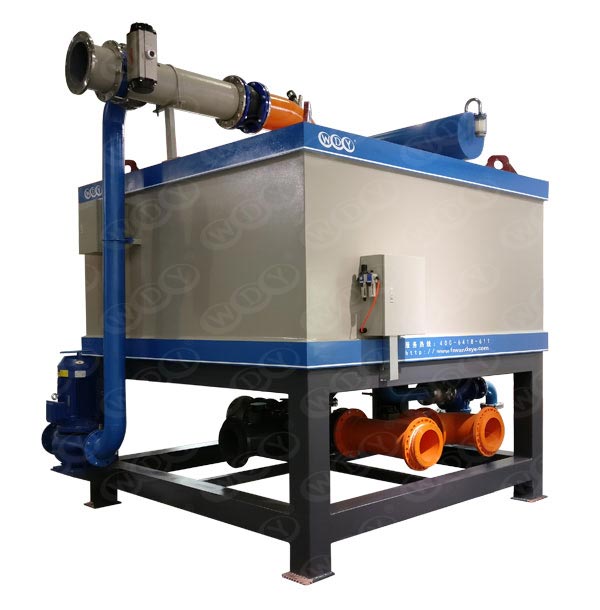
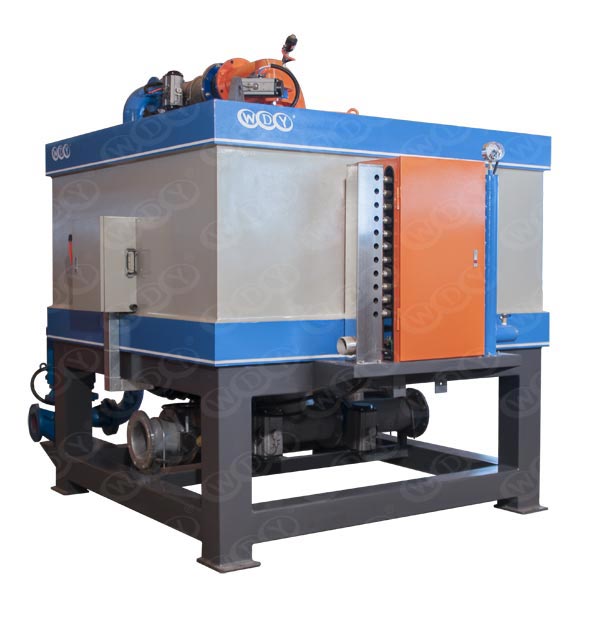
From an engineering standpoint, the core design variables are magnetic field strength and gradient, the way material contacts the magnetic field, and whether the feed is dry powder or slurry. Modern systems from leading Chinese manufacturers can integrate slurry, powder, vertical ring, belt conveyor, and permanent magnetic units into complete separation lines. [wdymagnetic]
You typically choose between:
– Dry powder magnetic separators for powders, granules, and bulk solids. [gme-magnet]
– Wet magnetic separators for slurries and high‑moisture feeds. [osencmag]
– Permanent magnetic separators that provide a constant magnetic field without external power. [elcanindustries]
– Electromagnetic separators where the field strength can be switched and adjusted. [elcanindustries]
Core Types of Magnetic Separators
Before focusing on powder and permanent designs, it helps to see where they sit within the wider portfolio. [magworks]
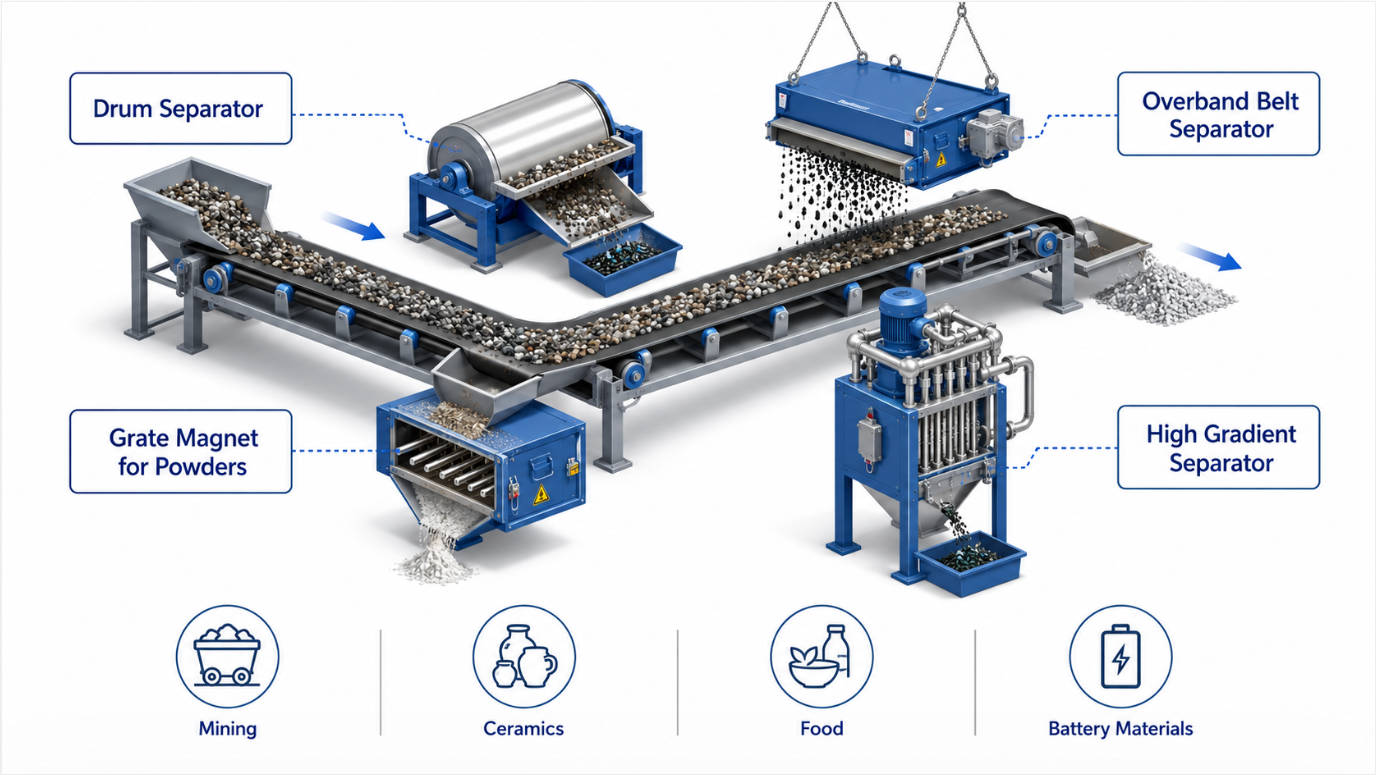
Common industrial magnetic separator types include: [guangdar]
– Drum magnetic separators for mining, recycling and bulk material handling. [magworks]
– Cross‑belt / overband separators mounted above conveyors to remove tramp iron. [guangdar]
– Roll and high‑gradient magnetic separators (HGMS) for fine and weakly magnetic particles. [greatmagtech]
– Tube, grate, and plate magnets in chutes and hoppers for powders and small flows. [mpimagnet]
– Rotary magnets specifically for cohesive powders that would bridge on static grates. [powder-solutions]
Dry vs wet classifications and low‑, medium‑, or high‑intensity designs then define the detailed performance envelope. [osencmag]
What Is a Powder Magnetic Separator?
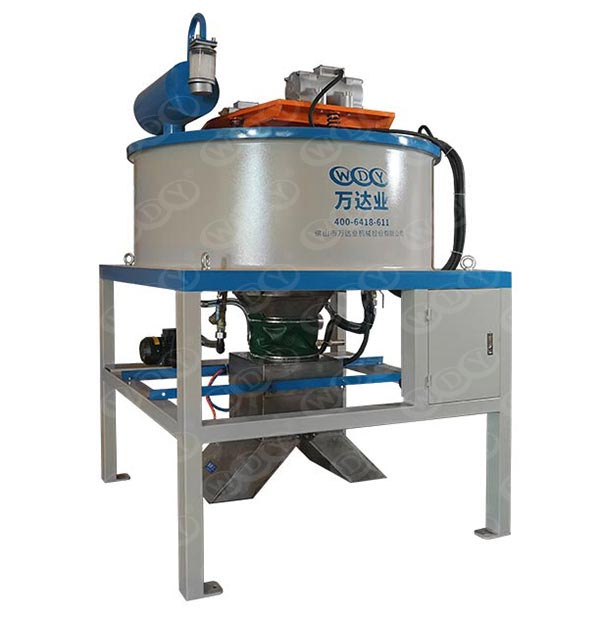
A powder magnetic separator is a dry magnetic separation system optimized for powders, granules, and other free‑flowing bulk solids. These units are engineered so that every particle has a high‑probability contact with strong magnetic fields while minimizing bridging, dust, and product degradation. [hsmagnets]
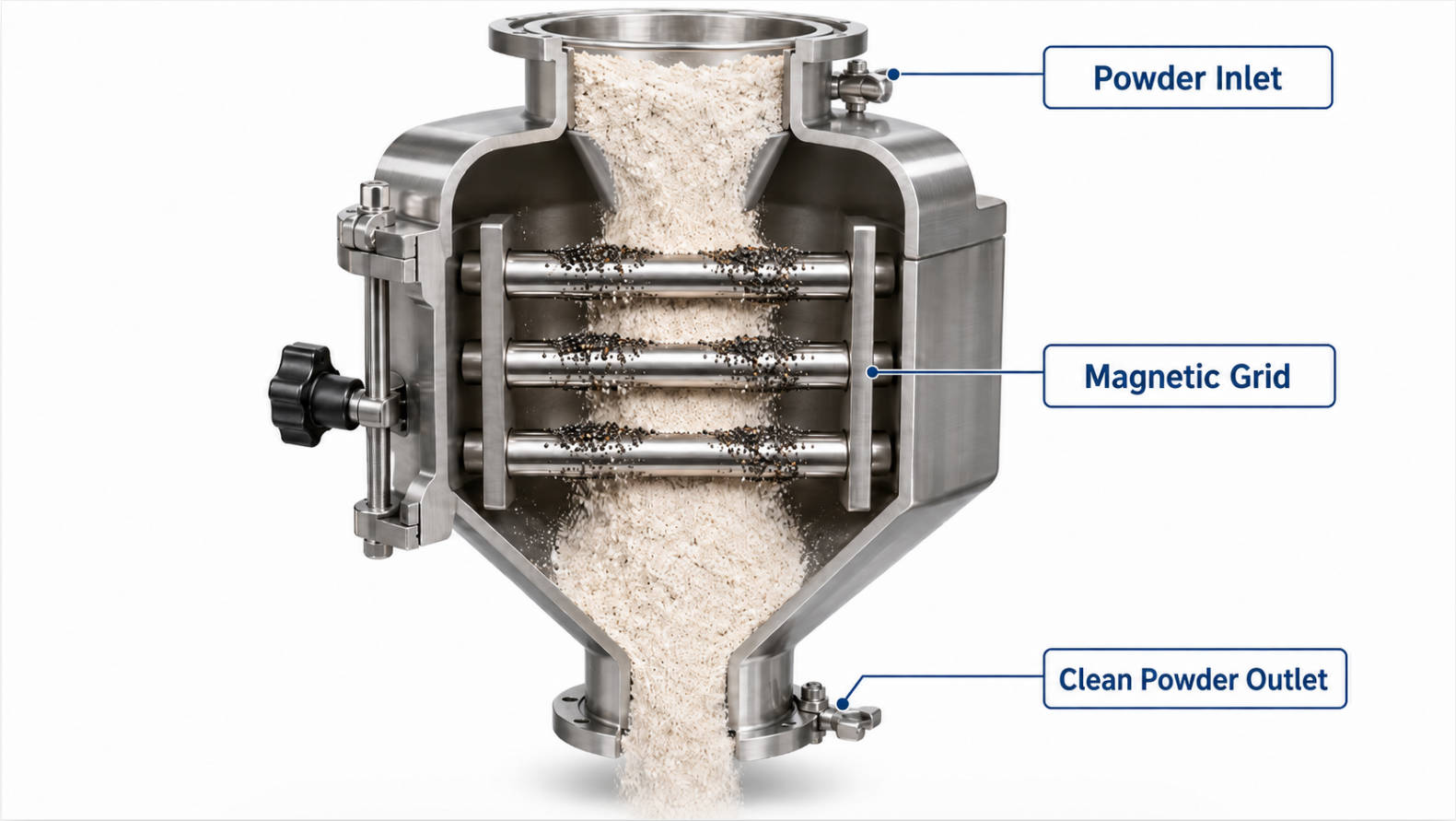
From an operator’s perspective, the key functions are:
– Remove fine ferrous and weakly magnetic particles from powders such as ceramic bodies, quartz, feldspar, battery cathode/anode materials, food ingredients, and plastic granules. [permagproducts]
– Protect downstream equipment like mills, extruders, and presses from metal damage. [hsmagnets]
– Improve whiteness, purity, and electrical performance of high‑value powders, especially in ceramics and new energy materials. [alibaba]
Typical powder solutions include grate/rod magnets in gravity chutes, rotary magnets in hoppers, and high‑gradient dry separators designed specifically for ultra‑fine powder flows. [permagproducts]
What Is a Permanent Magnetic Separator?
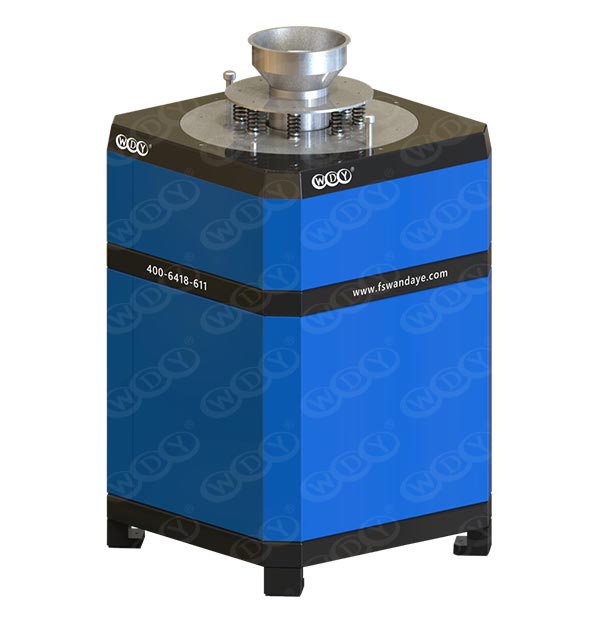
A permanent magnetic separator uses permanent magnet materials, such as neodymium (NdFeB), ferrite, or samarium cobalt, to generate a constant, stable magnetic field without power. These magnets are built into drums, plates, grids, belts, or rotary structures depending on the application. [hsmagnets]
Key characteristics include:
– Constant magnetism that does not need electrical excitation, which simplifies installation and reduces running cost. [elcanindustries]
– High durability, as modern rare‑earth magnets retain magnetization for years under industrial conditions. [hsmagnets]
– No external power requirement, which is valuable in remote sites or where power stability is an issue. [osencmag]
Permanent magnetic separators are widely used in mining, aggregates, recycling, food processing, plastics, and numerous powder applications where a stable field is sufficient. [alibaba]
Powder Magnetic Separator vs. Permanent Magnetic Separator
In practice, these two concepts overlap: most powder magnetic separators used in dry powder lines are in fact permanent‑magnet based, while some high‑end powder systems use electromagnets or hybrid designs. [gme-magnet]
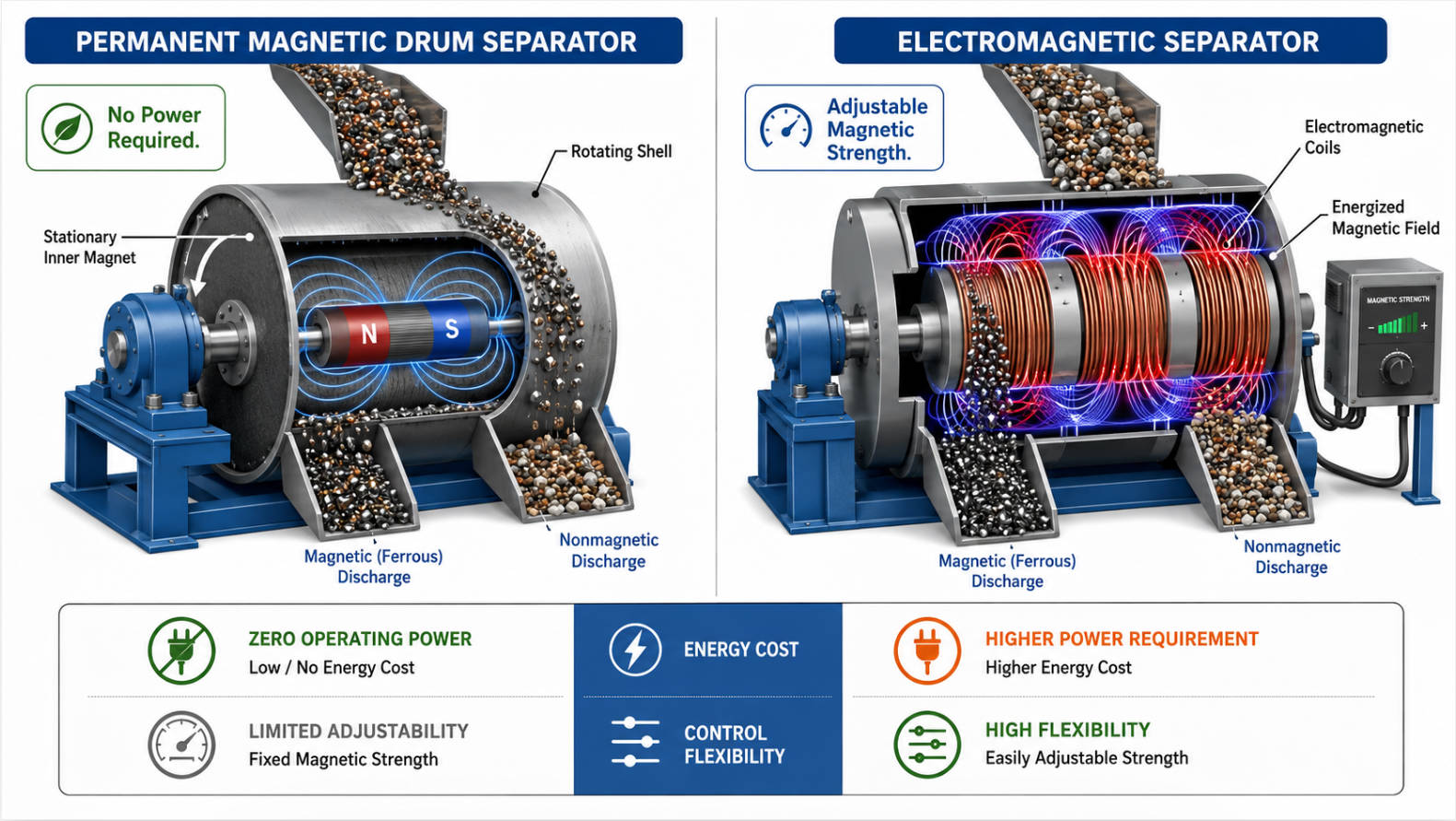
1. Design focus
– Powder magnetic separator: Defined by the *material state* (powder, granule, bulk solid) and by how the equipment handles flowability, bridging, and contact with the magnetic field. [powder-solutions]
– Permanent magnetic separator: Defined by the *magnet source* (permanent vs electromagnetic) and by long‑term field stability and energy use, independent of whether the feed is powder or slurry. [elcanindustries]
2. Power and operating cost
– Powder separators can be permanent or electromagnetic, so energy use depends on the chosen magnet system. [gme-magnet]
– Permanent separators have no continuous power consumption for the magnet itself, which lowers operating cost and simplifies maintenance. [osencmag]
3. Process flexibility
– Powder separators are engineered for gravity‑fed chutes, closed pneumatic conveying, or hopper discharges, with options like rotary grids to avoid bridging in cohesive powders. [hsmagnets]
– Electromagnetic separators can tune field strength for different materials and may be preferred where feed composition frequently changes. [elcanindustries]
4. Typical use cases
– Powder magnetic separators excel in ceramic powders, battery materials, plastic pellets, food powders, and mineral fillers, where dry processing and strict purity are required. [wdymagnetic]
– Permanent separators are widely used across mining, recycling, aggregate, and general bulk material handling where a constant field is adequate. [magworks]
Comparison table: powder vs permanent
| Aspect | Powder magnetic separator | Permanent magnetic separator |
|---|---|---|
| Primary definition | Based on feed form (powder / dry bulk) osencmag | Based on magnet type (permanent vs electromagnetic) osencmag |
| Typical magnet | Permanent or electromagnetic, often high‑gradient osencmag | Permanent rare‑earth or ferrite magnets osencmag |
| Best feed | Dry powders, granules, flakes hsmagnets | Powders, chips, scrap, or slurry, depending on structure osencmag |
| Power use | Depends on design; dry process needs no water osencmag | No power for magnet; drives only for mechanical parts osencmag |
| Key benefit | Optimized for flow, purity, and fine powder capture hsmagnets | Stable long‑term field, low energy cost elcanindustries |
| Typical industries | Ceramics, battery materials, food powder, plastics hsmagnets | Mining, recycling, building materials, food, plastics osencmag |
How Powder Magnetic Separators Work in Key Industries
Ceramics and glass
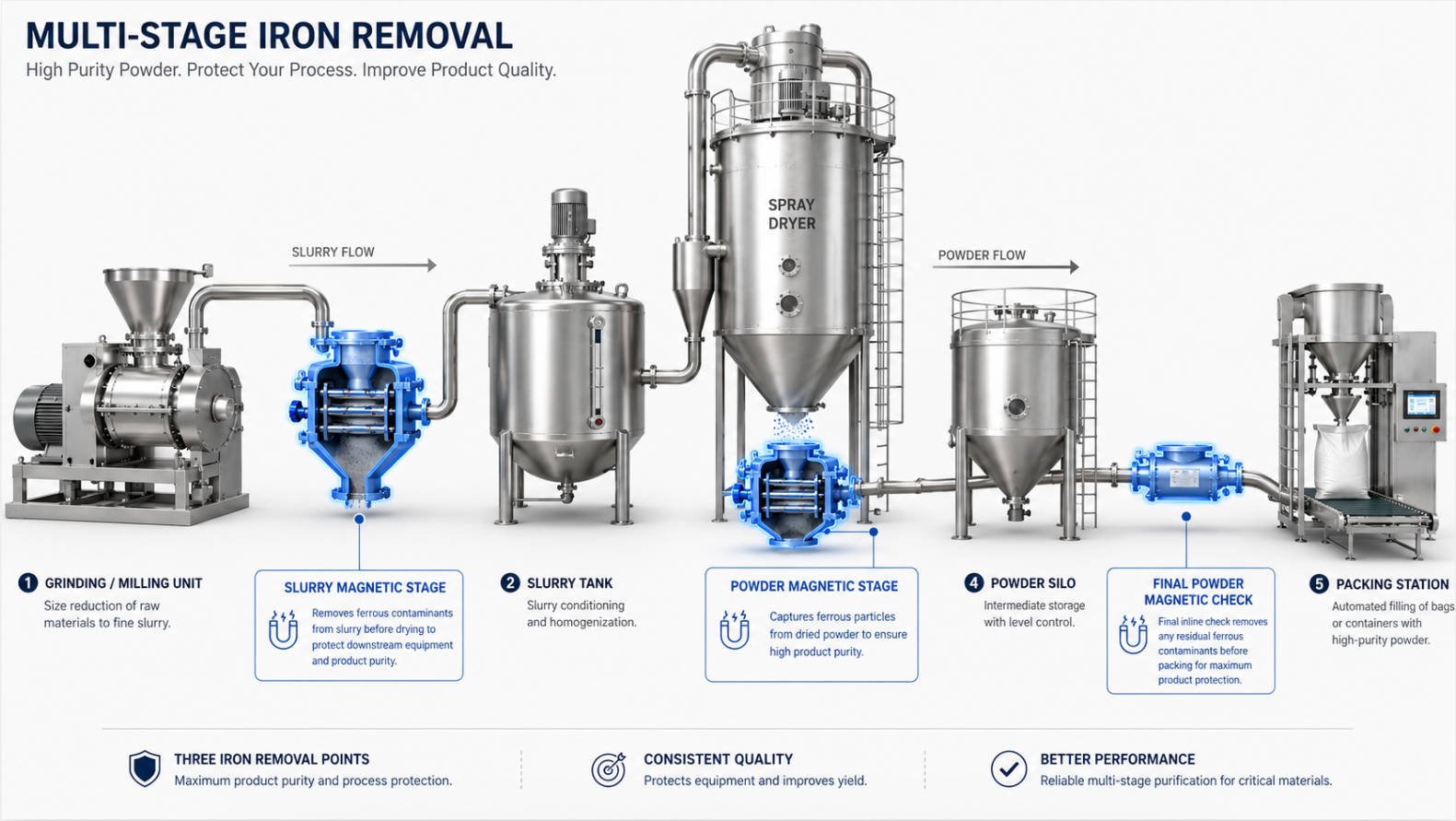
In ceramic and glass production, even trace ferrous contamination can cause black spots, glaze defects, or reduced translucency, directly impacting product grade. Powder magnetic separators placed after milling and before forming remove iron impurities from raw materials such as kaolin, feldspar, quartz, and ceramic body powders. [wdymagnetic]
Leading Chinese manufacturers integrate slurry and powder magnetic stages so that iron removal starts in wet milling and continues after spray drying in powder form for maximum whiteness and consistency. [alibaba]
New energy battery materials
For lithium‑ion battery cathode and anode powders, metallic contamination is a serious safety and performance risk. High‑gradient powder magnetic separators are used to remove micro‑sized ferromagnetic particles from NCM, LFP, graphite, and other electrode materials, often in enclosed, dust‑controlled lines. [alibaba]
Here, dry powder separators help control internal short‑circuit risk and improve yield in coating and cell assembly. [alibaba]
Food, plastics, and chemicals
In food processing, powder separators installed in gravity chutes and pneumatic lines help align with HACCP and other safety standards by capturing bolts, wire, and fine ferrous dust. In plastics and chemical powder plants, powder separators protect extruders, injection machines, and fine grinders from costly damage. [permagproducts]
When to Choose Permanent Magnetic Separators
From an industry engineer’s point of view, permanent magnetic separators are often the default choice in three scenarios:
– Continuous, stable processes where feed characteristics do not change dramatically and fixed field strength is acceptable. [magworks]
– Remote or high‑energy‑cost locations, where avoiding continuous electrical power for magnets is critical. [osencmag]
– Long‑term reliability priorities, as permanent magnets retain magnetization with minimal degradation when properly designed. [hsmagnets]
In mining, for example, permanent overband or drum separators remove tramp iron from conveyor belts and dense media circuits, preventing damage to crushers and mills. In plastics or recycling plants, permanent plate and drum magnets capture ferrous metals from shredded or granulated streams. [hsmagnets]
Electromagnetic separators become attractive when you need on/off control, easy cleaning, or adjustable field strength, such as in high‑value metal powder or semiconductor material lines. [elcanindustries]
Expert Guidelines for Selecting the Right Magnetic Separator
Drawing on current industry practice and published guidance, a structured selection approach for magnetic separators typically follows these steps: [powder-solutions]
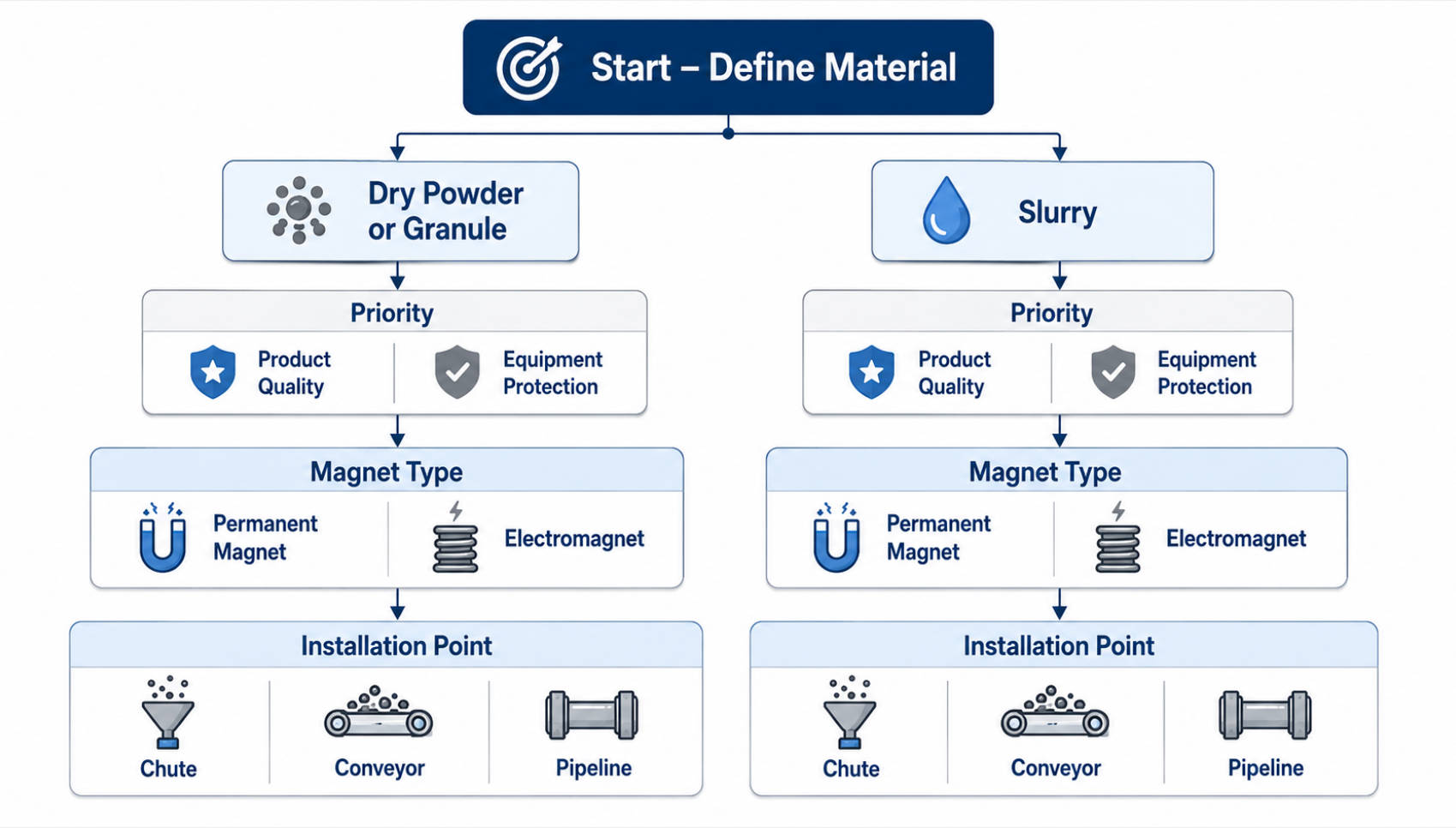
1. Define material state
– Powder, granule, flake, or slurry. [gme-magnet]
– For free‑flowing powders and granules, dry powder magnetic separators are generally preferred. [powder-solutions]
2. Clarify process objective
– Tramp metal protection vs ultra‑fine purification for product quality. [permagproducts]
– This influences whether a simple grate magnet or a high‑gradient unit is justified. [greatmagtech]
3. Select magnet source
– Permanent if you want simplicity and low energy use. [osencmag]
– Electromagnetic if you need adjustable strength or frequent cleaning. [elcanindustries]
4. Match installation point
– Gravity chute, hopper outlet, conveyor belt, pneumatic pipeline, or mixing point. [magworks]
– For powders, rotary magnets and inline plate magnets work well in chutes and conveying lines. [permagproducts]
5. Check operating cost and maintenance
– Consider energy use, cleaning frequency, access for maintenance, and expected lifetime. [gme-magnet]
Working with an experienced manufacturer that offers both powder and permanent magnetic separator systems helps integrate these decisions into a complete engineering solution across mining, ceramics, power, building materials, glass, environmental protection, rubber, plastics, pharmaceuticals, food, and positive/negative electrode materials. [wdymagnetic]
Conclusion and Call to Action
If you are specifying separation equipment for powders or mixed production lines, understanding the difference between powder magnetic separators and permanent magnetic separators helps you balance purity, flexibility, cost, and energy use. Powder‑optimized designs are your best option for dry, free‑flowing materials, while permanent magnets deliver long‑term, low‑energy performance in both powder and slurry applications. [gme-magnet]
If you are planning a new line or upgrading existing equipment, you should reach out to a specialist manufacturer that can design an integrated system covering powder, slurry, vertical ring, belt conveyor, and permanent magnetic separators tailored to your specific mining, ceramics, power, building materials, glass, environmental protection, rubber, plastics, pharmaceutical, food, or battery materials application. [wdymagnetic]
FAQ
1. How do I know if I need a powder magnetic separator or a wet separator?
If your material is a dry, free‑flowing powder or granule, a powder magnetic separator is usually more appropriate, while wet separators are designed for slurries and high‑moisture feeds. For borderline cases, moisture content, flowability, and downstream process requirements determine the final choice. [powder-solutions]
2. Are permanent magnetic separators strong enough for fine powder purification?
Modern rare‑earth permanent magnets (such as neodymium) can deliver very high surface field strengths and gradients, which are sufficient for many fine powder applications when correctly engineered. In extremely demanding cases, designers may combine permanent magnets with special circuits or use electromagnets. [greatmagtech]
3. How often should magnetic separators be cleaned?
Cleaning frequency depends on contamination levels, process criticality, and separator design, but many industrial guidelines recommend scheduled inspections plus additional cleaning whenever pressure drop or flow behavior changes. Recording captured metal volume per batch helps optimize cleaning intervals over time. [powder-solutions]
4. Can one magnetic separator handle both powders and slurries?
Standard units are usually optimized either for dry powders or for slurries, because flow behavior and housing design are very different. However, integrated systems can combine slurry and powder separators in sequence, especially in ceramics and battery material plants. [wdymagnetic]
5. What industries benefit most from powder magnetic separators?
Industries with high purity requirements for dry powders benefit most, including ceramics, glass, battery materials, food powder processing, plastics compounding, and fine chemical production. These processes gain better product quality, fewer defects, and improved equipment protection. [hsmagnets]
References
1. Osenc Magnet, “Magnetic Separator Types And A Guide To The Right Selection.” [osencmag]
<https://osencmag.com/blog/magnetic-separator-types-guide/>
2. MagWorks LLC, “Magnetic Separators: An In-Depth Overview.” [magworks]
<https://magworks.us/magnetic-separators-an-in-depth-overview/>
3. Great Magtech, “Types Of Magnetic Separator – Industry News.” [greatmagtech]
<https://www.greatmagtech.com/news/types-of-magnetic-separator-50686961.html>
4. HSMAG, “Industrial Magnetic Separation.” [hsmagnets]
<https://www.hsmagnets.com/blog/industrial-magnetic-separation/>
5. Permag Products, “Magnetic Separators – Industry Applications (Part 1).” [permagproducts]
<https://www.permagproducts.com/magnetic-separators-industry-applications-part-1/>
6. Elcan Industries, “What Are the Differences Between Permanent Magnets and Electromagnetic Separators?” [elcanindustries]
<https://elcanindustries.com/blog_posts/what-are-the-differences-between-permanent-magnets-and-electromagnetic-separators/>
7. Powder Solutions, “How to Choose a Magnetic Separating Solution for Your Conveying System.” [powder-solutions]
<https://www.powder-solutions.com/2018/06/21/how-to-choose-a-magnetic-separating-solution-for-your-conveying-system/>
8. Alibaba, “Understanding China Magnetic Separator: Standards, Properties & Types.” [alibaba]
<https://www.alibaba.com/product-insights/china-magentic-separator.html>
9. Foshan Wandaye Technology Co., Ltd., “Top 10 Magnetic Separator Machine Manufacturers in China.” [wdymagnetic]
<https://www.wdymagnetic.com/zh/top-10-magnetic-separator-machine-manufacturers-in-china.html>
10. GME Magnet, “How to Choose Dry or Wet Magnetic Separator.” [gme-magnet]
<https://www.gme-magnet.com/info/how-to-choose-dry-or-wet-magnetic-separator-103357025.html>