


Content Menu
● Understanding Magnetic Separation in Mining and Minerals
● Key Types of Magnetic Separators Used in Mining and Powder Processing
>> Low‑Intensity Magnetic Separators (LIMS) for Strongly Magnetic Minerals
>> High‑Intensity and High‑Gradient Magnetic Separators (HIMS & HGMS)
● Where Magnetic Separation Fits in a Modern Plant Flowsheet
>> Primary Protection – Tramp Metal Removal
>> Secondary Beneficiation – Magnetic Mineral Recovery
>> Final Purification – Ultra‑Clean Industrial Powders
● Industry Case Insights: Ceramics, Kaolin, Battery Materials, and Recycling
>> Ceramics and Ultra‑White Bodies
>> Kaolin and Quartz Sand Purification
>> Copper Recycling and Powder Processing
● How Powder and Permanent Magnetic Separators Solve Real Production Problems
>> Typical Problems Before Optimization
>> How Modern Powder Magnetic Separators Address These Issues
● Expert Checklist: Designing a Magnetic Separation Strategy for Your Plant
>> Practical Tips from the Field
● Selecting Magnetic Separators: Mining vs Industrial Powder Applications
>> Application‑Focused Overview Table
● Why Partner with a Professional Magnetic Separation Manufacturer
● Clear Next Steps: Optimize Your Magnetic Separation Line
● Frequently Asked Questions (FAQ)
>> 1. What is the difference between low‑intensity and high‑intensity magnetic separators?
>> 2. How do magnetic separators improve plant safety in mining?
>> 3. Why are high‑intensity separators critical for ceramics and glass?
>> 4. Can magnetic separation help in battery material production and recycling?
>> 5. Why should I work with a specialized magnetic separation equipment manufacturer?
From my experience working with process engineers and plant managers across mining, ceramics, battery materials, and food processing, magnetic separation has shifted from being a “supporting” step to a core technology that defines product quality, plant safety, and profitability. Today’s high‑intensity powder and permanent magnetic separators—such as those engineered by Foshan Wandaye Technology Co., Ltd.—are at the heart of cleaner ores, whiter ceramics, safer food, and more efficient cathode/anode material production. [buntingmagnetics]
Understanding Magnetic Separation in Mining and Minerals
In mineral processing, magnetic separation relies on differences in magnetic susceptibility between minerals to separate magnetic particles from non‑magnetic or weakly magnetic gangue. In practice, this means directing ore or industrial powders through controlled magnetic fields so that tramp iron and magnetic minerals are captured while non‑magnetic material continues along the process line. [minejxsc]
From an operator’s point of view, magnetic separation serves two main purposes in a plant:
– Protecting critical equipment by removing tramp metal early in the flowsheet (before crushers, screens, and conveyors). [buntingmagnetics]
– Upgrading or purifying products by separating magnetic minerals or tiny paramagnetic contaminants in later beneficiation or finishing stages. [buntingmagnetics]
In modern flowsheets for iron ore, rare earths, kaolin, quartz, and battery materials, the question is no longer “Do we need magnetic separation?” but “Where and how many stages of magnetic separation do we need for optimal performance?”. [saimm.co]
Key Types of Magnetic Separators Used in Mining and Powder Processing
From plant audits and commissioning projects, we typically specify a combination of low‑intensity and high‑intensity magnetic separators depending on ore type and process stage. [911metallurgist]
Low‑Intensity Magnetic Separators (LIMS) for Strongly Magnetic Minerals
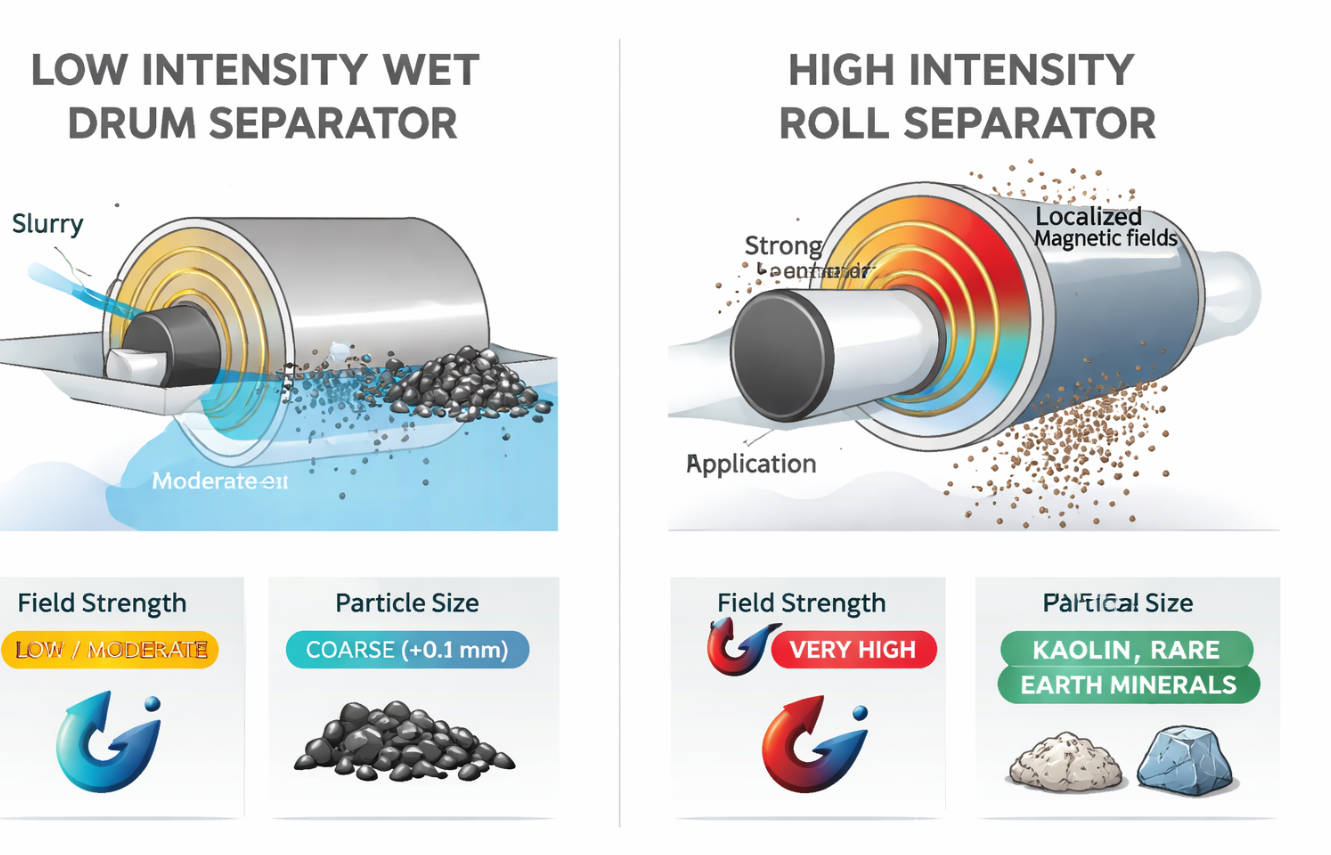
Low‑intensity separators are designed for ferromagnetic minerals such as magnetite, where a relatively modest magnetic field is enough to achieve efficient separation. [911metallurgist]
Common equipment includes:
– Drum magnetic separators for iron ore beneficiation and magnetite recovery. [buntingmagnetics]
– Overband and suspension magnets for tramp metal removal over conveyors and feed points. [buntingmagnetics]
In iron ore, standard low‑intensity drum separators using ferrite magnets typically provide fields around 0.12 T at 50 mm from the drum surface, with peak surface fields below 0.3 T. At these levels, magnetite can be selectively recovered while gangue is rejected, and roasted hematite or siderite can also be upgraded after magnetizing roasting. [911metallurgist]
High‑Intensity and High‑Gradient Magnetic Separators (HIMS & HGMS)
Where ores contain weakly magnetic or paramagnetic minerals—or where ultra‑fine contaminants must be removed from high‑value powders—high‑intensity or high‑gradient separators become essential. [minejxsc]
Typical high‑intensity solutions include:
– Wet high‑intensity magnetic separators (WHIMS) for kaolin, feldspar, quartz sand, and rare earth ore. [magneticseparatormachine.sell.everychina]
– Dry high‑intensity roll and disc separators for rutile, zircon, ilmenite, and complex heavy mineral sands. [buntingmagnetics]
– Electromagnetic filters for ultra‑fine iron and paramagnetic particles in ceramic glazes and slips. [buntingmagnetics]
In practice, these units generate very strong, focused magnetic fields and gradients through engineered matrices or rare earth magnet systems, enabling the capture of ultra‑fine particles that would pass straight through low‑intensity equipment. [magneticseparatormachine.sell.everychina]
Where Magnetic Separation Fits in a Modern Plant Flowsheet
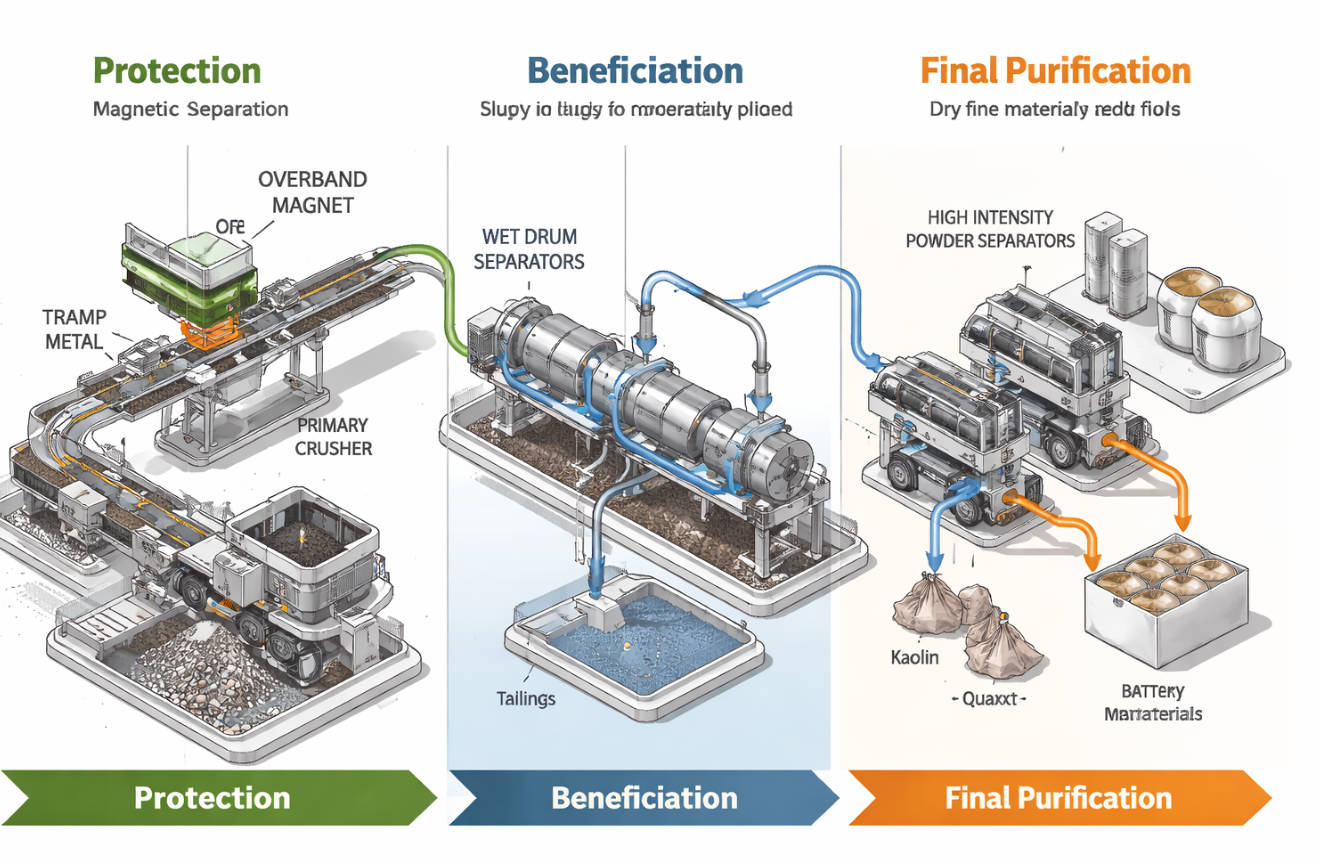
From flowsheet design work and troubleshooting engagements, we usually map magnetic separation across three main stages. [mineraldressing]
Primary Protection – Tramp Metal Removal
Early in the process, before size reduction, overband magnets, suspension magnets, and tramp metal detectors protect crushers, screens, and conveyors from damage. [buntingmagnetics]
Typical applications:
– Removing rebar, teeth, drill bits, and steel scrap from run‑of‑mine ore or quarry rock. [buntingmagnetics]
– Protecting downstream belts and chutes from puncture and excessive wear. [buntingmagnetics]
Because tramp metal can sink into the ore burden, deep magnetic fields are needed—often achieved with electro overband or suspension magnets that penetrate deep into the load. [buntingmagnetics]
Secondary Beneficiation – Magnetic Mineral Recovery
Once the ore is crushed and classified, low‑ and high‑intensity drum or roll separators are positioned to recover or upgrade magnetic minerals. [saimm.co]
Typical use cases:
– Magnetite recovery and cleaning in iron ore circuits via wet drum separators. [911metallurgist]
– Removal of iron‑bearing silicates or weakly magnetic impurities from non‑ferrous mineral streams. [minejxsc]
At this stage, the goal is to shift the overall grade and recovery of the valuable mineral, often in combination with gravity separation, flotation, or electrostatic separation. [im-mining]
Final Purification – Ultra‑Clean Industrial Powders
In industries such as ceramics, glass, battery materials, plastics, food, and pharmaceuticals, magnetic separation becomes a final cleaning step to meet strict quality and safety specifications. [en.fswandaye]
Typical examples:
– Removing tiny iron and paramagnetic particles from kaolin and quartz to achieve high whiteness for ceramics and glass. [en.fswandaye]
– Purifying cathode/anode powders and metallic copper in recycling lines using high‑intensity powder separators. [wdymagnetic]
– Capturing stainless steel fragments and ferrous contamination in food and pharmaceutical processing lines for regulatory compliance. [mineraldressing]
In these cases, the separator is effectively a quality‑assurance tool, ensuring consistent color, purity, and safety across each batch. [buntingmagnetics]
Industry Case Insights: Ceramics, Kaolin, Battery Materials, and Recycling
From recent industry projects and published case material, several sectors stand out for their heavy reliance on advanced magnetic separation. [im-mining]
Ceramics and Ultra‑White Bodies
High‑intensity magnetic separators are now standard in advanced ceramic plants, particularly for sanitaryware, tiles, and high‑whiteness tableware. [magneticseparatormachine.sell.everychina]
Key outcomes reported by ceramic producers include:
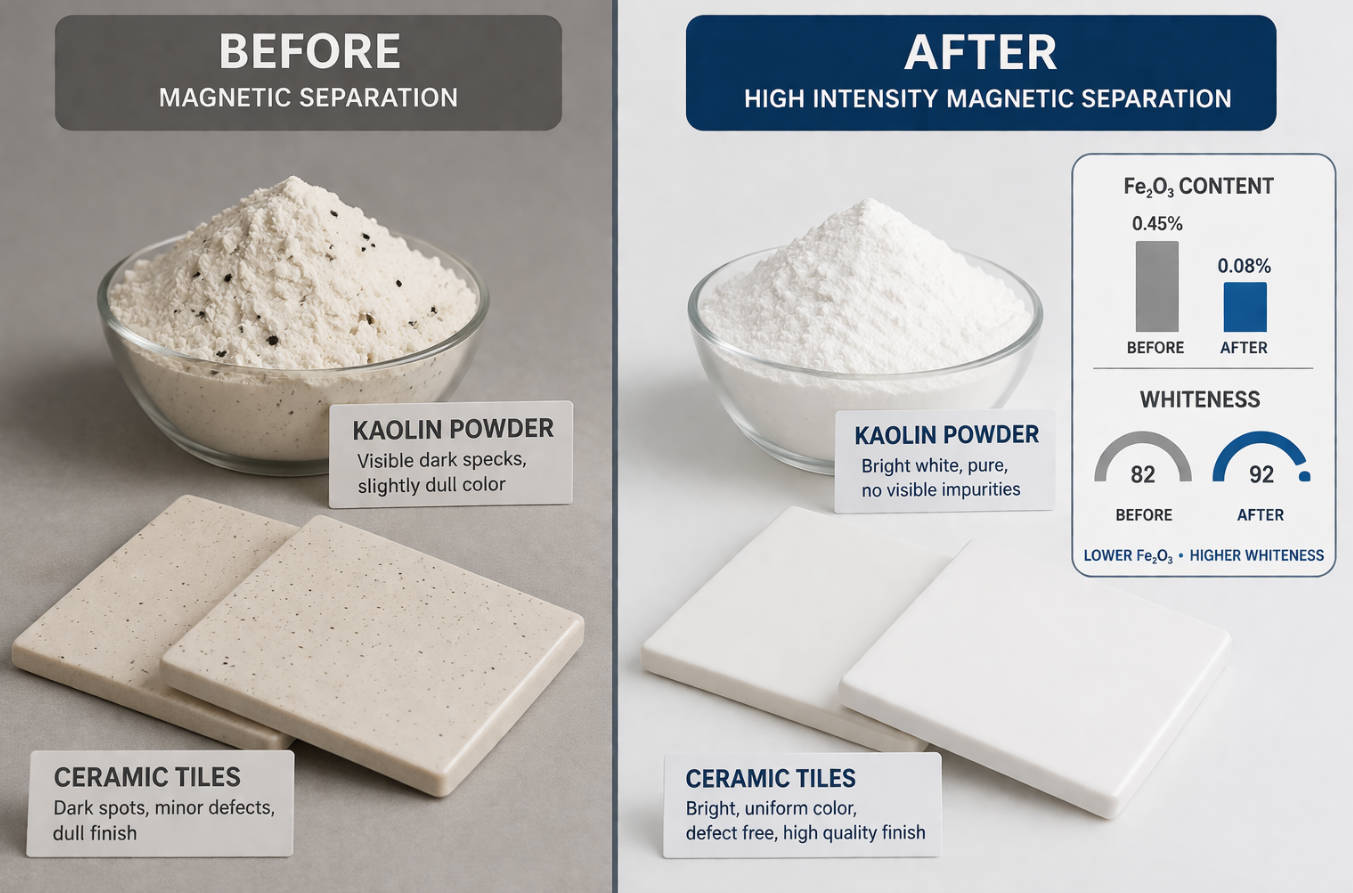
– Reduced rejects and rework due to iron specks and dark spots. [buntingmagnetics]
– Increased product whiteness and more stable firing behavior for glazes and slips. [magneticseparatormachine.sell.everychina]
Electromagnetic filters, feeding ceramic slips upward through a stainless‑steel matrix under a powerful magnetic field, can intensify the field up to three times at matrix points, enabling capture of ultra‑fine iron and paramagnetic minerals that would otherwise pass through. [buntingmagnetics]
Kaolin and Quartz Sand Purification
In kaolin and high‑purity quartz applications, wet high‑intensity magnetic separation (WHIMS) and specialized powder separators remove iron‑bearing minerals and titanium impurities. [en.fswandaye]
Typical results include:
– Lower Fe2O3 content, directly improving brightness and whiteness. [en.fswandaye]
– Stable feed quality for downstream ceramics, glass, and electronics applications. [en.fswandaye]
Commercial WHIMS equipment designed for kaolin demonstrates how targeted magnetic field control can significantly improve the economic value of industrial minerals. [magneticseparatormachine.sell.everychina]
Copper Recycling and Powder Processing
In copper recycling and metal powder processing, high‑intensity separators are increasingly used in combination with electrostatic separation. [wdymagnetic]
Field experience and recent reports highlight several benefits:
– Higher copper recovery rates from complex scrap streams, especially when paired with electrostatic separators that exploit conductivity differences. [im-mining]
– Improved purity of recovered metals and powders used in downstream manufacturing. [wdymagnetic]
For copper recycling and powder processing, professional enterprises such as Foshan Wandaye are designing high‑intensity systems that combine strong magnetic fields with powder‑optimized feed systems to maximize metal recovery and product purity. [wdymagnetic]
How Powder and Permanent Magnetic Separators Solve Real Production Problems
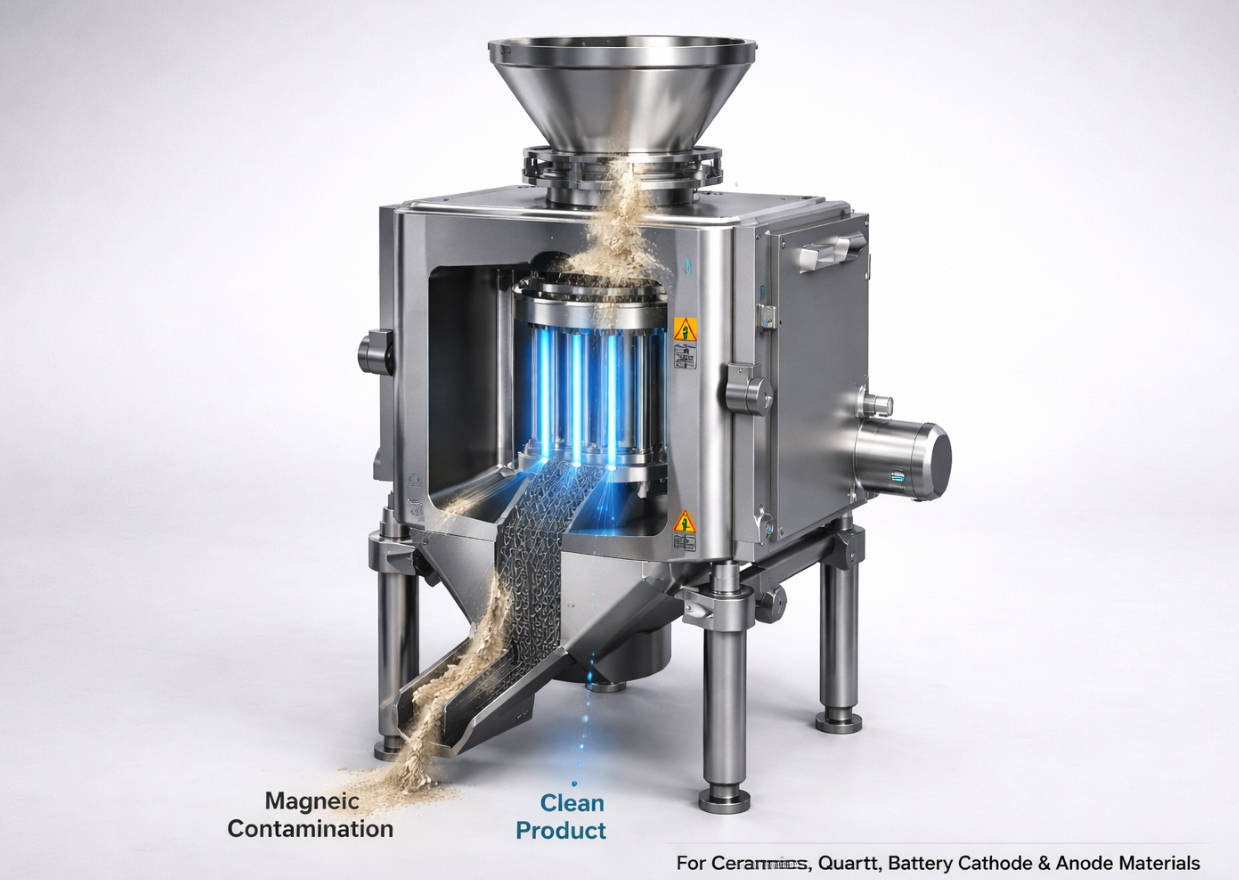
As a manufacturer of powder magnetic separators and permanent magnetic separators, we repeatedly see the same pain points when we visit plants: unplanned downtime, product rework, and hidden quality complaints. [en.fswandaye]
Typical Problems Before Optimization
From customer feedback and plant audits, recurring issues include:
– Frequent crusher or mill shutdowns due to tramp metal damage. [mineraldressing]
– Discoloration or black specks in high‑whiteness ceramics and glass products. [buntingmagnetics]
– Off‑spec battery materials due to trace metal contamination, causing poor capacity or safety concerns. [wdymagnetic]
– Metal fragments in food or plastic products, triggering recalls or customer complaints. [mineraldressing]
These issues are often linked to insufficient or outdated magnetic separation equipment, poor magnet positioning, or inadequate cleaning routines. [buntingmagnetics]
How Modern Powder Magnetic Separators Address These Issues
Modern powder magnetic separators and permanent magnetic separators are engineered with:
– Optimized magnetic circuit design to create strong, focused fields for fine powders. [en.fswandaye]
– Configurable magnetic intensity and gradient to match specific materials and contamination profiles. [minejxsc]
– Easy‑clean or automatic cleaning mechanisms to reduce manual labor and maintain consistent performance. [mineraldressing]
By integrating these separators in the right points of the process, plants can cut rework, protect equipment, and stabilize product quality across shifts. [buntingmagnetics]
Expert Checklist: Designing a Magnetic Separation Strategy for Your Plant
When we help clients design or upgrade a magnetic separation line, we follow a structured approach that balances performance, cost, and maintainability. [minejxsc]
Step‑by‑Step Approach
1. Define the objective
Clarify whether the primary goal is equipment protection, product upgrade, or final purification. [buntingmagnetics]
2. Characterize the material
Analyze particle size, moisture, magnetic properties, and contamination type and level. [saimm.co]
3. Map the process line
Identify key transfer points, chutes, mixers, mills, and packaging stations where magnetic separation can be most effective. [mineraldressing]
4. Select separator types and locations
Combine tramp metal magnets, low‑intensity drums, and high‑intensity powder units to create a layered defense and quality system. [911metallurgist]
5. Plan inspection and cleaning
Define cleaning intervals, verification checks, and magnet performance audits to maintain long‑term effectiveness. [buntingmagnetics]
6. Pilot and optimize
Run small‑scale or on‑site tests with actual material to validate separation performance and adjust parameters before full deployment. [minejxsc]
Practical Tips from the Field
– Always align magnet design with process reality—bulk density, flow pattern, and installation constraints matter as much as field strength. [buntingmagnetics]
– For powders, avoid dead zones and ensure smooth, controlled feeding into the magnetic zone to maximize capture of fine contaminants. [wdymagnetic]
– Re‑evaluate magnet positions after major process changes (new mill, revised recipe, or higher throughput) to prevent blind spots. [buntingmagnetics]
Selecting Magnetic Separators: Mining vs Industrial Powder Applications
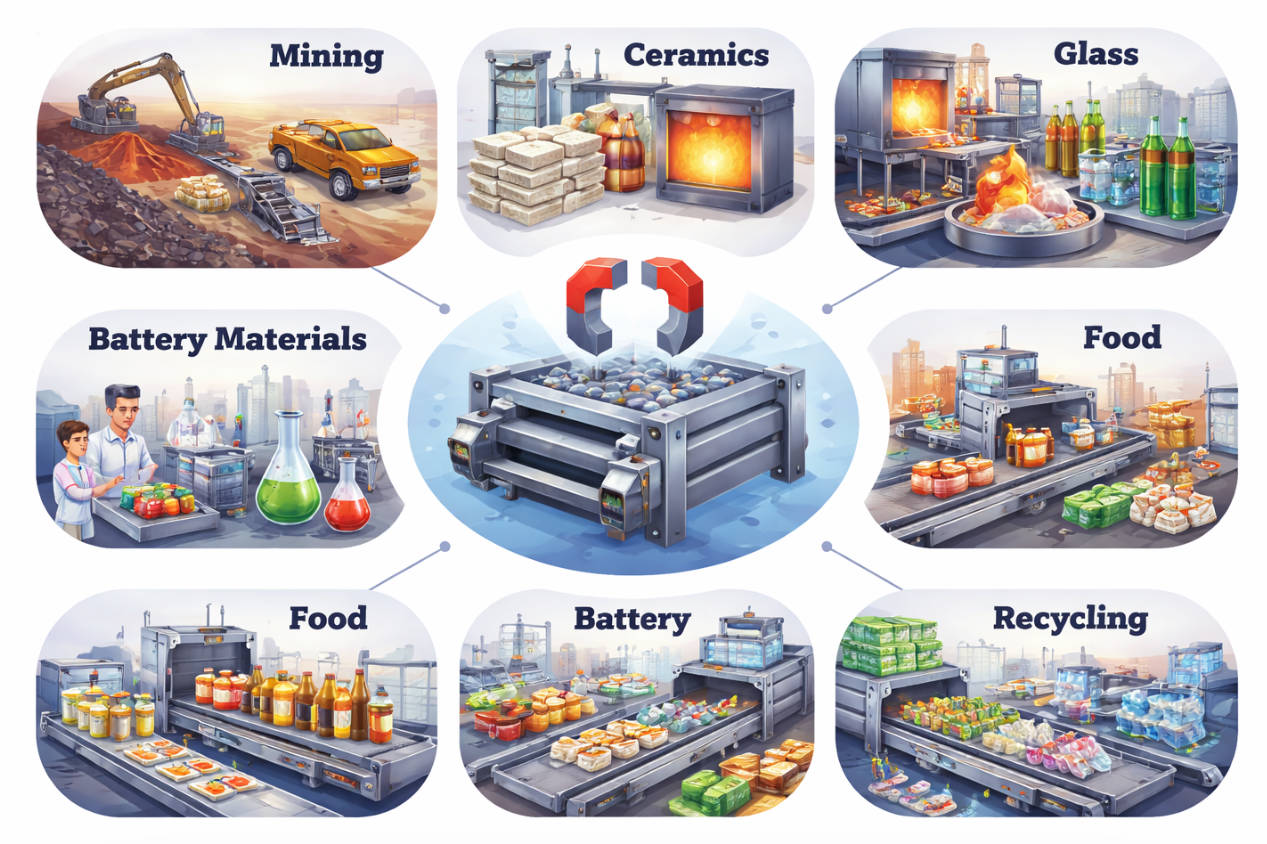
Different sectors demand different separator configurations and performance criteria. [en.fswandaye]
Application‑Focused Overview Table
| Application area | Typical contaminants or targets | Recommended separator focus |
|---|---|---|
| Iron ore mining | Magnetite recovery, tramp iron | Low‑intensity wet drum, overband magnets buntingmagnetics |
| Rare earth / heavy minerals | Weakly magnetic rare earth minerals | High‑intensity roll and WHIMS units buntingmagnetics |
| Ceramics & kaolin | Fine iron, titanium, paramagnetic minerals | High‑intensity wet separators, electromagnetic filters buntingmagnetics |
| Glass & quartz | Iron staining and color defects | Powder magnetic separators, WHIMS magneticseparatormachine.sell.everychina |
| Battery materials | Trace metal contamination, off‑spec powders | High‑intensity powder magnetic separators wdymagnetic |
| Copper recycling | Copper recovery from complex scrap and powders | High‑intensity separators plus electrostatic units im-mining |
| Food & pharma | Ferrous and stainless fragments | Grate, tube, and plate magnets with high intensity mineraldressing |
In all these settings, professional manufacturers like Foshan Wandaye design electromagnetic, permanent, slurry, and dry powder magnetic separators specifically tailored to the material characteristics and purity targets of each segment. [en.fswandaye]
Why Partner with a Professional Magnetic Separation Manufacturer
For many plant teams, the main risk is not buying “too much magnet,” but installing the wrong type of separator in the wrong place. Working with a dedicated magnetic separation enterprise allows you to align equipment design with process data, product specs, and regulatory requirements. [en.fswandaye]
Foshan Wandaye Technology Co., Ltd. is one such professional manufacturer, integrating R&D, engineering design, production line installation, and commissioning for powder and permanent magnetic separators used across mining, ceramics, power, building materials, glass, environmental protection, rubber, plastics, pharmaceuticals, food, and positive/negative electrode materials. By combining field experience with application‑specific designs—such as slurry magnetic separators for kaolin, dry powder separators for quartz, and high‑intensity units for battery materials—Wandaye supports customers through the full lifecycle from project definition to stable mass production. [en.fswandaye]
Clear Next Steps: Optimize Your Magnetic Separation Line
If you are planning a new plant or upgrading an existing line, a targeted magnetic separation audit can quickly reveal where you are losing value or taking unnecessary risk. Reviewing your flowsheet with a specialist team can identify the optimal combination of powder magnetic separators, permanent magnetic separators, and high‑intensity units for your specific ore or industrial powders. [minejxsc]
Call to action: If you want to improve product purity, reduce equipment downtime, or explore high‑intensity solutions for battery materials, ceramics, kaolin, or recycling, contact Foshan Wandaye Technology Co., Ltd. for an expert assessment and customized magnetic separation proposal. [en.fswandaye]
Frequently Asked Questions (FAQ)
1. What is the difference between low‑intensity and high‑intensity magnetic separators?
Low‑intensity separators are used for strongly magnetic minerals like magnetite and typically operate below about 0.3 T at the drum surface. High‑intensity separators generate stronger, more focused fields to capture weakly magnetic or ultra‑fine paramagnetic particles in minerals such as kaolin, quartz, and rare earth ores. [magneticseparatormachine.sell.everychina]
2. How do magnetic separators improve plant safety in mining?
Magnetic separators installed as overband or suspension magnets remove tramp ferrous metal before crushers and conveyors, preventing catastrophic equipment damage and unplanned shutdowns. This protection extends the life of mechanical equipment and maintains more stable production. [buntingmagnetics]
3. Why are high‑intensity separators critical for ceramics and glass?
High‑intensity separators remove ultra‑fine iron and paramagnetic minerals that cause specks and color defects in ceramic bodies, glazes, and glass. This directly improves whiteness, reduces rejects, and supports premium product positioning. [buntingmagnetics]
4. Can magnetic separation help in battery material production and recycling?
Yes, high‑intensity magnetic separators are increasingly used to purify cathode and anode powders and to enhance metal recovery in copper and battery recycling lines. They help remove metallic contaminants that can reduce battery performance or create safety issues. [im-mining]
5. Why should I work with a specialized magnetic separation equipment manufacturer?
A specialized manufacturer can match separator type, magnetic intensity, and mechanical design to your specific material, flowsheet, and quality targets. This ensures higher separation efficiency, better reliability, and faster payback compared with generic or incorrectly specified equipment. [en.fswandaye]
References
1. Bunting Magnetics. “Magnetic Separation in Mining and Mineral Processing.”
<https://buntingmagnetics.com/blog/magnetic-separation-in-mining-and-mineral-processing> [buntingmagnetics]
2. Bunting Magnetics. “Magnetic Separators For Mineral Processing.”
<https://buntingmagnetics.com/blog/magnetic-separators-for-mineral-processing> [buntingmagnetics]
3. Bunting Magnetics. “Protect Your Investment: Magnetic Separation for Mining.”
<https://buntingmagnetics.com/blog/protect-your-investment-tramp-metal-removal-for-mining> [buntingmagnetics]
4. JXSC. “Expert Guide: Magnetic Separation in Mineral Processing.”
<https://www.minejxsc.com/blog/magnetic-separation-in-mineral-processing/> [minejxsc]
5. 911Metallurgist. “Wet Magnetic Drum Separator.”
<https://www.911metallurgist.com/equipment/wet-magnetic-drum-separator/> [911metallurgist]
6. Foshan Wandaye Machinery Equipment Co., Ltd. “Magnetic Separator | Magnetic Separation Equipment.”
<http://en.fswandaye.com> [en.fswandaye]
7. Foshan Wandaye Machinery Equipment Co., Ltd. “WDY Magnetic Separation Equipment – Products.”
<http://en.fswandaye.com/Products/> [en.fswandaye]
8. Bunting. “High-Intensity Magnetic Separation at Ceramitec 2024.”
<https://buntingmagnetics.com/blog/high-intensity-magnetic-separation-at-ceramitec-2024> [buntingmagnetics]
9. EveryChina listing. “Wet High Intensity Magnetic Separation Equipment For Kaolin.”
<https://magneticseparatormachine.sell.everychina.com/p-110633075-wet-high-intensity-magnetic-separation-equipment-for-kaolin.htm> [magneticseparatormachine.sell.everychina]
10. International Mining. “Bunting ups the mineral separation ante with ElectroStatic Separator.”
<https://im-mining.com/2020/05/11/bunting-ups-mineral-separation-ante-electrostatic-separator/> [im-mining]
11. Mineral Dressing. “Improve Mineral Processing Efficiency By Magnetic Separator.”
<https://mineraldressing.com/blog/improve-mineral-processing-efficiency-by-magnetic-separator/> [mineraldressing]
12. Foshan Wandaye Technology Co., Ltd. “High-Intensity Magnetic Separators Optimise Copper Recycling And Powder Processing.”
<https://www.wdymagnetic.com/high-intensity-magnetic-separators-optimise-copper-recycling-and-powder-processing.html> [wdymagnetic]
13. SAIMM. “Flowsheet development of two distinct rare earth-bearing heavy mineral sands deposits.”
<https://www.saimm.co.za/Conferences/files/rare-eaths-2024/06_RE02-Raffaillac%20.pdf> [saimm.co]
Hot Tags: Magnetic Mining, Mining Magnets, Manufacturers, Customized, Custom, Suppliers, Buy, Cheap, Quality, Advanced, Durable, in Stock, Made in China, Price, Quotation