


Content Menu
● What Makes Powder Iron Removal So Difficult?
● Understanding Powders and Metal Contamination
>> Typical Sources of Metal Contamination in Powders
● Why You Need Both Magnetic Separators and Metal Detectors
>> How Magnetic Separators Work in Powder Lines
>> How Metal Detectors Complement Magnets
● How Powder Flow Behavior Affects Iron Separation
>> Powder Cohesion and Agglomeration
● Key Designs of Powder Magnetic Separators
>> Tube, Grate, and Drawer Magnets
>> In‑Line Magnetic Separators (Gravity & Pneumatic)
● From Theory to Practice: Designing a Multi‑Stage Powder Purification Line>> A Typical Multi‑Stage Iron Removal Layout
● Cross‑Industry Applications and Standards in 2026
● Practical Selection Guide: Choosing the Right Powder Magnetic Separator
>> Separator Selection Snapshot for Powder Lines
● Step‑by‑Step Checklist to Improve Iron Removal Efficiency
● Call to Action: Engineering a Powder‑Specific Solution
>> 1. How do I know if I need a powder magnetic separator or a metal detector?
>> 2. What is the best separator for very fine powders like battery cathode or ceramic glaze?
>> 3. How often should magnetic separators be cleaned in powder applications?
>> 4. Can permanent magnetic separators replace electromagnetic systems?
As an engineer who has spent years optimizing powder processing lines in ceramics, food, battery materials, and plastics, I have learned that achieving truly iron‑free powders is never about installing one “strong” magnet and calling it a day—it is about understanding how powders behave and then engineering a complete separation strategy around that behavior. In this guide, I will walk through how modern powder magnetic separators and metal detectors work together, where traditional approaches fail, and how manufacturers like Foshan Wandaye are using high‑gradient permanent magnetic technology to meet today’s stricter quality and safety demands. [fortunebusinessinsights]
What Makes Powder Iron Removal So Difficult?
Fine iron in dry powders is hard to remove not because magnets are weak, but because powders behave neither like a typical solid nor a typical liquid. When powders flow, vibrate, or compress, they constantly change density, contact area, and flow patterns, and this directly affects how much iron actually reaches the magnetic field. [sourcifychina]
From a practical, plant‑floor perspective, three behaviors matter most:
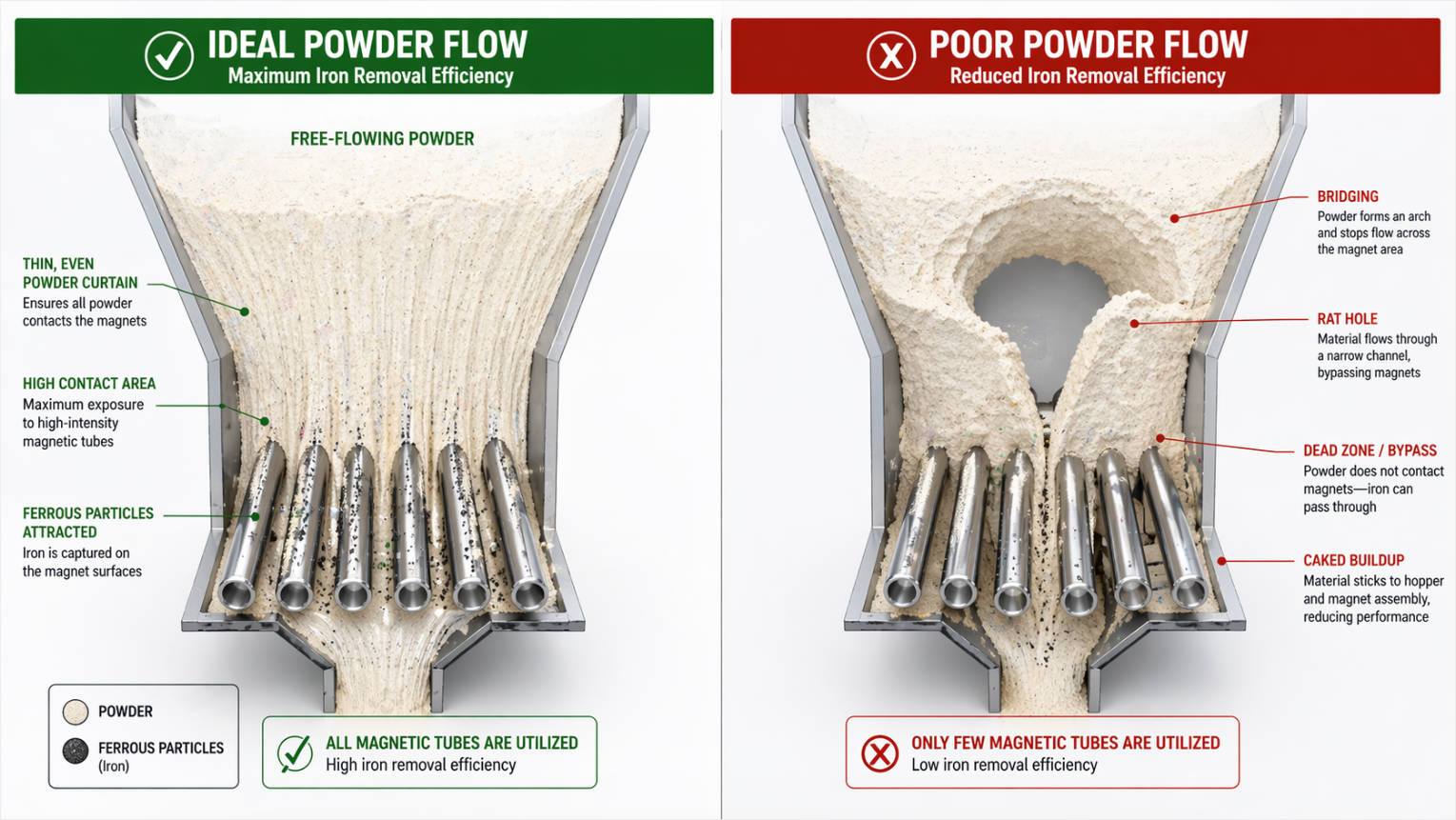
– Powders can bridge and form rat holes in hoppers, bypassing magnetic zones if the separator is poorly positioned. [fortunebusinessinsights]
– Fine particles coagulate under Van der Waals forces, so iron can be “locked” inside powder agglomerates instead of touching the magnet surface. [fortunebusinessinsights]
– Vibration or over‑compression can turn a free‑flowing powder into a dense plug, starving magnetic separators and metal detectors of consistent product flow. [fortunebusinessinsights]
As a result, even very high‑intensity neodymium magnets will underperform if the flow geometry and feed control are not carefully engineered. [fortunebusinessinsights]
Understanding Powders and Metal Contamination
In industries such as food, ceramics, battery materials, plastics, and pharmaceuticals, “powder” usually means fine, dry particles produced by crushing, grinding, atomizing, or spray drying. Although they look simple, powders present several contamination challenges throughout their life cycle. [shsunight]
Typical Sources of Metal Contamination in Powders
In real production environments, I usually classify metal contamination in powders into three categories: [gdqiaoyue]
1. Primary large tramp metal
– Screws, bolts, nuts, spanners, broken tools.
– Often introduced during maintenance, upstream conveying, or raw material handling. [fortunebusinessinsights]
2. Primary fine iron in raw materials
– Abrasion from mining, crushing, milling, or bulk transport.
– Naturally occurring iron in minerals or process water. [cction]
3. Secondary fine iron generated in the process
– Large tramp iron going through crushers or mills, breaking into fine particles.
– Wear from mixers, screw feeders, mills, valves, and pipeline elbows.
– Rust from chains, hoists, silo structures, or poorly coated surfaces. [cctime]
If large tramp metal is not removed early, it turns into hard‑to‑detect fine iron and simultaneously damages high‑value equipment. This is why a modern powder purification line always starts with early‑stage tramp removal and then moves progressively toward fine iron removal and final metal detection. [fortunebusinessinsights]
Why You Need Both Magnetic Separators and Metal Detectors
From an engineering standpoint, magnetic separators and metal detectors do very different jobs, and treating them as interchangeable is a common—and costly—mistake. [fortunebusinessinsights]
How Magnetic Separators Work in Powder Lines
Most powder magnetic separators rely on permanent magnets made from ceramic ferrite or rare earth neodymium alloys. [alibaba]
– Ceramic ferrite: deep but lower‑strength field, suitable for larger ferrous pieces.
– Neodymium (NdFeB): extremely high flux density, ideal for capturing very fine ferrous contamination. [fortunebusinessinsights]
In powder systems, you’ll commonly see:
– Tube / grate / drawer magnets placed in hoppers or chutes.
– Plate magnets and in‑line magnets in gravity or pneumatic pipelines.
– Drum magnets and center‑flow magnets where continuous, high‑throughput separation is required. [sourcifychina]
Magnetic separators are best at:
– Removing ferrous and weakly magnetic stainless steel particles.
– Handling both large tramp and fine iron, if correctly specified and positioned.
– Operating continuously with low energy use, especially when using permanent magnetic separators. [alibaba]
How Metal Detectors Complement Magnets
Metal detectors do not remove metal by themselves; they detect it by sensing changes in an electromagnetic field as product passes through a coil. The system then activates a reject flap, valve, or diverter to remove contaminated product. [fortunebusinessinsights]
They are especially valuable for:
– Detecting non‑magnetic metals like aluminum, copper, or non‑magnetic stainless steel.
– Serving as the final “police check” after magnetic separation, usually just before packaging. [alibaba]
Detectors work best on larger pieces because finer fragments create a weaker “state change” in the detection field, which is why magnets and detectors should operate together rather than in isolation. [fortunebusinessinsights]
How Powder Flow Behavior Affects Iron Separation
In many audits I have conducted, the magnets themselves were strong enough—but separation efficiency was poor because powder never actually reached the exposed magnetic area. The key is to understand how powders flow and interact with magnetic surfaces. [sourcifychina]
Powder Cohesion and Agglomeration
– Fine particles stick to each other due to Van der Waals forces, electrostatics, moisture, and surface roughness.
– Iron particles can be trapped inside these clusters and never come close enough to the magnet to be captured. [fortunebusinessinsights]
For best performance, any separator treating fine powders must:
– Maximize contact between powder and magnet surface.
– Avoid buildup that forms a thick “carpet” of powder over the magnet.
– Maintain powder as a thin, controlled curtain rather than dense plugs. [fortunebusinessinsights]
Hopper and Chute Effects
Flow problems like bridging, rat holing, or flooding can starve magnets or create bypass routes around the magnetic field. In practice, that means: [fortunebusinessinsights]
– Correct hopper angles and internal finishes are critical.
– Flow‑aid devices (vibrators, air pads) must be tuned so they help flow without over‑compacting powders.
– The geometry of magnetic grates and plates must be designed together with the hopper, not bolted on later. [fortunebusinessinsights]
Key Designs of Powder Magnetic Separators
Different separator designs address different flow behaviors and levels of contamination. Below is an engineer‑level overview of the main types used in powder systems and where they fit. [sourcifychina]
Tube, Grate, and Drawer Magnets
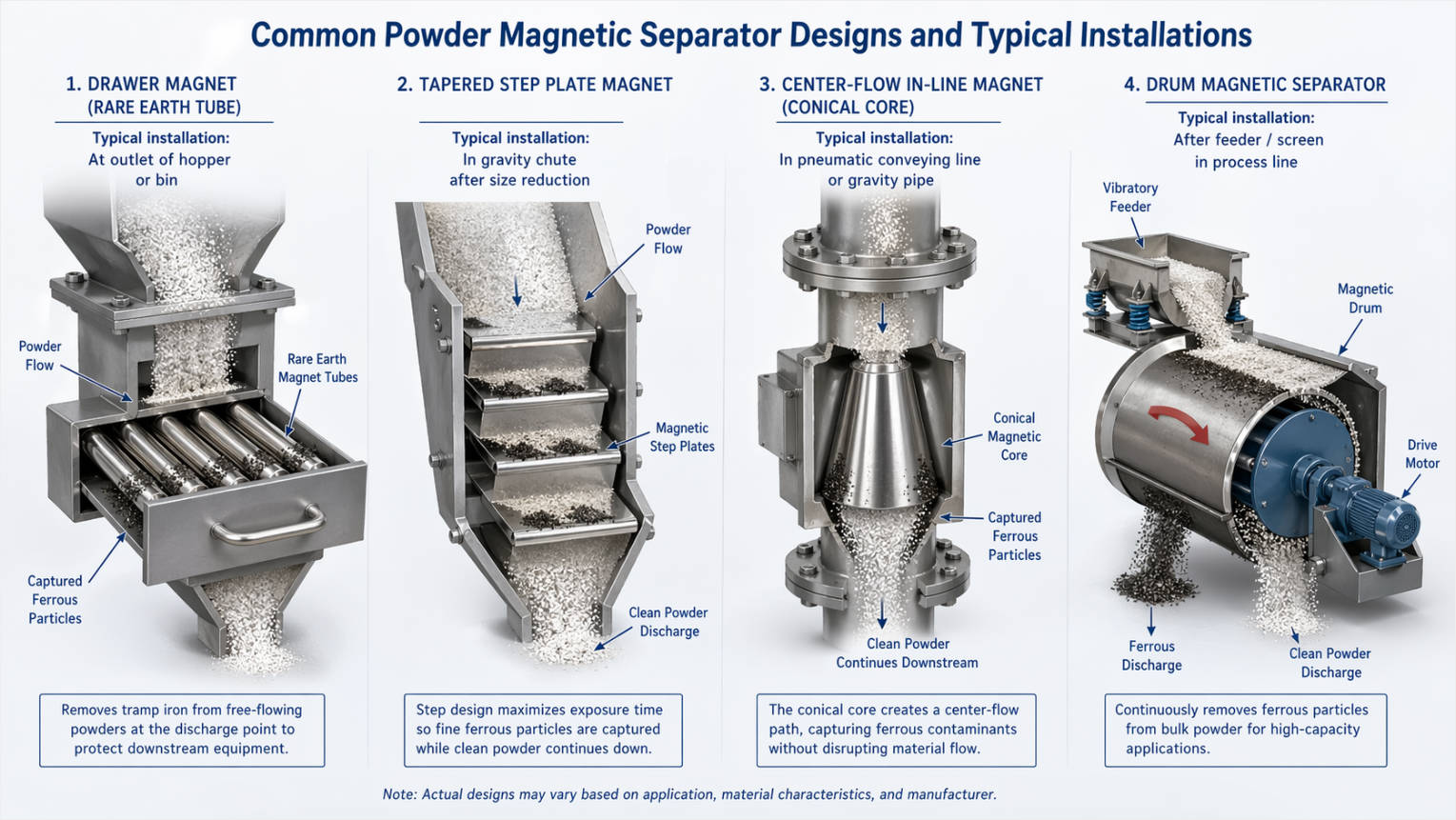
Tube (rod/cartridge) magnets are the workhorses for gravity‑fed powders. Installed as a grid (grate), they force product to cascade across multiple high‑intensity magnetic surfaces. [fortunebusinessinsights]
– Grate magnets sit inside hoppers or chutes; deflectors above the gaps ensure powder impacts the tube surfaces.
– Drawer magnets integrate grates into a housing with a pull‑out drawer design for easier cleaning. [fortunebusinessinsights]
Main considerations:
– Excellent for fine iron when powders are reasonably free‑flowing.
– Efficiency drops if powder cakes on the tubes; in severe cases this can fully block the housing.
– Cleaning frequency and cleaning method (manual, semi‑automatic) must match contamination load. [fortunebusinessinsights]
Tapered Step Plate Magnets
Plate magnets are ideal when powders can flow over a surface, such as in chutes or small conveyors. Using rare earth plates with a tapered step significantly improves fine iron capture because captured particles migrate behind the step, out of the main flow, reducing the risk of re‑entrainment into clean product. [fortunebusinessinsights]
Use cases:
– Gravity chutes where space is limited.
– Upstream of mills or sifters to protect equipment and reduce secondary fine iron generation. [fortunebusinessinsights]
In‑Line Magnetic Separators (Gravity & Pneumatic)
In‑line designs integrate plate magnets into a housing, creating a compact separation module. [fortunebusinessinsights]
– Gravity in‑line magnets (GIM) are installed in sloping round spouting under gravity flow; angles should not exceed about 60° from horizontal to balance flow with capture. [fortunebusinessinsights]
– Pneumatic in‑line magnets (PIM) work in dilute phase conveying (typically up to around 15 psi) and perform best in horizontal runs with the magnet facing down to exploit material stratification. [fortunebusinessinsights]
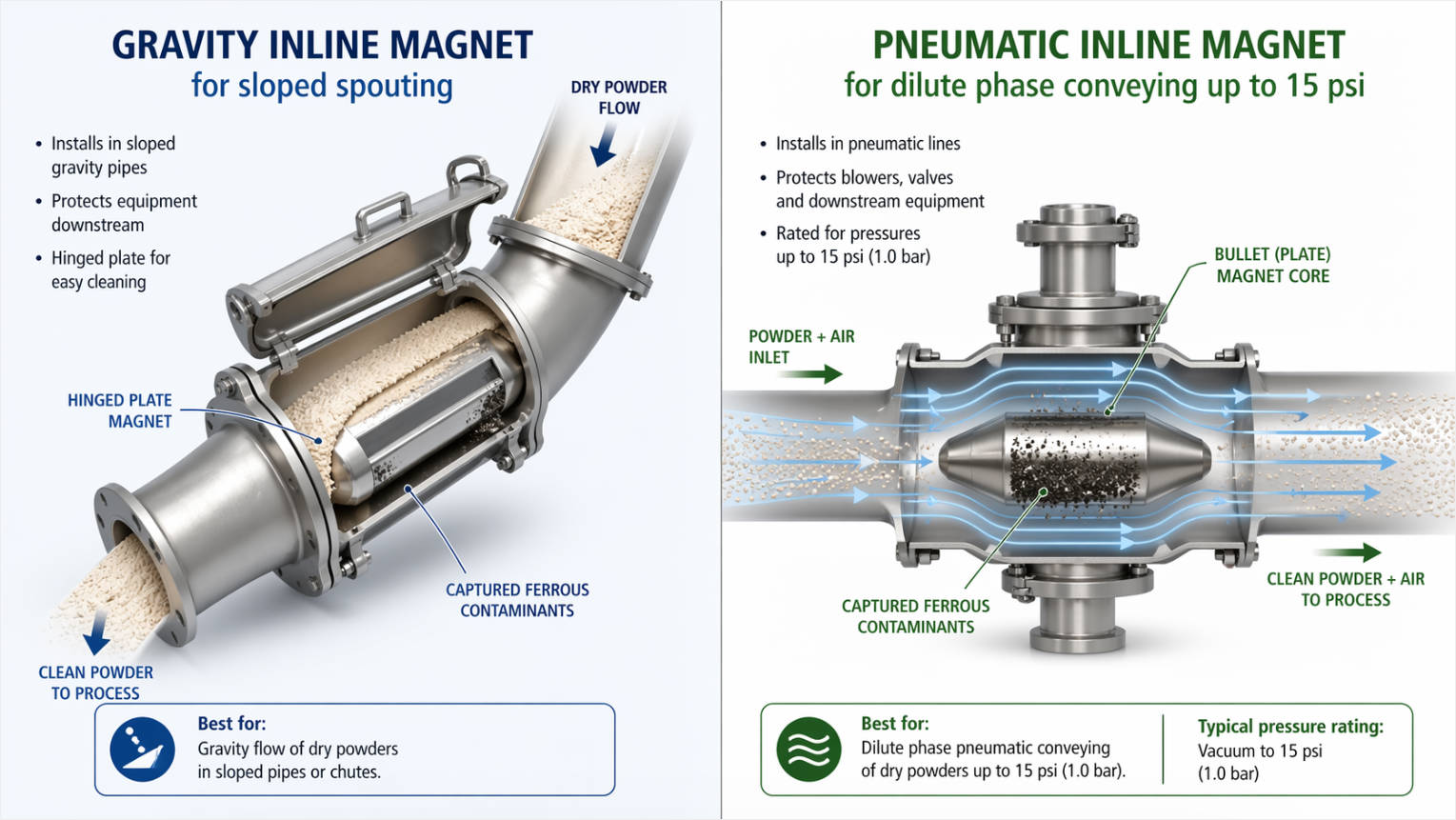
These designs are particularly useful for closed systems such as plastic resin, fine ceramic powders, or battery cathode/anode materials transported pneumatically. [yzvideo-c.yizimg]
Center‑Flow Magnets
Center‑flow magnets suspend a conical rare earth magnet in the center of a tubular housing. This configuration allows powders to flow around the cone while maximizing contact between product and magnetic field. [fortunebusinessinsights]
Benefits:
– Minimal obstruction, so they suit high‑capacity bulk handling.
– Tapered poles pull ferrous fines out of the main flow and hold them on the trailing magnetic pole. [fortunebusinessinsights]
Drum Magnetic Separators
Drum magnets are often the best choice when processing high‑density or abrasive powders like refractories, abrasives, and some mineral powders. [cnpowder.com]
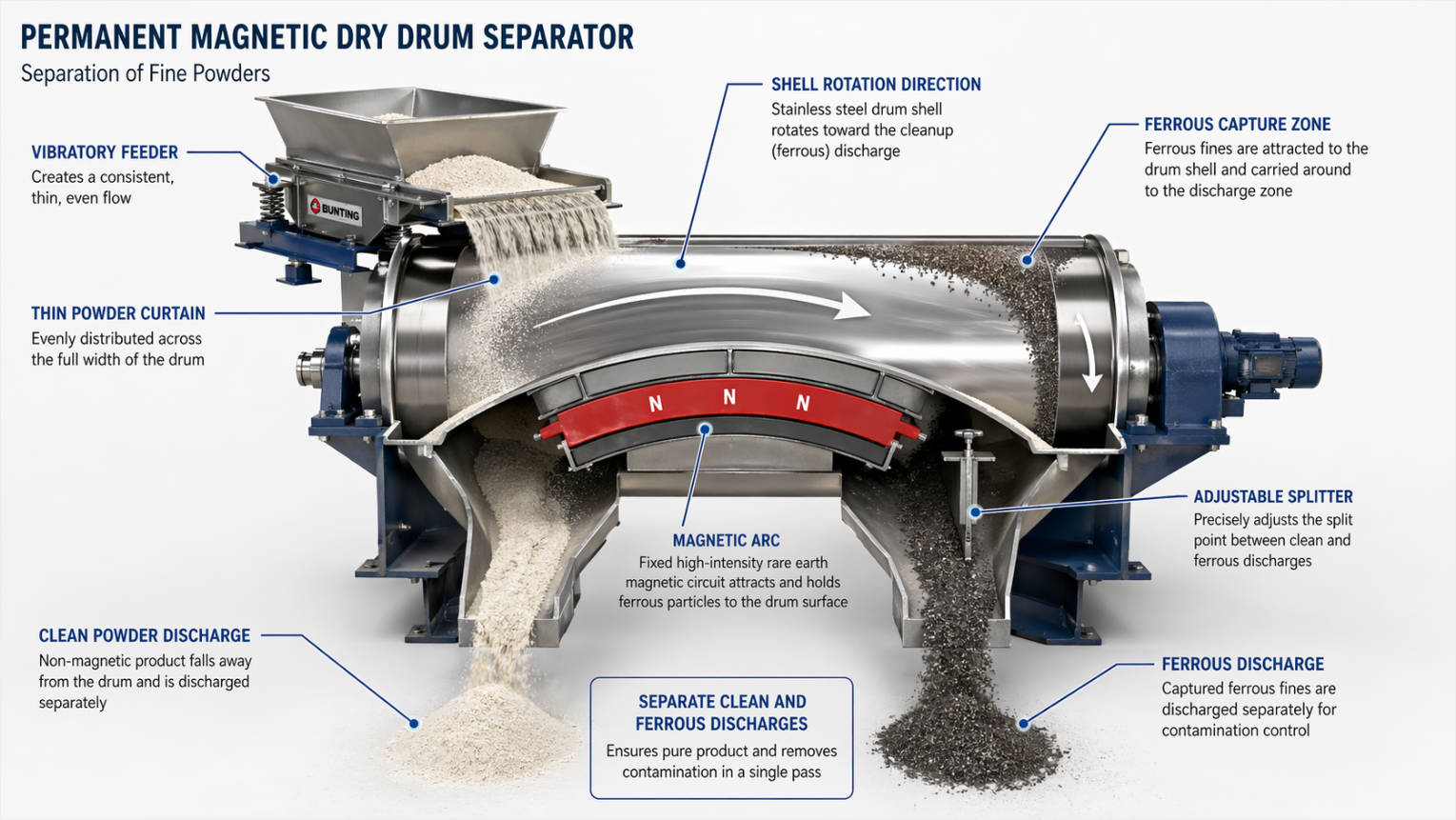
– Product is usually fed via a vibratory feeder onto the rotating shell.
– A stationary, high‑strength magnetic arc inside the shell captures fine iron on the drum surface while clean material falls away. [fortunebusinessinsights]
– A radial field configuration ensures that captured particles remain attached until they leave the magnetic zone and are discharged separately. [fortunebusinessinsights]
Critical parameters:
– Feed control: an air‑assisted vibratory feeder gives a thin, uniform curtain and avoids clumps.
– Shell speed: higher speeds reduce product loss and minimize entrapment by limiting the material layer on the surface. [fortunebusinessinsights]
From Theory to Practice: Designing a Multi‑Stage Powder Purification Line
In my experience, the plants that achieve the lowest residual iron levels do not rely on a single device; instead, they engineer a multi‑stage separation strategy tailored to their material and industry requirements. [shsunight]
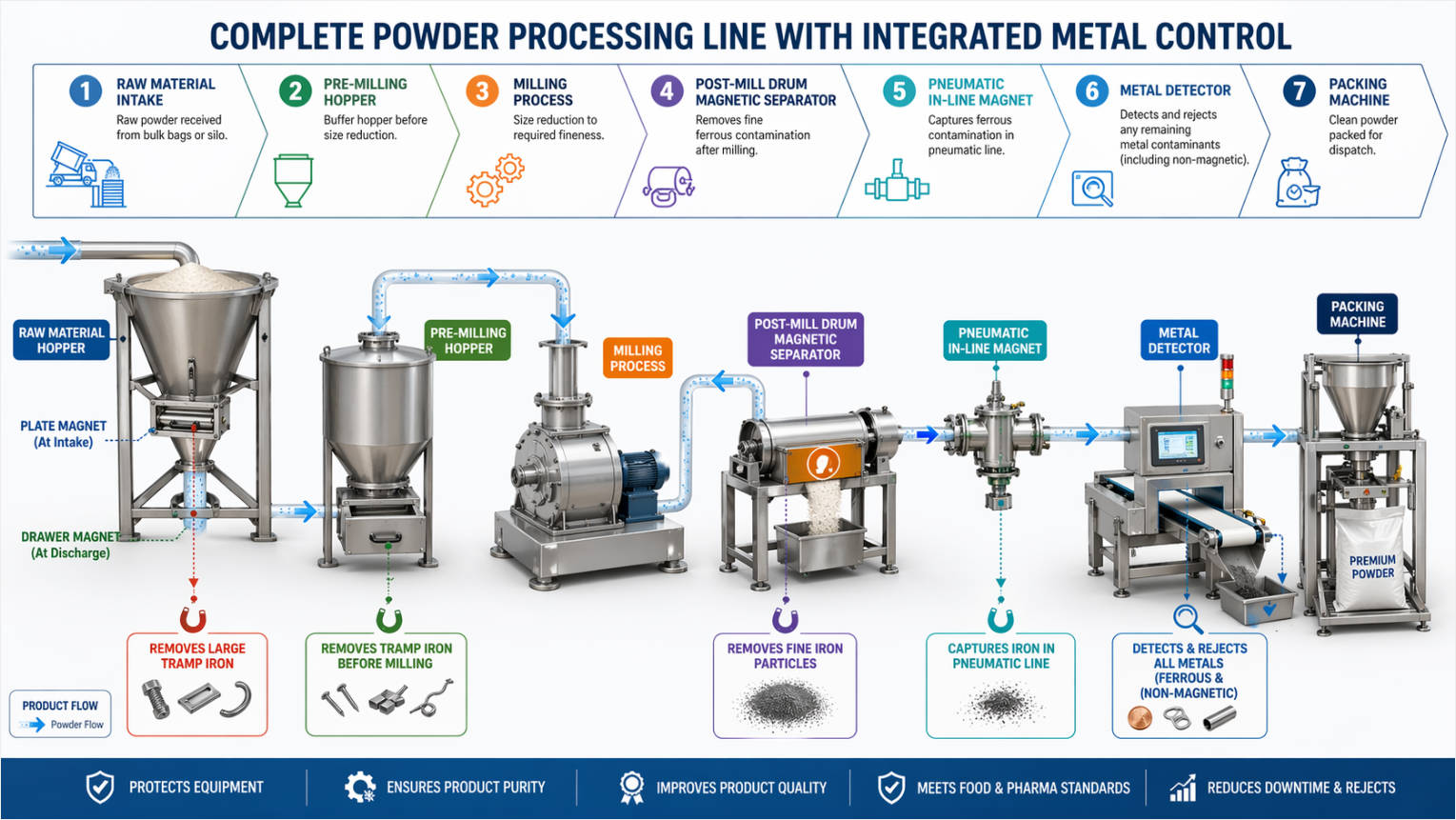
A Typical Multi‑Stage Iron Removal Layout
For a powder like ceramic glaze or battery cathode material, an effective line might look like this:
1. Raw material intake
– Heavy‑duty plate magnet or drum magnet to remove large tramp iron.
2. Pre‑grinding or pre‑mixing
– Grate or drawer magnet in the feed hopper to capture medium‑sized ferrous contamination.
3. Post‑grinding / classification
– High‑intensity tube/grate magnets or center‑flow magnet to remove newly generated fine iron. [fortunebusinessinsights]
4. Pneumatic conveying to storage
– Pneumatic in‑line magnet in horizontal runs for continuous fine iron capture. [yzvideo-c.yizimg]
5. Final packing line
– High‑sensitivity metal detector with automatic reject as the final quality gate, catching any remaining ferrous or non‑ferrous metal. [fortunebusinessinsights]
This multi‑stage concept is exactly where advanced powder magnetic separators and permanent magnetic separators from manufacturers such as Foshan Wandaye play a central role, integrating with sensors, feeders, and dust‑tight systems for industries from ceramics and glass to food, rubber, plastics, and battery materials. [shsunight]
Cross‑Industry Applications and Standards in 2026
By 2026, magnetic separation for powders has become a strategic technology across multiple sectors, driven by stricter regulations, higher purity demands, and the shift toward electrification and sustainable manufacturing. [cctime]
Key Application Sectors
– Mining and minerals: Upgrading iron ores, cleaning feldspar, quartz, and other non‑metallic minerals using high‑gradient and drum‑type separators. [cnblogs]
– Ceramics and glass: Removing iron to prevent discoloration and rejects in tiles, sanitaryware, and high‑clarity glass. [tymagnets]
– Food and pharmaceuticals: Ensuring consumer safety by eliminating metal fragments in flour, starch, sugar, chocolate, milk powder, and APIs, often under HACCP and GMP frameworks. [gdqiaoyue]
– Rubber and plastics: Protecting extruders and injection machines, improving surface quality, and meeting OEM cleanliness specifications. [alibaba]
– Battery cathode/anode materials: Achieving ultra‑low metal contamination to avoid internal short circuits and improve battery life and safety. [yzvideo-c.yizimg]
Regulatory expectations (for example, food‑grade hygiene, dust‑explosion safety, and traceability) mean that equipment design, material selection, and documentation are now as important as magnetic strength itself. [gdqiaoyue]
Practical Selection Guide: Choosing the Right Powder Magnetic Separator
When I help a plant manager choose magnetic equipment, we always start with the process and the risk—not the catalog. Below is a simplified selection framework.
Separator Selection Snapshot for Powder Lines
| Process stage | Main goal | Recommended technology |
|---|---|---|
| Raw material intake | Remove large tramp metal | Plate magnet, magnetic drum, overband magnet fortunebusinessinsights |
| Pre‑milling hopper | Medium tramp + coarse fines | Grate / drawer magnet, tube magnets fortunebusinessinsights |
| Post‑milling powder | Fine iron removal | High‑intensity grate, center‑flow, drum magnet fortunebusinessinsights |
| Pneumatic conveying | Continuous fine iron capture | Pneumatic in‑line magnet (PIM) fortunebusinessinsights |
| Final packing | All metals, including non‑magnetic | High‑sensitivity metal detector with automatic reject fortunebusinessinsights |
Beyond process location, we also look at:
– Target particle size and required residual iron level.
– Temperature, abrasiveness, and explosivity of the powder.
– Cleaning method (manual, semi‑automatic, automatic) and available downtime.
– Integration needs with existing conveyors and control systems. [sourcifychina]
Step‑by‑Step Checklist to Improve Iron Removal Efficiency
If you already have magnets installed but still see metal complaints or rejects, this is the field‑tested step‑by‑step approach I typically recommend.
1. Map contamination hotspots
– Analyze complaints, lab results, or sieve residues to see where metal likely enters or increases.
2. Evaluate existing equipment
– Verify magnet type, magnetic strength, installation orientation, and distance from product stream.
3. Check powder flow patterns
– Look for bypass paths, bridging, or dead zones in hoppers and chutes.
4. Optimize feeding
– Use vibratory feeders or air beds to create thin, even curtains onto drum or plate magnets. [fortunebusinessinsights]
5. Upgrade to high‑gradient, rare earth designs where needed
– Use neodymium‑based tube, grate, or drum magnets for fine iron and high‑value products. [alibaba]
6. Add final‑stage metal detection
– Install and routinely validate a metal detector just before packaging.
7. Implement monitoring and documentation
– Record inspections, cleaning cycles, and test results to support audits and continuous improvement. [shsunight]
Call to Action: Engineering a Powder‑Specific Solution
Every powder behaves differently, and the “strongest” magnet is not always the most effective choice without the right process engineering behind it. If you are processing minerals, ceramics, glass, plastics, food, pharmaceuticals, or battery materials and struggling with recurring metal contamination, the most efficient path forward is a customized separation strategy that combines powder magnetic separators, permanent magnetic separators, and high‑sensitivity metal detection. [sourcifychina]
If you’d like expert support in designing or upgrading a powder purification line—from process analysis and equipment selection through installation and commissioning—contact Foshan Wandaye’s technical team to discuss your specific material, capacity, and purity targets. [alibaba]
Frequently Asked Questions
1. How do I know if I need a powder magnetic separator or a metal detector?
In most powder lines you need both: magnetic separators to continuously remove ferrous and weakly magnetic particles, and a metal detector as the final check for all metal types, including non‑magnetic stainless steel. If you only install one technology, you will either miss certain metal types or struggle to reach the lowest contamination levels in high‑risk applications such as food and battery materials. [shsunight]
2. What is the best separator for very fine powders like battery cathode or ceramic glaze?
For ultra‑fine powders, high‑intensity rare earth equipment such as multi‑row grate magnets, center‑flow magnets, or drum magnets with high‑gradient fields usually delivers the best performance. However, achieving target purity also depends heavily on controlling powder flow, preventing caking on the magnet surface, and sometimes combining several separator types in sequence. [cnpowder.com]
3. How often should magnetic separators be cleaned in powder applications?
Cleaning frequency depends on contamination load, product value, and regulatory requirements, but in practice most plants clean critical magnets at least once per shift and more often in high‑risk food or pharma lines. For abrasive or high‑volume powders, semi‑automatic or automatic cleaning systems can reduce labor while maintaining consistent separation performance. [gdqiaoyue]
4. Can permanent magnetic separators replace electromagnetic systems?
In many modern powder lines, high‑performance permanent magnetic separators based on rare earth materials can replace traditional electromagnets, offering high field strength with lower energy consumption and simpler maintenance. Electromagnets still have a role in some very large‑scale or special‑duty applications, but for most powder processes, permanent designs are now the preferred solution. [alibaba]
5. What standards or regulations should I consider for magnetic separation in food and pharma powders?
Food and pharmaceutical manufacturers typically design their magnetic separation and metal detection systems in line with HACCP, GMP, and retailer or brand‑owner codes of practice, which specify minimum sensitivities and validation intervals. In practice this means selecting hygienic, cleanable designs, validating performance with test pieces, and maintaining detailed records of inspections and corrective actions. [gdqiaoyue]
References
1. Bunting Magnetics. “Separating Fine Iron from Powders with Metal Detection and Magnetic Separators.”[link]
2. Sourcify China. “Comprehensive Guide to Magnetic Separation Equipment in China.”[link]
3. 广东桥粤. “永磁磁选机的工作原理及其在各行业中的应用价值探讨.”[link]
4. 上海三奈磁业. “磁选机在食品与医药领域应用.”[link]
5. Fortune Business Insights. “磁选机市场规模、份额|趋势报告,2034 年.”[link]
6. 粉体网. “华特立环高梯度磁选机在长石选矿中的应用.”[link]
7. 阿里巴巴 Product Insights. “Understanding China Magnetic Separator: Standards, Properties…”[link]
8. 瓦恩默磁电技术资料(浆料及粉体永磁过滤与除铁应用,PDF 报告). [yzvideo-c.yizimg]
Hot Tags: Can Magnets Go Through Metal Detectors, Manufacturers, Customized, Custom, Suppliers, Buy, Cheap, Quality, Advanced, Durable, in Stock, Made in China, Price, Quotation