


Content Menu
● Why Copper Recycling Needs High-Intensity Magnetic Separation
● How High-Intensity Magnetic Separators Work in Copper Recycling
● Optimising Copper Recovery with High Intensity Separation
● Beyond Copper: Powder and Permanent Magnetic Separators Across Industries
● Comparing Powder vs Permanent Magnetic Separators in Copper and Related Applications
● Practical Design Steps: Building a High-Intensity Magnetic Separation Line
● Trends in High-Intensity Magnetic Separation
● Why Work with a Full-Scope Magnetic Separator Manufacturer
● Call to Action: Plan Your Next Magnetic Separation Upgrade
● FAQ
>> 1. What is a high-intensity magnetic separator in copper recycling?
>> 2. How does a powder magnetic separator differ from a permanent magnetic separator?
>> 3. Where should magnetic separators be installed in a copper recycling line?
>> 4. Can high-intensity magnetic separators help with e-waste and battery recycling?
>> 5. Why should recyclers work with a specialized magnetic separator manufacturer?
High-intensity magnetic separators are quietly transforming copper recycling, turning what used to be “good enough” recovery into consistently premium‑grade secondary copper that can compete with virgin material on both quality and cost. Drawing on my experience working with recyclers and material processors across metals, ceramics, and battery materials, I have seen how the right combination of powder and permanent magnetic separation technology can unlock hidden value in copper‑rich waste streams while protecting downstream equipment and stabilizing plant profitability. [buntingmagnetics]
Why Copper Recycling Needs High-Intensity Magnetic Separation
Copper is 100% recyclable and retains its properties indefinitely, but contamination from ferrous and weakly magnetic metals can quickly destroy its market value. In a typical home there may be around 100 kg of copper, and even a standard computer can contain 1.5 kg, making post‑consumer copper recovery a critical environmental and economic priority. [par.nsf]
From an industry perspective, three pressures are driving recyclers toward high‑intensity magnetic separators:
– Stricter purity specifications from smelters and wire & cable manufacturers. [recyclingproductnews]
– Rising energy and carbon costs for primary copper production, making high‑yield recycling more attractive. [eriez]
– Increasing complexity of feedstock (shredder residue, WEEE, EV batteries, fine powders) that standard permanent magnets can no longer handle effectively. [recyclemetals]
Recycling copper can save up to 85% of the energy required for primary production and avoid tens of millions of tonnes of CO₂ annually, but only if plants can reliably produce clean, low‑contamination fractions that meet high‑value end‑user requirements. [buntingmagnetics]
How High-Intensity Magnetic Separators Work in Copper Recycling
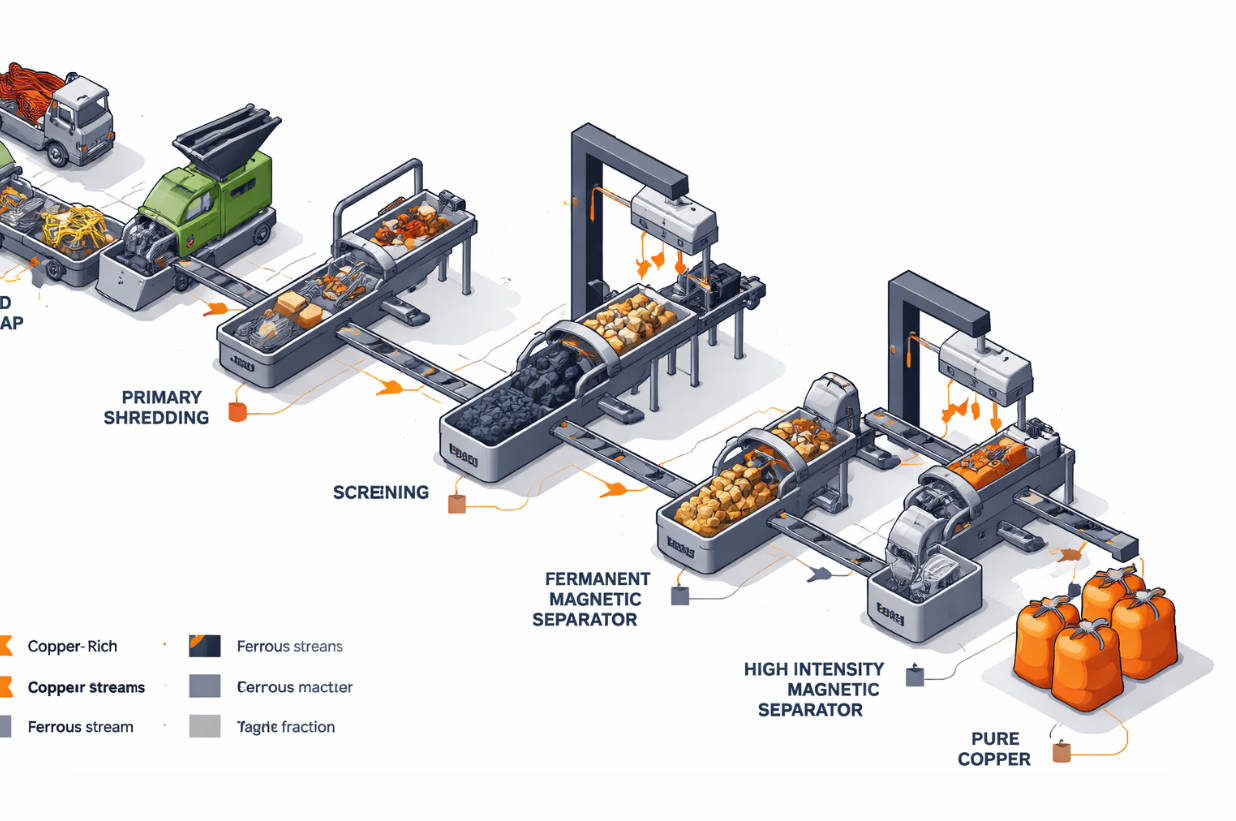
High‑intensity magnetic separators generate ultra‑strong magnetic fields that capture not only clearly ferromagnetic particles, but also fine, weakly magnetic contaminants that usually pass through conventional equipment. In copper recycling plants, they are typically installed after primary ferrous removal and size reduction to refine copper‑rich fractions. [blakertech]
A modern high‑intensity system often combines:
– Electromagnetic or rare‑earth magnetic sources delivering very high gauss levels at the working gap. [recyclingproductnews]
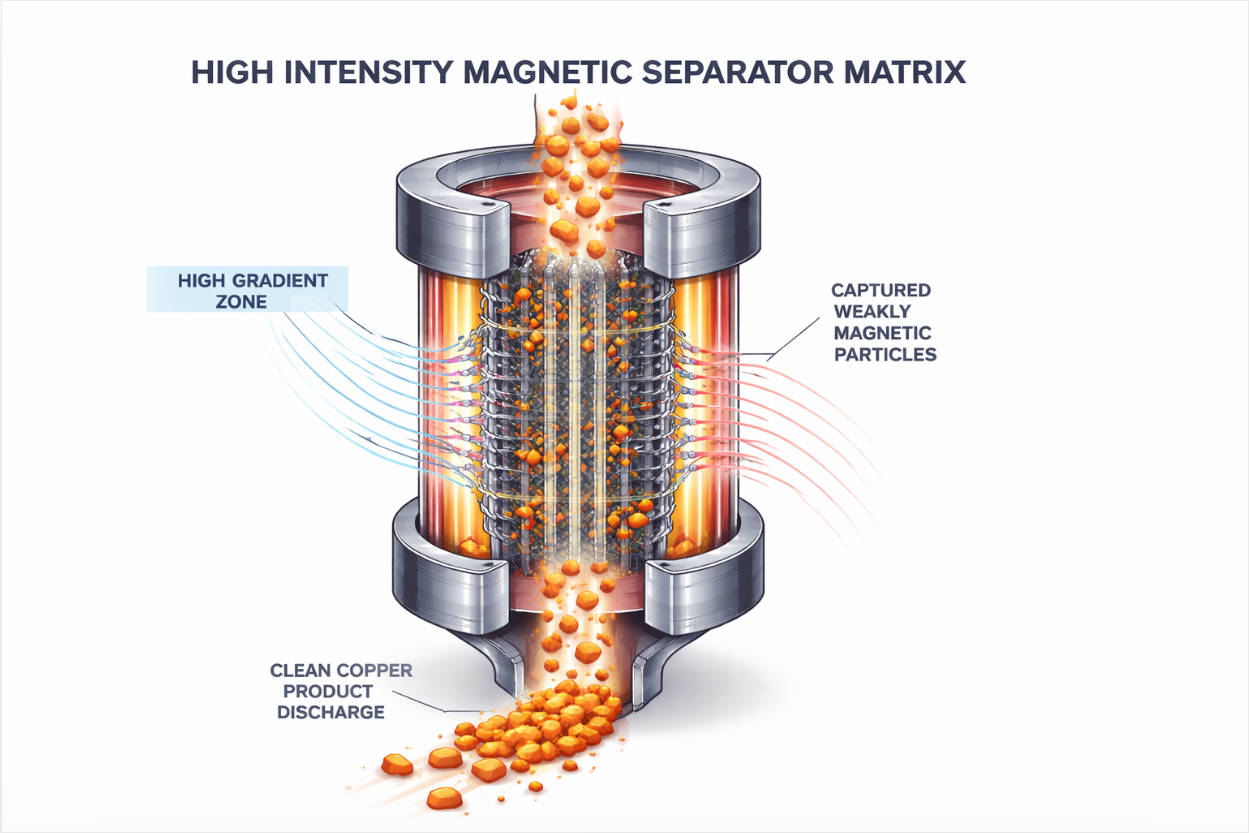
– Engineered matrix or rotor designs that create multiple magnetic capture points for fine particles. [recyclemetals]
– Precise control of belt speed, splitter positions, and feed presentation to stabilize separation performance. [buntingmagnetics]
For copper recyclers, this means:
– Higher copper recovery from mixed scrap and fines.
– Lower residual iron and stainless content in the copper stream.
– Better protection of downstream shredders, granulators, and sorters from tramp metal damage. [buntingmagnetics]
To enhance visual understanding, this section is an ideal place to insert:
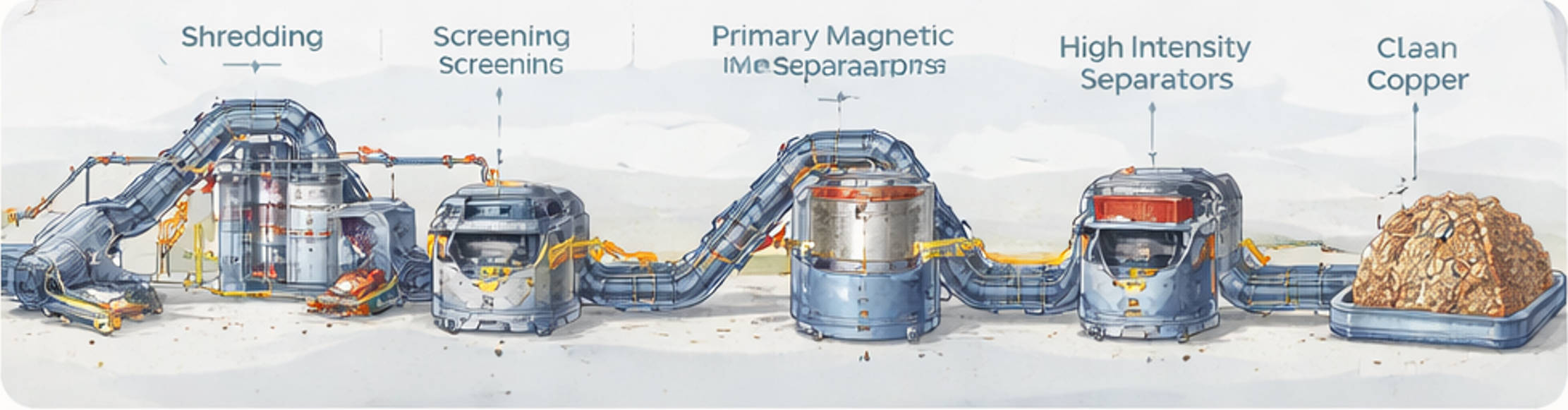
– A process flow diagram showing where powder and permanent magnetic separators sit in a copper recycling line.
– A cross‑section illustration of a high‑intensity magnetic separator matrix capturing fine contaminants.
Optimising Copper Recovery with High Intensity Separation
Industry case studies show that integrating high‑intensity magnetic separation downstream of primary ferrous removal can dramatically improve both copper yield and quality. In one widely cited example, a recycler processing copper‑rich shredder streams used a high‑intensity separation conveyor to remove stainless steel and other weakly magnetic contaminants that standard magnets could not capture. [eriez]
From an operator’s standpoint, the impact is visible in three areas:
1. Product purity – Copper fractions consistently meet stringent “low‑copper‑in‑ferrous” and “low‑iron‑in‑copper” specifications, enabling premium pricing. [buntingmagnetics]
2. Yield – Improved separation sharpness reduces the amount of copper lost to ferrous or waste streams, increasing overall recovered metal tonnage. [recyclingproductnews]
3. Process stability – Cleaner feed entering eddy current separators, optical sorters, and granulators lowers unplanned downtime and wear. [blakertech]
To make this case study content more engaging for decision‑makers, you can insert:
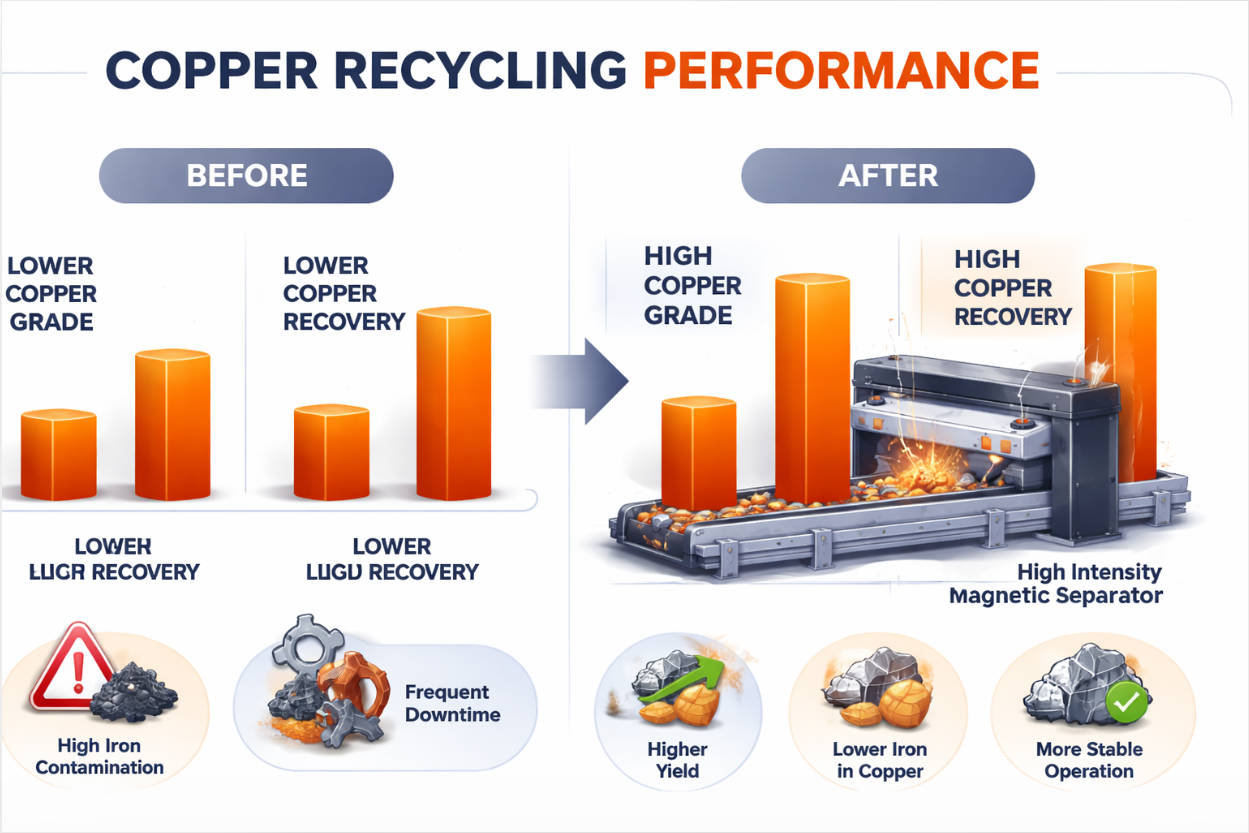
– Before/after bar charts showing copper grade and recovery rates with and without high‑intensity separation.
– Short video clips of magnetic separation conveyors in operation within a recycling plant. [youtube]
Beyond Copper: Powder and Permanent Magnetic Separators Across Industries
While copper recycling is a flagship application, high‑intensity powder and permanent magnetic separators now play a central role in many powder‑based and bulk material processes. Manufacturers in ceramics, glass, new energy materials, and food processing deploy these systems to remove ferrous contamination, protect quality, and comply with stringent industry standards. [magneticseparatormachine.sell.everychina]
A professional magnetic separation enterprise such as Foshan Wandaye Technology Co., Ltd. combines R&D, engineering design, production line installation, and commissioning to deliver end‑to‑end solutions rather than standalone machines. Typical equipment portfolios include: [en.fswandaye]
– Dry powder magnetic separators for fine powders such as quartz, kaolin, and battery materials.
– Permanent magnetic separators for continuous protection of conveyors and chutes.
– Slurry and wet high‑intensity units for ceramic slurries, kaolin, and mineral processing. [en.fswandaye]
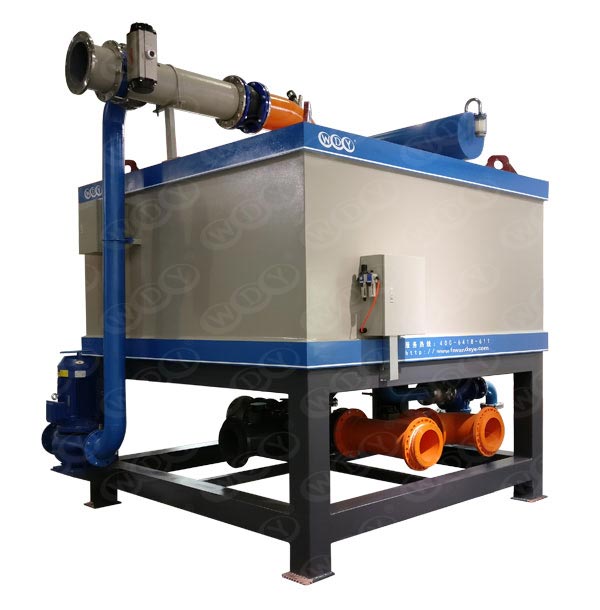
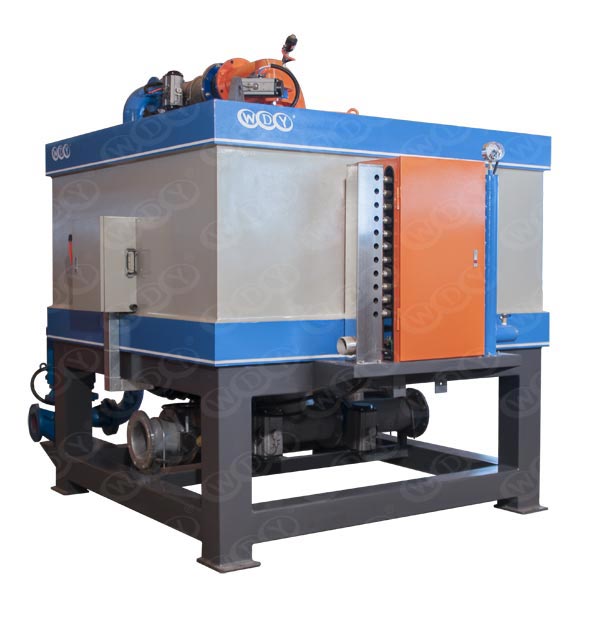
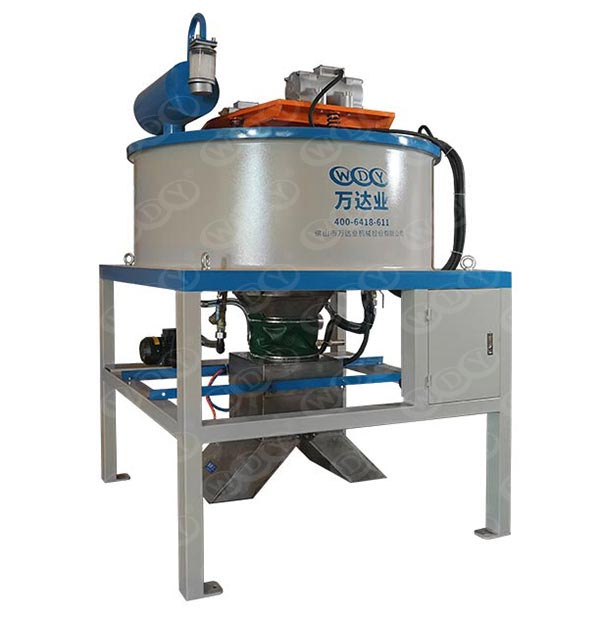
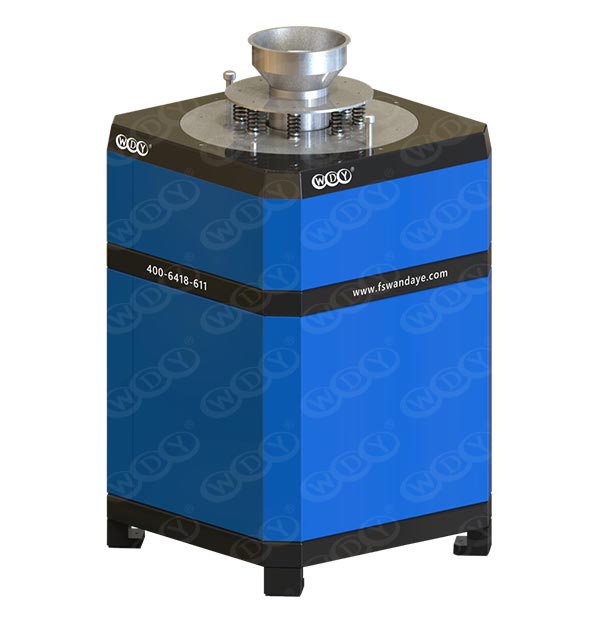
This section is ideal for product photos and application images:
– Close‑ups of powder magnetic separators integrated into ceramic or quartz sand lines.
– Plant‑level photos of permanent magnetic separators installed over conveyors in recycling or building materials plants.
Comparing Powder vs Permanent Magnetic Separators in Copper and Related Applications
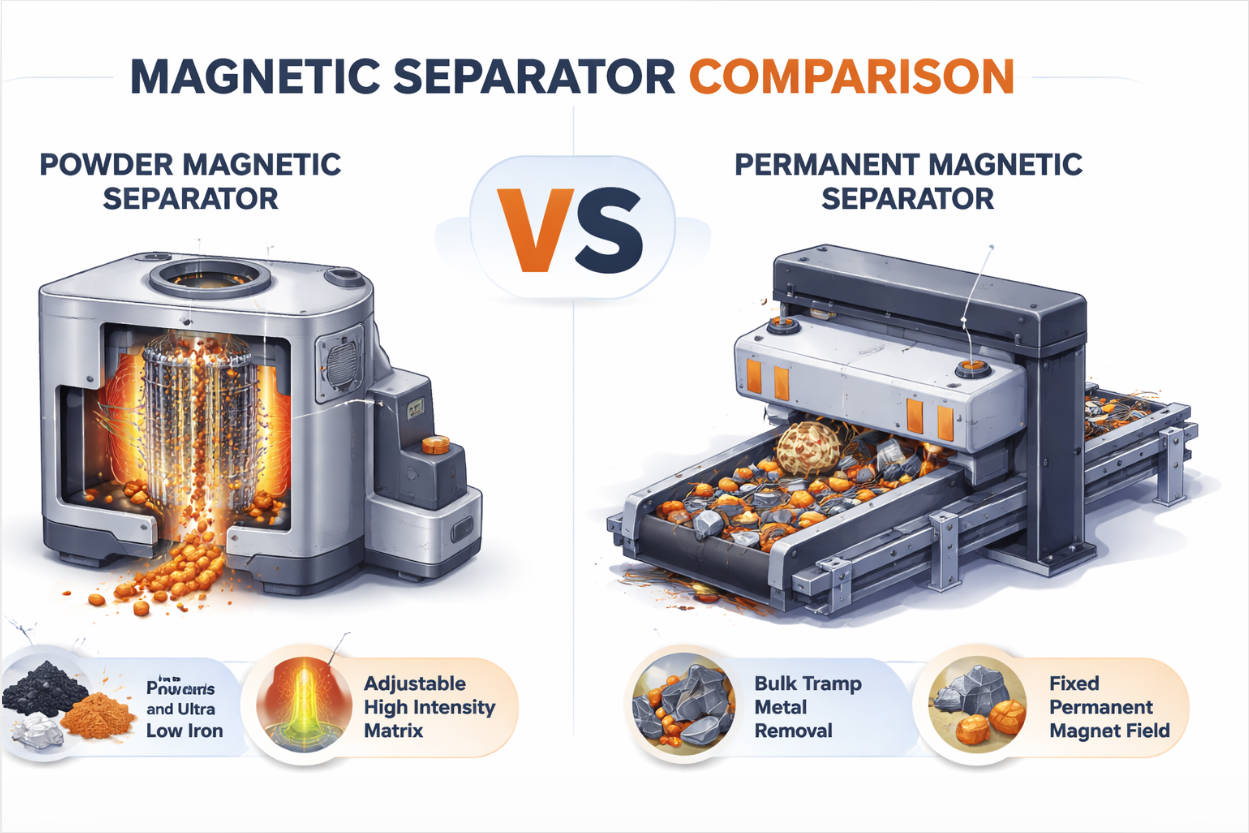
Copper recyclers and advanced materials producers often evaluate both powder and permanent magnetic separators as part of an integrated line design. The table below summarizes practical differences from an engineering and operations perspective. [wdymagnetic]
| Aspect | Powder Magnetic Separator | Permanent Magnetic Separator |
|---|---|---|
| Typical media | Dry powders, fine granules, battery materials, kaolin recyclemetals | Coarser bulk materials on belts, chutes, or pipes buntingmagnetics |
| Magnetic field | Often high‑intensity, focused matrix for ultra‑fine removal recyclemetals | Fixed field strength based on permanent rare‑earth or ferrite magnets buntingmagnetics |
| Main goal | Ultra‑low iron content, refined product purity in powders recyclemetals | Tramp iron removal and equipment protection in continuous flow buntingmagnetics |
| Adjustment | Configurable matrix, field intensity, and flow paths recyclemetals | Limited adjustment, mainly installation position and gap buntingmagnetics |
| Typical use in copper | Cleaning fine copper powders and concentrates, e‑waste fines buntingmagnetics | Removing bulky ferrous and weakly magnetic pieces from mixed scrap streams recyclingproductnews |
In a well‑designed copper recycling or battery materials plant, these technologies complement each other rather than compete, with permanent magnets handling bulk tramp removal and high‑intensity powder units delivering final product polishing. [magneticseparatormachine.sell.everychina]
Practical Design Steps: Building a High-Intensity Magnetic Separation Line
From my work with plant engineering teams, the most successful magnetic separation projects follow a clear, step‑by‑step design and validation process.
1. Define the problem and targets
– Characterize the feed: particle size distribution, moisture, bulk density, copper content, and current contamination levels. [par.nsf]
– Set measurable goals: target copper purity, allowed iron or stainless content, and acceptable metal losses.
2. Select separator types and positions
– Use permanent magnetic separators at early stages to remove coarse ferrous and protect shredders and crushers. [en.fswandaye]
– Introduce high‑intensity powder or conveyor‑type units downstream to refine copper or critical powder streams. [recyclemetals]
3. Pilot testing and sample evaluation
– Run controlled tests with different magnet configurations, belt speeds, and splitter positions.
– Analyze separated fractions using laboratory methods (e.g., ICP‑OES for metal content in e‑waste trials). [par.nsf]
4. Integrate automation and monitoring
– Add sensors and SCADA integration to monitor throughput, magnet temperature, and key performance indicators.
– Implement routine audits of product purity and metal recovery to maintain long‑term performance.
5. Plan for maintenance and cleaning
– Design access for matrix cleaning, magnet inspection, and wear part replacement.
– Establish documented cleaning intervals for powder systems to prevent build‑up and maintain field strength efficiency. [en.fswandaye]
Illustrations that can elevate this section:
– A layout sketch of a copper recycling line with labeled magnet positions.
– A simple flow chart showing the decision path from feed analysis to equipment selection and optimization.
Trends in High-Intensity Magnetic Separation
Looking ahead, several trends are reshaping how operators think about high‑intensity magnetic separation across copper recycling and adjacent industries.
– Electromagnetic dry filters for ultra‑fine powders – New high‑intensity electromagnetic filters can remove free fine iron from difficult‑to‑process powders used in ceramics, chemicals, and advanced materials, achieving separation efficiencies far beyond traditional permanent units. [magneticseparatormachine.sell.everychina]
– Integration with electrostatic and eddy current separation – Plants increasingly combine magnetic, electrostatic, and eddy current technologies to selectively recover copper, aluminium, and other non‑ferrous metals from complex e‑waste and shredder residues. [buntingmagnetics]
– Application to battery and EV recycling – As positive and negative electrode materials enter the recycling stream, powder magnetic separators are being deployed to remove metal impurities from active materials and protect downstream refining steps. [wdymagnetic]
From an engineering standpoint, the most competitive plants over the next decade will be those that treat magnetic separation not as a bolt‑on accessory, but as a core process technology that is co‑designed with crushing, screening, and sorting operations.
Why Work with a Full-Scope Magnetic Separator Manufacturer
For operators in mining, ceramics, power, building materials, glass, environmental protection, rubber, plastics, pharmaceuticals, food, and positive/negative electrode materials, partnering with a specialist manufacturer can sharply reduce project risk. Companies such as Foshan Wandaye Technology focus on magnetic separation and iron‑removal equipment across multiple specifications, providing integrated engineering from feasibility through commissioning. [en.fswandaye]
A full‑scope partner can deliver:
– Application‑specific design for powder, slurry, and bulk materials.
– On‑site installation, alignment, and commissioning to shorten ramp‑up time.
– Long‑term support, including performance audits and retrofits as feed and product requirements evolve.
Call to Action: Plan Your Next Magnetic Separation Upgrade
If your copper recycling or powder processing line is struggling with inconsistent purity, high copper losses, or frequent equipment damage, it is time to reassess your magnetic separation strategy. By combining high‑intensity powder magnetic separators with robust permanent magnetic separators, you can unlock hidden value in existing material streams while preparing your plant for more demanding future specifications. [buntingmagnetics]
To move forward:
– Audit your current metal losses, contamination levels, and downtime causes.
– Share representative samples and process data with a specialist magnetic separator manufacturer.
– Request an engineering review and pilot test program tailored to your materials and performance targets.
For operators seeking a partner that can deliver R&D support, engineering design, production line installation, and on‑site commissioning for powder and permanent magnetic separators, you can contact Foshan Wandaye Technology Co., Ltd. to discuss your specific application requirements. [en.fswandaye]
Contact us to get more information!
FAQ
1. What is a high-intensity magnetic separator in copper recycling?
A high‑intensity magnetic separator is a system that generates very strong magnetic fields to remove ferrous and weakly magnetic contaminants from copper‑rich materials, improving copper purity and recovery in recycling plants. [blakertech]
2. How does a powder magnetic separator differ from a permanent magnetic separator?
A powder magnetic separator is engineered for fine powders and typically uses a high‑intensity matrix to capture ultra‑fine contaminants, while a permanent magnetic separator focuses on removing coarser tramp metal from bulk materials using fixed‑strength magnets. [wdymagnetic]
3. Where should magnetic separators be installed in a copper recycling line?
Permanent magnetic separators are usually installed early in the process to protect crushers and shredders, while high‑intensity units are positioned downstream to refine copper products and recover fine metals from mixed or powder streams. [eriez]
4. Can high-intensity magnetic separators help with e-waste and battery recycling?
Yes, high‑intensity magnetic separators and electromagnetic dry filters are increasingly used to remove iron and other magnetic contaminants from fine e‑waste fractions and battery electrode powders, enabling higher‑value metal recovery and cleaner active materials. [recyclemetals]
5. Why should recyclers work with a specialized magnetic separator manufacturer?
Specialized manufacturers provide application‑specific equipment, test support, engineering design, installation, and long‑term service, helping recyclers reduce risk, accelerate commissioning, and maintain stable high‑purity production over the life of the plant. [magneticseparatormachine.sell.everychina]
References
1. Bunting Magnetics – “High Intensity Magnetic Separator Optimises Copper Recycling”. Available at: <https://buntingmagnetics.com/blog/high-intensity-magnetic-separator-optimises-copper-recycling> [buntingmagnetics]
2. Recycling Product News – “Bunting’s HISC high intensity separation conveyor optimizes copper recovery”. Available at: <https://www.recyclingproductnews.com/article/33510/buntings-hisc-high-intensity-separation-conveyor-optimizes-copper-recovery> [recyclingproductnews]
3. Bunting Magnetics – “Metal Recycling Equipment”. Available at: <https://buntingmagnetics.com/industries/metal-recycling-equipment> [buntingmagnetics]
4. BMRA – “Bunting develops high-intensity Electromagnetic Dry Filter”. Available at: <https://www.recyclemetals.org/newsandarticles/bunting-high-intensity-electromagnetic-dry-filter.html> [recyclemetals]
5. EveryChina product listing – “Wet High Intensity Magnetic Separation Equipment For Kaolin (WANDAYE)”. Available at: <https://magneticseparatormachine.sell.everychina.com/p-110633075-wet-high-intensity-magnetic-separation-equipment-for-kaolin.html> [magneticseparatormachine.sell.everychina]
6. NSF Public Access – “Selective recovery and separation of copper and iron from fine e‑waste materials”. Available at: <https://par.nsf.gov/servlets/purl/10081334> [par.nsf]
7. Foshan Wandaye – “Magnetic Separator | Magnetic Separation Equipment | Iron Removal Equipment”. Available at: <http://en.fswandaye.com> [en.fswandaye]
8. Foshan Wandaye – “WDY Magnetic Separation Equipment – Products”. Available at: <http://en.fswandaye.com/Products/> [en.fswandaye]
9. Wandaye Magnetics – Company overview. Available at: <https://www.wdymagnetic.com> [wdymagnetic]
10. Blake Technical – “How magnetic separation works in an eddy current separator”. Available at: <https://www.blakertech.com/news/how-magnetic-separation-works-in-an-eddy-current-separator/> [blakertech]
11. Eriez – “Shred1 Ballistic Separator Elevates Low-Copper Recovery & Melt”. Case study PDF. Available at: <https://eriez.com/Documents/Case-Studies/Eriez-CS-76-Shred1-Ballistic-Separator.pdf> [eriez]
12. Bunting Magnetics – “New ElectroStatic Separator”. Available at: <https://buntingmagnetics.com/blog/new-electrostatic-separator> [buntingmagnetics]
13. Wandaye (English site) – “High-Intensity Magnetic Separation Conveyors: Why Auto Recyclers Can’t Afford to Ignore Them”. Available at: <https://www.wdymagnetic.com/high-intensity-magnetic-separation-conveyors-why-auto-recyclers-cant-afford-to-ignore-them.html/> [wdymagnetic]
Hot Tags: Copper Recycling Separator, Manufacturers, Customized, Custom, Suppliers, Buy, Cheap, Quality, Advanced, Durable, in Stock, Made in China, Price, Quotation