


Content Menu
● What Is Magnetic Separation in Mineral Processing?
● Why Magnetic Separation Matters More Than Ever in 2026
● Core Magnetic Separator Types for Dry Mineral Processing
>> Rare Earth Roll Magnetic Separator (RER)
>> Induced Magnetic Roll (IMR) Separators
>> Magnetic Disc Separators (MDS)
● Wandaye’s Perspective: Powder & Permanent Magnetic Separators in Modern Plants
● Step‑By‑Step: How to Select the Right Magnetic Separator
● Real‑World Application Examples Across Industries
● Key Design and Operating Variables That Drive Performance
● Powder vs Permanent Magnetic Separators: Practical Comparison
>> Separator Types and Typical Uses
● How Foshan Wandaye Supports Complete Line Engineering
● Call to Action: Plan Your Next Magnetic Separation Upgrade
>> 1. How do I know if my mineral is suitable for magnetic separation?
>> 2. What’s the main difference between powder magnetic separators and permanent magnetic separators?
>> 3. Can magnetic separators help me meet stricter environmental or ESG requirements?
>> 4. How important is pilot testing before buying equipment?
>> 5. What information should I prepare before consulting a magnetic separator supplier?
Magnetic separation has quietly become one of the most critical technologies in modern mineral processing, ceramics, glass, and battery-material production. From my work on powder and permanent magnetic separator projects at Foshan Wandaye, I have seen first-hand how a well‑designed separator can turn marginal ore, contaminated powders, or off‑spec ceramic batches into reliable, high‑margin products. [linkedin]
What Is Magnetic Separation in Mineral Processing?
Magnetic separation is a selective process that uses magnetic forces to separate or purify mineral particles based on their magnetic properties. In practical terms, it removes tramp iron and weakly magnetic impurities from valuable non‑metallic minerals, or recovers magnetic ores like magnetite and ilmenite from low‑grade deposits. [buntingmagnetics]
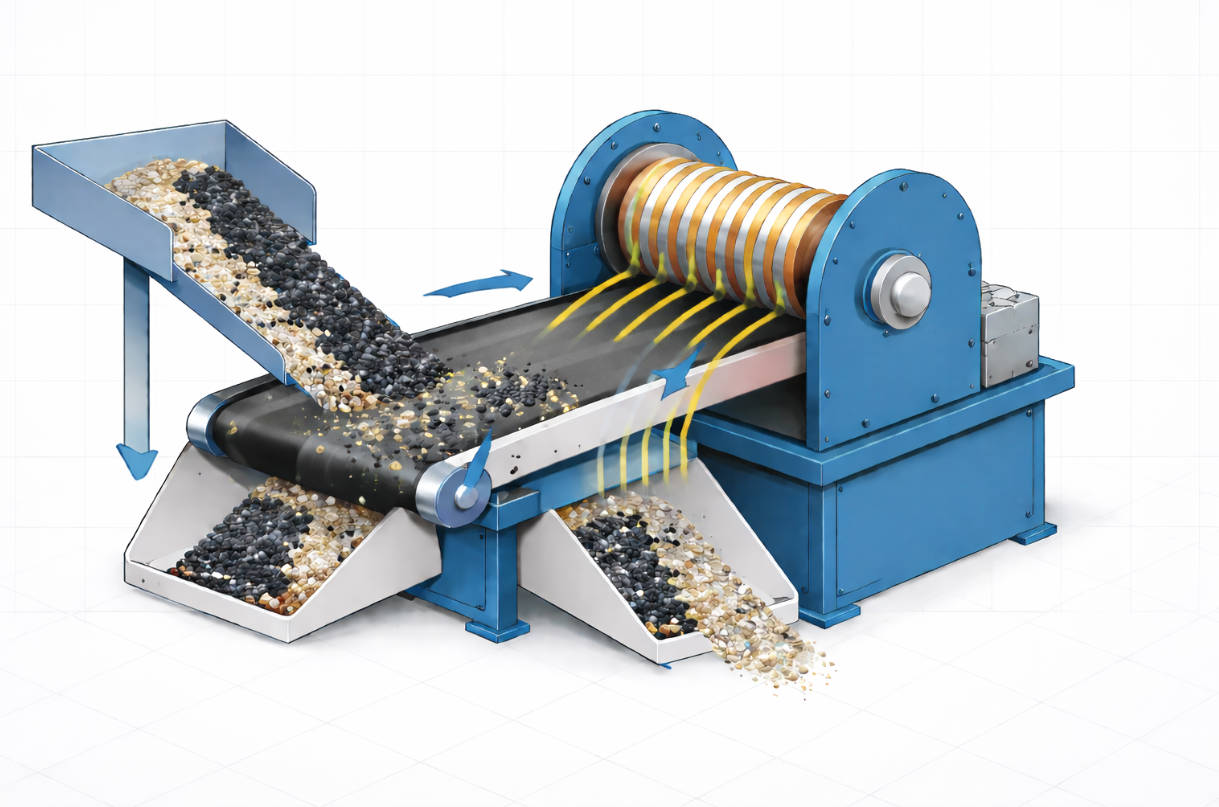
Minerals fall into three broad magnetic categories.
– Ferromagnetic: Strongly attracted (e.g. magnetite), easily removed with low‑intensity separators.
– Paramagnetic: Weakly attracted (e.g. hematite, ilmenite, chromite), require high‑intensity or high‑gradient equipment.
– Diamagnetic: Very weakly repelled (e.g. silica, feldspar), typically report to non‑magnetic product.
Behind every separation is a three‑way competition between magnetic force, gravity/inertia, and inter‑particle forces. If the magnetic force is strong enough to pull a particle away from its natural trajectory, that particle can be separated. In formula form, the magnetic force on a paramagnetic particle is often expressed as F(m)=V⋅K⋅H⋅H/R, where V is particle volume, K is magnetic susceptibility, H is field strength, and H/R is the field gradient.
Where to insert visuals:
– After this section, add a simple diagram showing particle trajectories in a magnetic field versus gravity (schematic cross‑section of a separator).
Why Magnetic Separation Matters More Than Ever in 2026
Global demand for magnetic separation is expanding steadily as mining, recycling, and advanced materials manufacturers all chase higher recovery and cleaner products. Recent market analyses value the magnetic separator market at around USD 1.24 billion in 2026, with forecasts approaching USD 1.56 billion by 2030 at roughly 5.9% CAGR. Permanent magnet separators alone already account for close to 60% of total market revenue, reflecting their reliability and low operating cost in continuous processing. [researchandmarkets]
In mining, innovations in high‑intensity and high‑gradient separation are expected to lift mineral extraction efficiency by up to 30% by the mid‑2020s, especially on low‑grade or complex ores. At the same time, new application drivers are emerging: [globenewswire]
– Rapid growth of lithium‑ion battery and cathode/anode materials, demanding ultra‑low iron contamination. [futuremarketinsights]
– Tighter environmental regulations on waste and tailings, making higher recovery and cleaner effluent non‑negotiable. [linkedin]
– Rising use of rare‑earth permanent magnets and AI‑enabled, sensor‑based control systems that push separation efficiency above 98% in optimized conditions. [radialmagnet]
As a manufacturer, we see a clear shift in client conversations: instead of asking “Can you remove iron?”, customers now ask how magnetic separation can support sustainability targets, OEE improvement, and battery‑grade purity across a full production line. [linkedin]
Where to insert visuals:
– Industry trend infographic: global market size, CAGR, and top growth segments (mining, battery materials, ceramics).
Core Magnetic Separator Types for Dry Mineral Processing
The legacy Bunting article focuses on three dry, high‑intensity separator designs that still form the backbone of many mineral processing flowsheets. As an engineer, I recommend starting with a clear understanding of how these machines behave on real feeds, not just in diagrams. [linkedin]
Rare Earth Roll Magnetic Separator (RER)
Rare Earth Roll (RER) separators use Neodymium Iron Boron permanent magnets built into a high‑intensity magnetic head pulley. Carefully engineered pole spacing produces strong magnetic field gradients that exert a high magnetic force on paramagnetic particles as they pass over the roll.
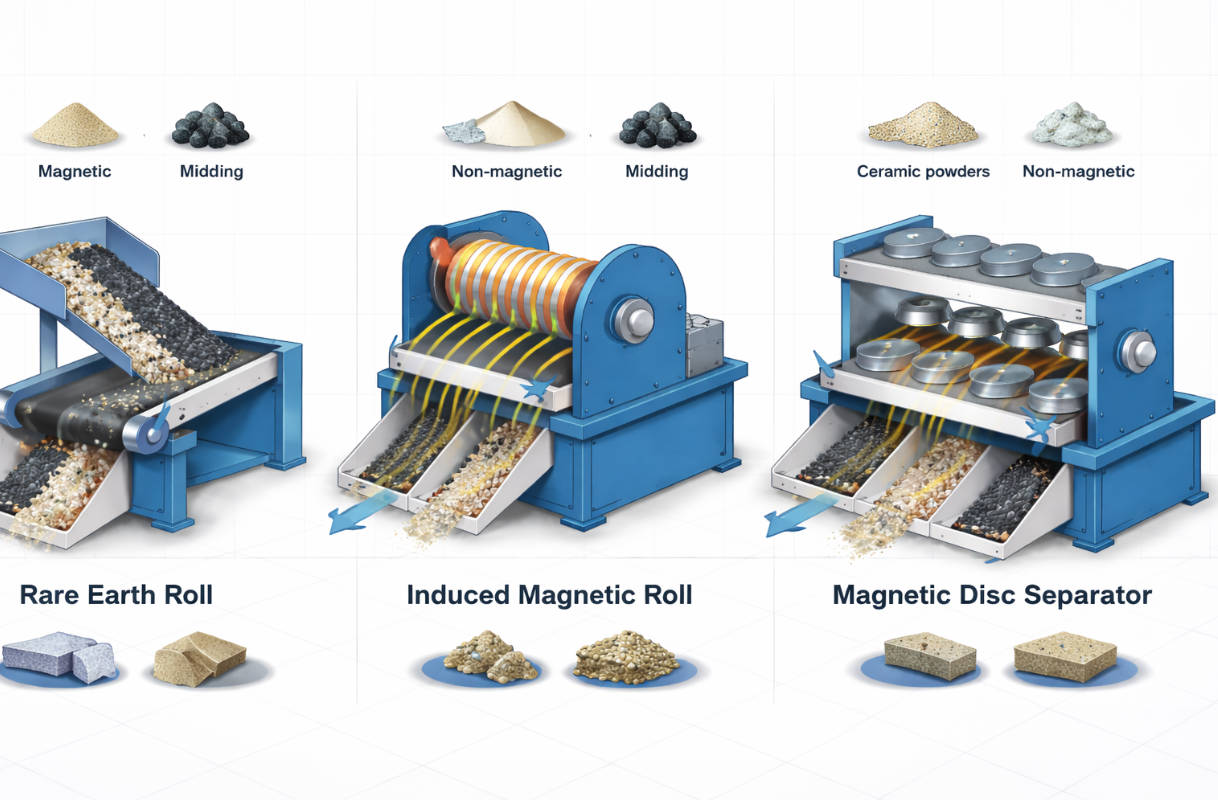
Key characteristics:
– Processes a wide particle size range from about 75 microns up to 15 mm.
– Handles 2–4 tonnes per hour per metre width, depending on mineral type and objectives.
– Typically delivers three product streams: non‑magnetic, middlings (weakly magnetic), and magnetics (strongly magnetic).
Typical uses include:
– Removing iron contamination from silica sand, feldspar, and other non‑metallic industrial minerals.
– Upgrading ilmenite and processing beach sands.
– Recycling applications such as removing fine iron from cullet (crushed glass) and granulated slag.
From a plant‑design standpoint, RER separators appeal because they have low operating cost, a compact footprint, and minimal infrastructure requirements, which suits retrofit projects on existing dry lines.
Induced Magnetic Roll (IMR) Separators
Induced Magnetic Roll (IMR) separators use an electromagnet to generate an adjustable high‑intensity field at the roll surface. Material is fed as a thin layer onto the roll, paramagnetic particles are attracted to the roll face, and non‑magnetic particles follow their normal trajectory and discharge separately.
Practical advantages include:
– Variable magnetic field strength up to around 2.2 Tesla (22,000 Gauss).
– Adjustable roll speed and roll/pole gap for different mineral feeds and size ranges.
– Ability to handle hot feeds up to approximately 80–100 °C without compromising efficiency.
For process engineers, IMR units offer fine control:
– Splitter plates can be configured to produce two or three product streams (including middlings).
– High field strength and low static build‑up on the roll surface minimize fines carryover, improving both grade and recovery for valuable minerals.
– Typical capacities for a 1‑m wide unit depend strongly on the mineral, but field data suggest 4 tph for ilmenite sands, 3–5 tph for chromite, and 2–3 tph for silica sand upgrading.
Magnetic Disc Separators (MDS)
Magnetic Disc Separators date back over a century, yet modern versions remain a workhorse for complex mineral mixtures. A typical unit carries up to three high‑intensity electromagnetic discs, each at a different height, so progressively stronger fields capture different magnetic fractions.
Real‑world applications include:
– Removing weakly magnetic minerals from high‑purity quartz sand.
– Separation of ilmenite, monazite, zircon, garnet, wolframite, and cassiterite.
– Processing columbite and tantalite, critical for electronics and optical applications, especially in African operations.
Engineers value MDS designs because they deliver:
– Very high field strengths, adjustable from roughly 1,000 to 14,000 Gauss.
– Up to six different magnetic fractions by tuning disc gaps and coil currents.
– Flexible handling of multi‑mineral feeds (rutile–zircon–ilmenite–monazite–garnet–silica mixtures).
Wandaye’s Perspective: Powder & Permanent Magnetic Separators in Modern Plants
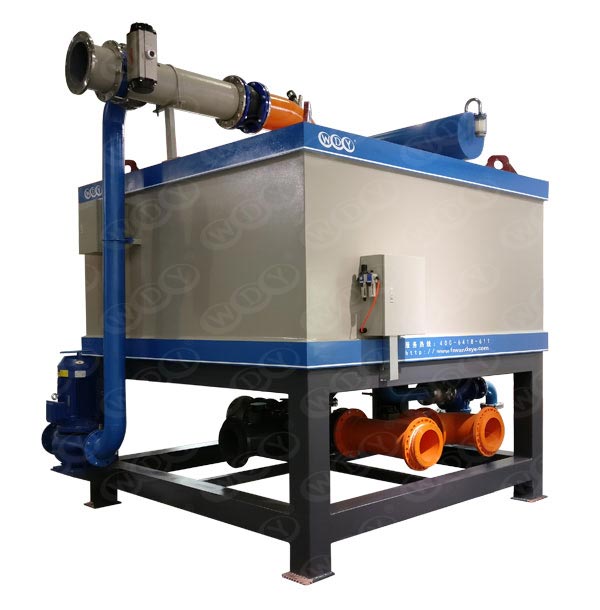
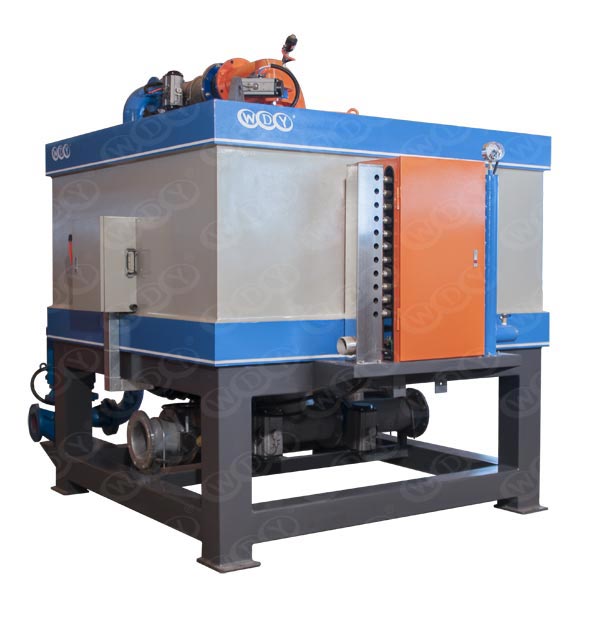
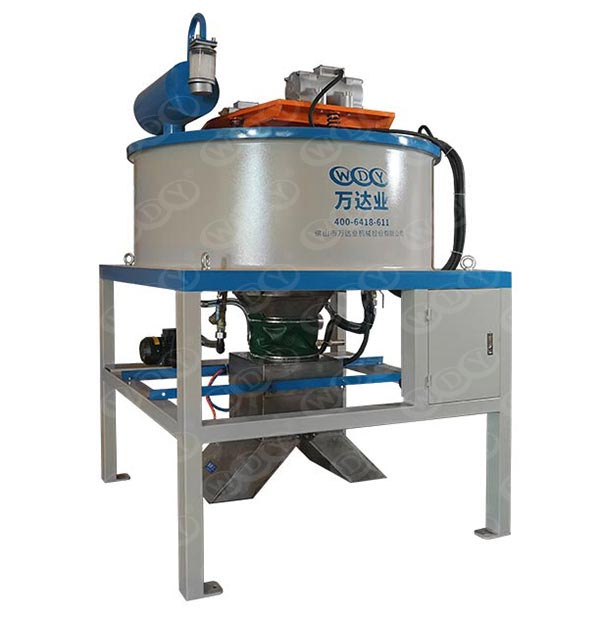
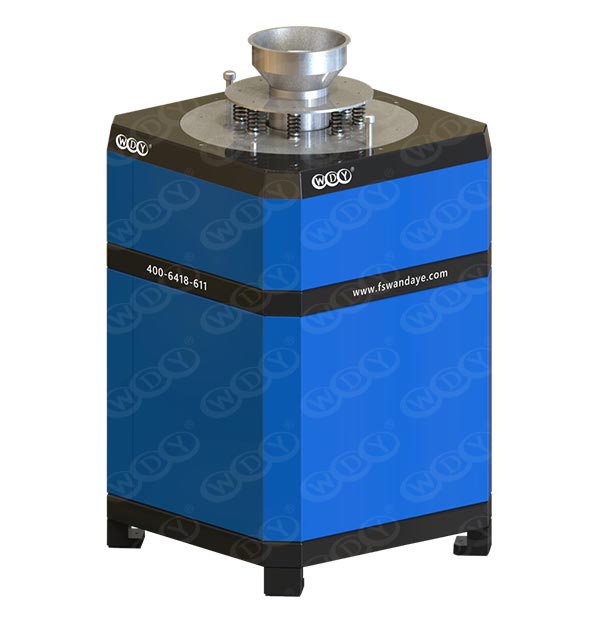
While the classic Bunting designs remain fundamental, today’s plants increasingly rely on powder magnetic separators, permanent magnetic separators, and high‑gradient vertical ring systems tailored to specific industries. [fswandaye]
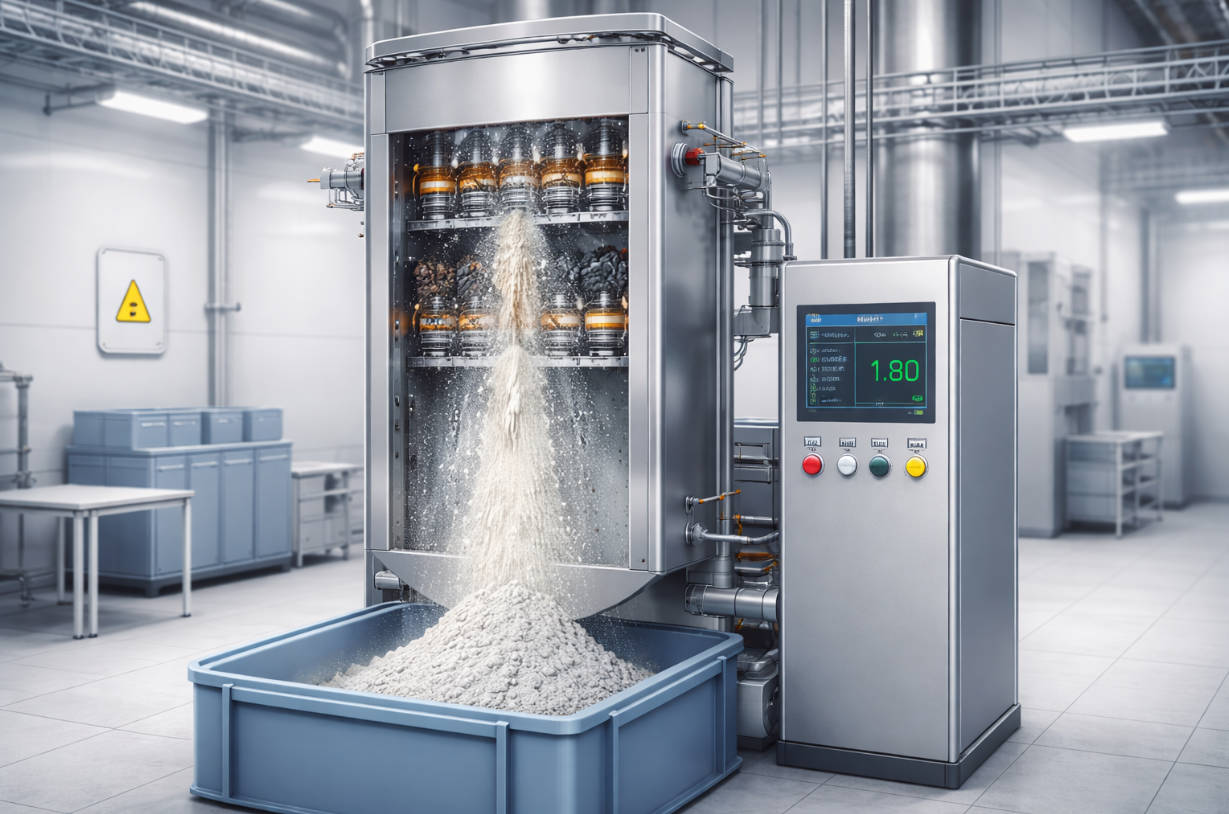
From our experience at Foshan Wandaye, the most common project types include: [linkedin]
– Non‑metallic minerals: Quartz, kaolin, potassium‑sodium feldspar, and other ceramic minerals requiring ultra‑low iron for high‑end tiles, sanitaryware, and glass. [linkedin]
– Battery materials: Cathode/anode powders where trace iron can trigger micro‑shorts or reduce cycle life. [wdymagnetic]
– Food, pharma, and plastics: Powder and slurry lines where metal contamination is a safety and brand‑risk issue. [linkedin]
Our portfolio spans: [wdymagnetic]
– Electromagnetic dried‑powder separators with multi‑pole, large‑angle magnetic regions for intensive iron removal from fine powders.
– Permanent powder magnetic separators for low‑maintenance, continuous duty in dry powder processing.
– Vertical ring high‑gradient magnetic separators for fine, weakly magnetic minerals in slurry form.
– Belt conveyor‑type magnetic separators and large pulley magnets for front‑end tramp iron removal and crusher protection.
Because we integrate R&D, engineering design, whole‑line installation, and commissioning, we can tune the separator configuration to the customer’s complete flowsheet rather than selling a standalone machine. This “process‑first” approach is particularly important in complex plants where magnetic separation must work alongside crushing, grinding, flotation, and filtration. [linkedin]
Step‑By‑Step: How to Select the Right Magnetic Separator
From an engineer’s point of view, separator selection is less about catalog models and more about matching physics to your feed. Here is a practical framework we use in project work. [buntingmagnetics]
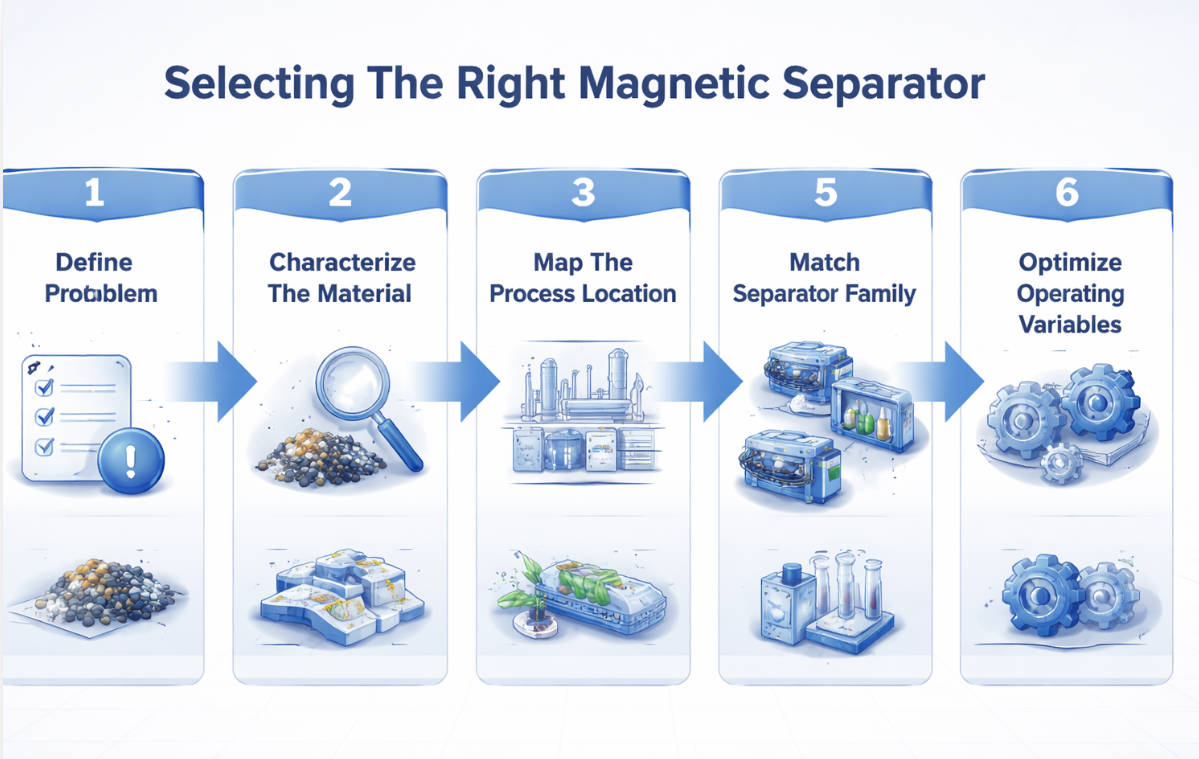
1. Define the problem clearly
– What needs to be removed or recovered (tramp iron, weakly magnetic impurities, or valuable magnetic ore)?
– What purity and recovery targets must you achieve (e.g. <100 ppm Fe, 98% magnetic recovery)?
2. Characterize the material
– Particle size distribution (e.g. −15 mm, +45 µm for dry mineral separation).
– Mineralogical composition and magnetic properties (ferromagnetic vs paramagnetic vs diamagnetic).
– Bulk density, moisture, and temperature, which affect feeding and separation stability. [linkedin]
3. Map the process location
– Is this a front‑end protection duty (over‑belt, pulley magnets)?
– A mid‑stream beneficiation duty (RER, IMR, vertical ring HGMS)?
– Or a final polishing step to meet ultra‑low iron specs (high‑gradient powder separator)? [linkedin]
4. Match separator family to duty
– Coarse tramp iron, high load: Over‑band or belt conveyor‑type permanent separators. [futuremarketinsights]
– Dry, fine paramagnetic impurities: RER, IMR, or MDS with calibrated field strengths. [buntingmagnetics]
– Slurry‑phase, weakly magnetic minerals: Vertical ring high‑gradient or slurry electromagnetic separators. [imt-inc]
5. Pilot testing and laboratory trials
– Use lab‑scale versions of industrial separators to generate performance curves and scale‑up data.
– Combine with XRF/XRD to understand mineral associations and design liberation strategies.
6. Optimize operational variables
– Adjust field strength, roll or ring speed, splitter positions, and feed rate to balance grade vs recovery.
– In advanced systems, link sensors and control logic so separators self‑adjust based on real‑time feed analysis. [futuremarketinsights]
Where to insert visuals:
– Flowchart illustrating the six‑step selection process, from feed characterization to optimization.
Real‑World Application Examples Across Industries
Based on our projects and published industry case experience, modern magnetic separation delivers measurable gains in multiple sectors. [imt-inc]
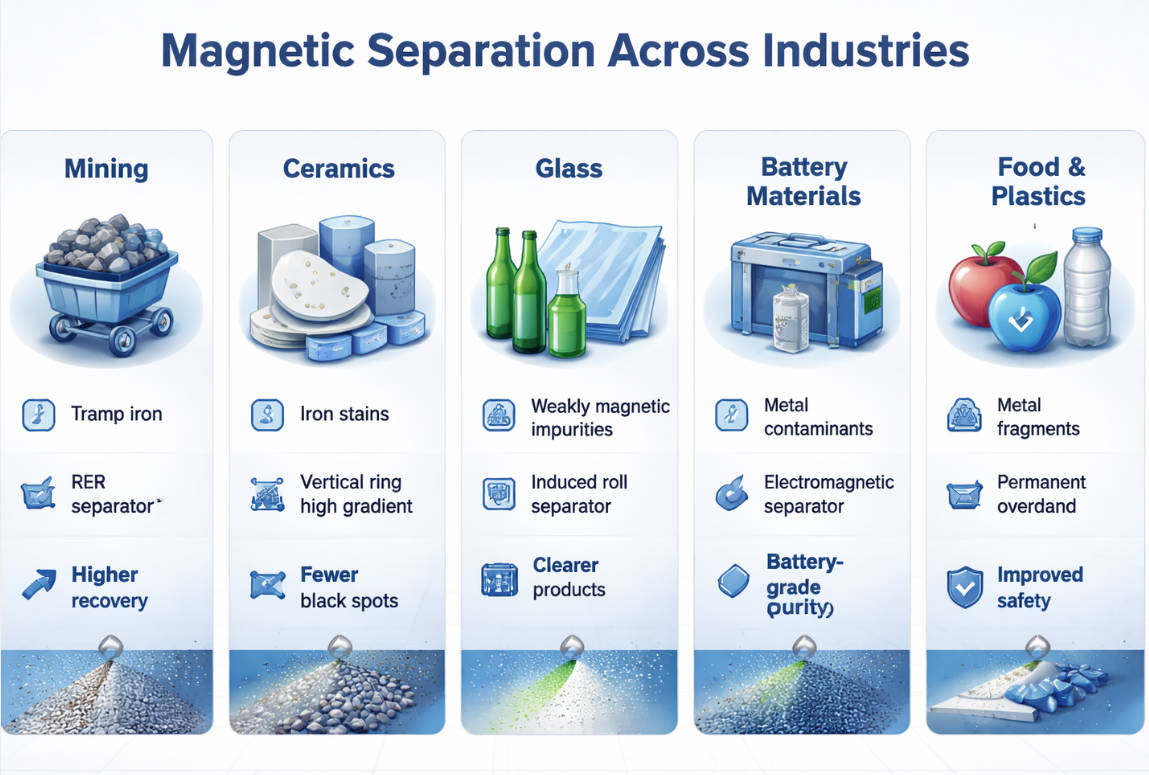
– Quartz and glass sand
– Use high‑intensity RER or vertical ring separators to reduce iron minerals, achieving glass‑grade or solar‑grade purity. [linkedin]
– Typical benefits: higher transparency, fewer defects, improved furnace performance.
– Ceramics and tiles
– Powder and slurry separators remove iron from kaolin, feldspar, and ceramic body slips, cutting black spots and surface defects. [linkedin]
– Outcome: fewer rejected tiles, more stable kiln operations, stronger premium‑grade yield.
– Mining and mineral beneficiation
– Wet drum separators recover magnetite or ferrosilicon in dense media circuits; high‑intensity units upgrade hematite and ilmenite. [imt-inc]
– Gains: improved overall recovery, reduced tailings volume, extended mine life. [grandviewresearch]
– Battery materials (cathode/anode)
– High‑gradient powder separators and permanent magnetic filters reduce iron contamination in NCM, LFP, and graphite materials. [wdymagnetic]
– Effects: lower internal short risk, better cycle life, and fewer downstream line stops during calendering and winding.
– Food, pharma, rubber, and plastics
– Permanent magnetic tubes, grids, and conveyor separators capture ferrous fragments before they reach the consumer or damage extruders. [wdymagnetic]
– Benefits: enhanced safety compliance, less unplanned downtime, and stronger brand protection.
Key Design and Operating Variables That Drive Performance
Even the most advanced magnetic separator will underperform if feed and operating variables are not managed carefully. In our commissioning experience, the following factors consistently separate “average” from “world‑class” magnetic separation lines. [linkedin]
– Particle size control
– Keep a tight size range when possible; broad distributions complicate separation and reduce selectivity.
– Liberation and cleanliness
– Ensure target minerals are liberated via appropriate grinding, and remove agglomerates or dust that affect bed stability.
– Layer thickness and feeding
– Maintain a uniform, monolayer feed on rolls and discs; avoid surging or starving conditions.
– Magnetic field strength and gradient
– Use just enough intensity to meet targets; excessive intensity may increase middlings and energy use without added value.
– Maintenance and inspection
– Regularly inspect belts, rolls, and magnetic surfaces, and monitor for magnet degradation or coil issues. [linkedin]
– In permanent systems, clean captured iron frequently to avoid magnetic “shielding” effects. [linkedin]
Increasingly, plants pair these fundamentals with IoT and AI‑driven control: smart separators adjust field strength, speed, and splitter positions based on sensor feedback, reducing operating costs by roughly 15–20% and pushing efficiencies above 98% under ideal conditions. [futuremarketinsights]
Powder vs Permanent Magnetic Separators: Practical Comparison
The table below summarizes how powder electromagnetic separators and permanent magnetic separators typically compare in plant use. [wdymagnetic]
Separator Types and Typical Uses
| Aspect | Powder Magnetic Separators | Permanent Magnetic Separators |
|---|---|---|
| Magnetic source | Electromagnetic coils with high field and gradient linkedin | Rare‑earth or ferrite permanent magnets futuremarketinsights |
| Best for | Fine powders, weakly magnetic impurities, ultra‑low Fe specs linkedin | Tramp iron removal, coarse or mixed materials, continuous duty futuremarketinsights |
| Industries | Quartz, feldspar, kaolin, battery materials, ceramics linkedin | Mining, aggregates, recycling, food, plastics, power plants futuremarketinsights |
| Operating cost | Higher power use, more controls but high precision imt-inc | Very low power (mostly drives), minimal complexity futuremarketinsights |
| Flexibility | Tunable field strength, often PLC‑controlled linkedin | Fixed field strength, some adjustability via gap/position linkedin |
| Typical duty | Final polishing and beneficiation steps linkedin | Front‑end protection and bulk clean‑up futuremarketinsights |
Where to insert visuals:
– High‑resolution photos or 3D renders of a powder electromagnetic separator and a permanent over‑belt separator side‑by‑side.
How Foshan Wandaye Supports Complete Line Engineering
One of the strongest levers for plant performance is partnering with a supplier who can deliver end‑to‑end engineering, not just hardware. Foshan Wandaye acts as a specialized magnetic separation partner, integrating: [wdymagnetic]
– Mineral processing experiments and mineral analysis to quantify separation potential.
– Full process design, including flowsheet development and equipment matching.
– Production line installation, commissioning, and after‑sales optimization.
Over the past decade, our teams have delivered more than 100 turnkey magnetic separation projects covering kaolin, potassium‑sodium feldspar, quartz sand, and other challenging industrial minerals. Our engineers frequently collaborate with clients’ plant staff to redesign existing circuits, debottleneck critical stages, and introduce high‑gradient, energy‑efficient separators that align with corporate efficiency, energy‑saving, environmental protection, and intelligence goals. [linkedin]
If you are considering a new mineral processing project or an upgrade to existing lines, integrating magnetic separation early in the flowsheet design typically yields the highest ROI and avoids costly retrofits later. [linkedin]
Call to Action: Plan Your Next Magnetic Separation Upgrade
If your mining, ceramics, glass, or battery material operation is fighting iron contamination, low recovery, or unstable quality, you are likely leaving money on the table. A structured magnetic separation assessment can reveal quick wins—often within the existing footprint—and lay the roadmap for deeper process improvements. [wdymagnetic]
You can:
– Share a sample and process data for a laboratory‑scale separation study. [linkedin]
– Request a whole‑line engineering proposal, from feed characterization to commissioning. [wdymagnetic]
– Discuss powder or permanent magnetic separator upgrades tailored to your product and market requirements. [linkedin]
To explore what a modern magnetic separation solution could deliver for your plant, contact Foshan Wandaye Technology Co., Ltd. via our website inquiry form or sales team for a detailed technical consultation. [wdymagnetic]
Frequently Asked Questions
1. How do I know if my mineral is suitable for magnetic separation?
Most ores contain at least some ferromagnetic or paramagnetic components such as magnetite, hematite, ilmenite, or chromite, which respond well to magnetic fields. Laboratory testing with small‑scale separators and mineralogical analysis (XRF/XRD) is the most reliable way to determine if magnetic separation will deliver economic benefits. [buntingmagnetics]
2. What’s the main difference between powder magnetic separators and permanent magnetic separators?
Powder magnetic separators rely on electromagnets to generate strong, high‑gradient fields, making them ideal for removing weakly magnetic contaminants from fine powders at very low residual iron levels. Permanent magnetic separators use fixed magnet blocks, are simpler and more energy‑efficient, and are best suited for removing tramp iron and strongly magnetic particles in bulk material streams. [imt-inc]
3. Can magnetic separators help me meet stricter environmental or ESG requirements?
Yes. By boosting magnetic mineral recovery and reducing iron‑bearing impurities in tailings, magnetic separation can cut waste volumes and improve water quality, supporting environmental compliance. In addition, modern systems with rare‑earth magnets and optimized circuits reduce energy consumption per tonne processed, aligning with ESG and decarbonization strategies. [globenewswire]
4. How important is pilot testing before buying equipment?
Pilot and laboratory testing are critical if you are targeting demanding purity or recovery goals or dealing with complex multi‑mineral feeds. Tests using lab‑scale RER, IMR, disc, or high‑gradient separators provide reliable data to size industrial equipment and justify the investment with quantified performance guarantees. [linkedin]
5. What information should I prepare before consulting a magnetic separator supplier?
To accelerate design work, prepare details on your feed material (size distribution, mineralogy, moisture, temperature), current process flowsheet, target product specifications, and any quality or downtime issues you are facing. Sharing throughput targets and future expansion plans also helps engineers design a scalable, future‑proof magnetic separation solution. [wdymagnetic]
References
1. Bunting Magnetics, “Magnetic Separators for Mineral Processing.”
<https://buntingmagnetics.com/blog/magnetic-separators-for-mineral-processing>
2. Bunting Magnetics, “Magnetic Separation in Mining and Mineral Processing.”
<https://buntingmagnetics.com/blog/magnetic-separation-in-mining-and-mineral-processing> [buntingmagnetics]
3. Foshan Wandaye Technology Co., Ltd., “Magnetic Separator Machine Manufacturer & Supplier in China | Wandaye Magnetics.”
<https://www.wdymagnetic.com> [wdymagnetic]
4. Foshan Wandaye Technology Co., Ltd., Chinese‑language product and company profile.
<http://www.fswandaye.com> [fswandaye]
5. Future Market Insights, “Global Magnetic Separator Market – Industry Analysis to 2036.”
<https://www.futuremarketinsights.com/reports/global-magnetic-separator-market> [futuremarketinsights]
6. Research and Markets, “Magnetic Separator Market Report 2026.”
<https://www.researchandmarkets.com/reports/6075450/magnetic-separator-market-report> [researchandmarkets]
7. IMT, “Wet Drum Magnetic Separators Explained.”
<https://www.imt-inc.com/wet-drum-magnetic-separators-explained/> [imt-inc]
8. Grand View Research, “Magnetic Separation in Mining Market Report.”
<https://www.grandviewresearch.com/industry-analysis/magnetic-separation-mining-market-report> [grandviewresearch]
9. Foshan Wandaye Technology Co., Ltd., “Magnetic Separation in Modern Mining and Mineral Processing: An Expert’s Perspective.”
<https://www.wdymagnetic.com/magnetic-separation-in-modern-mining-and-mineral-processing-an-experts-perspective.html/> [wdymagnetic]
10. LinkedIn, “Permanent Magnetic Separator Market: Global Market Trends and Forecast.”
<https://www.linkedin.com/pulse/permanent-magnetic-separator-market-global-trends-forecast-p1zqe> [linkedin]
Hot Tags: Magnetic Separation in Mineral Processing, Manufacturers, Customized, Custom, Suppliers, Buy, Cheap, Quality, Advanced, Durable, in Stock, Made in China, Price, Quotation