


Content Menu
● What Are Axial and Radial Magnetic Fields?
● Why Field Geometry Matters in Real Applications
● Axial Magnetic Fields: Maximizing Product Purity
>> Typical Axial Field Use Cases
● Radial Magnetic Fields: Maximizing Metal Recovery
>> Typical Radial Field Use Cases
● Axial vs Radial: Side‑by‑Side Comparison
● How Powder Magnetic Separators Use These Fields
● Permanent Magnetic Separators: Design and Market Trends
● How to Choose Axial vs Radial for Your Line
● Real‑World Application Scenarios
>> 1. Ceramic Powder Production
>> 2. Battery Cathode and Anode Materials
● Design Considerations for High‑Performance Magnetic Systems
● Call to Action: Get an Application‑Specific Field Design
● FAQs About Axial and Radial Magnetic Fields
>> 1. How do I quickly tell if a separator uses an axial or radial field?
>> 2. Can I use both axial and radial fields in the same production line?
>> 3. Are permanent magnetic separators strong enough for ultrafine powders?
>> 4. How often should I clean a powder magnetic separator?
>> 5. What information should I prepare before consulting a separator manufacturer?
In my work with powder magnetic separators and permanent magnetic separators, the choice between an axial and a radial magnetic field is one of the most misunderstood – but most profitable – decisions an engineer can make. This guide explains these field types from a practical, plant‑floor perspective and shows how a specialist manufacturer like Foshan Wandaye Technology Co., Ltd. applies them across powders, slurries and high‑purity production lines. [buntingmagnetics]
What Are Axial and Radial Magnetic Fields?
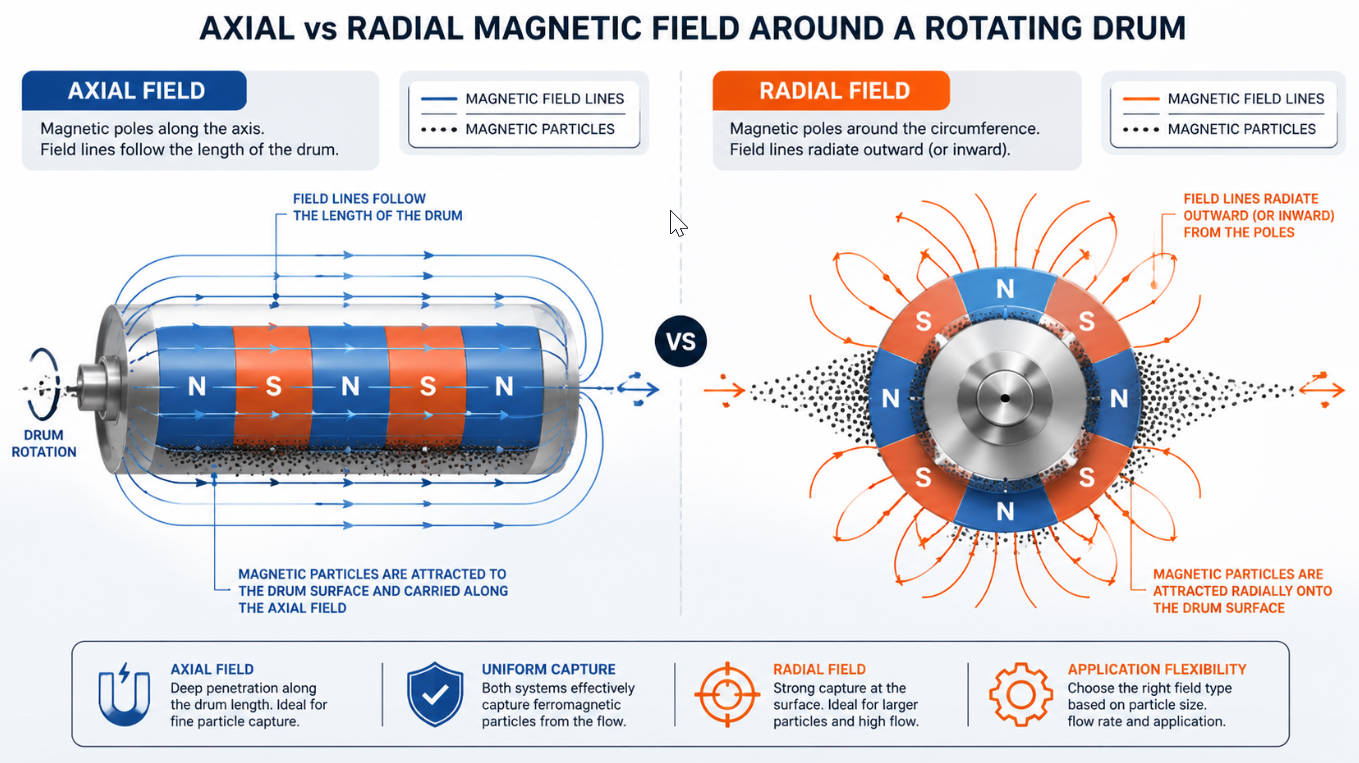
In a rotary drum or roll‑type magnetic separator, “axial” and “radial” describe how magnetic poles are arranged around the rotor and how the field lines interact with material. [buntingmagnetics]
– In an axial magnetic field, the poles run parallel to the direction of rotation, so material experiences a tumbling effect as it passes the magnetic zone. [buntingmagnetics]
– In a radial magnetic field, poles are arranged around the circumference, creating a strong radial pull with longer retention of magnetic particles on the surface. [recyclingproductnews]
The practical result is simple: axial favors purity, radial favors maximum recovery. [recyclingproductnews]
Why Field Geometry Matters in Real Applications
From a user’s perspective, field geometry is not an academic detail; it directly affects yield, purity, energy use and maintenance. [archivemarketresearch]
When I audit existing lines, most performance problems fall into one of three categories:
– The wrong field type for the process objective (purity vs recovery).
– The right field type but incorrect gap, speed or bed depth.
– A mismatch between magnet strength, particle size and bulk density. [archivemarketresearch]
Choosing axial or radial correctly often delivers double‑digit improvements in either recovered metal or product cleanliness, without changing the rest of the line. [recyclingproductnews]
Axial Magnetic Fields: Maximizing Product Purity
How an Axial Field Behaves
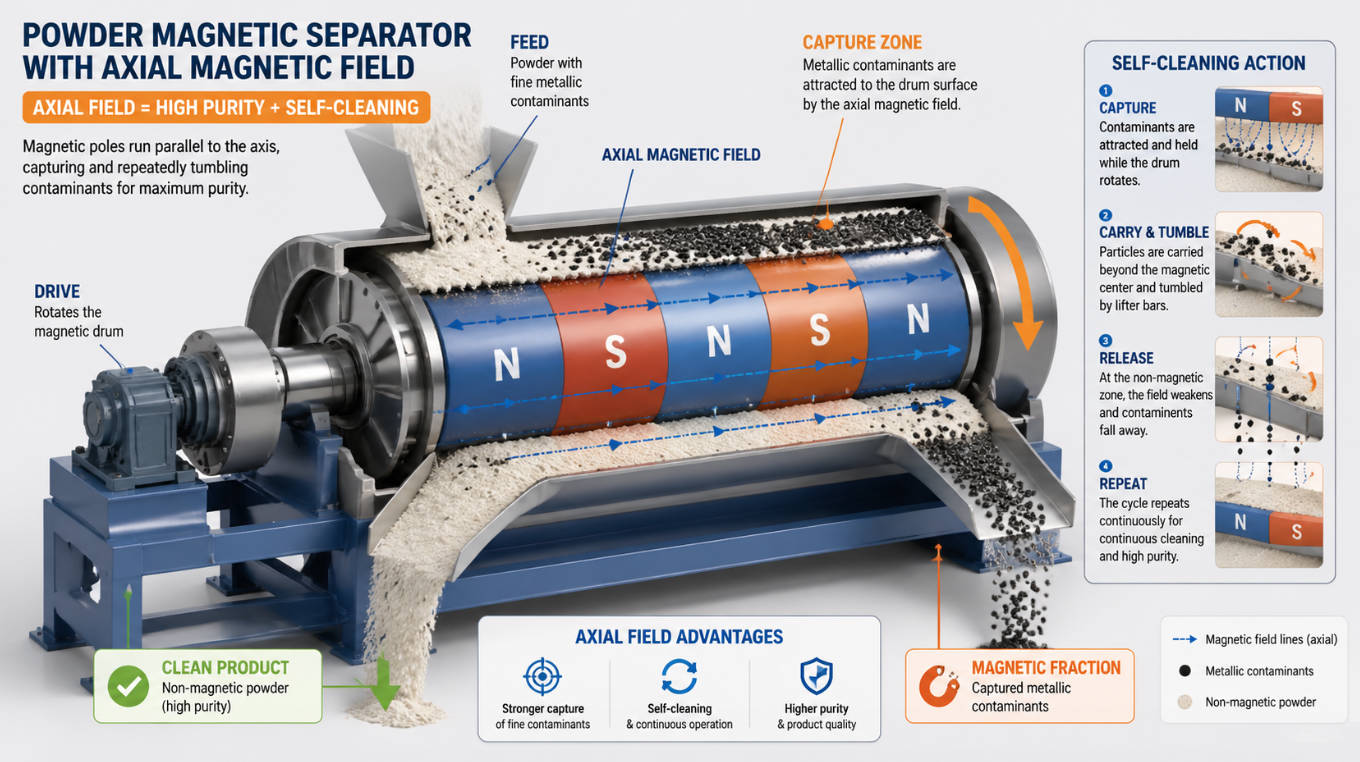
In an axial design, ferrous particles are captured and then repeatedly lifted and dropped as the drum or roll rotates, because the poles are aligned along the axis. This creates a self‑cleaning, tumbling action that helps release non‑magnetic material trapped between magnetic particles. [buntingmagnetics]
Key characteristics of axial fields: [buntingmagnetics]
– High purity of recovered ferrous fraction.
– Slightly lower total recovery of ferrous metal.
– Excellent when entrainment of non‑magnetics is a major quality risk.
Typical Axial Field Use Cases
You will usually choose an axial field when purity is more valuable than volume:
– Auto recycling: maximising resale value of shredded ferrous scrap. [buntingmagnetics]
– High‑grade steel recovery from mixed metal streams.
– Food and pharmaceutical powder polishing, where tiny non‑magnetic inclusions trapped in a ferrous cluster can still cause a rejection or safety incident. [archivemarketresearch]
In fine powder applications, axial fields are particularly effective when combined with multi‑stage rare‑earth permanent magnets, ensuring each pass reduces residual contamination to ppm level ranges. [archivemarketresearch]
Radial Magnetic Fields: Maximizing Metal Recovery
How a Radial Field Behaves
In a radial design, magnetic poles alternate around the circumference of the drum or roll. The field lines extend radially from the surface, gripping magnetic particles strongly and holding them longer as the rotor turns. [buntingmagnetics]
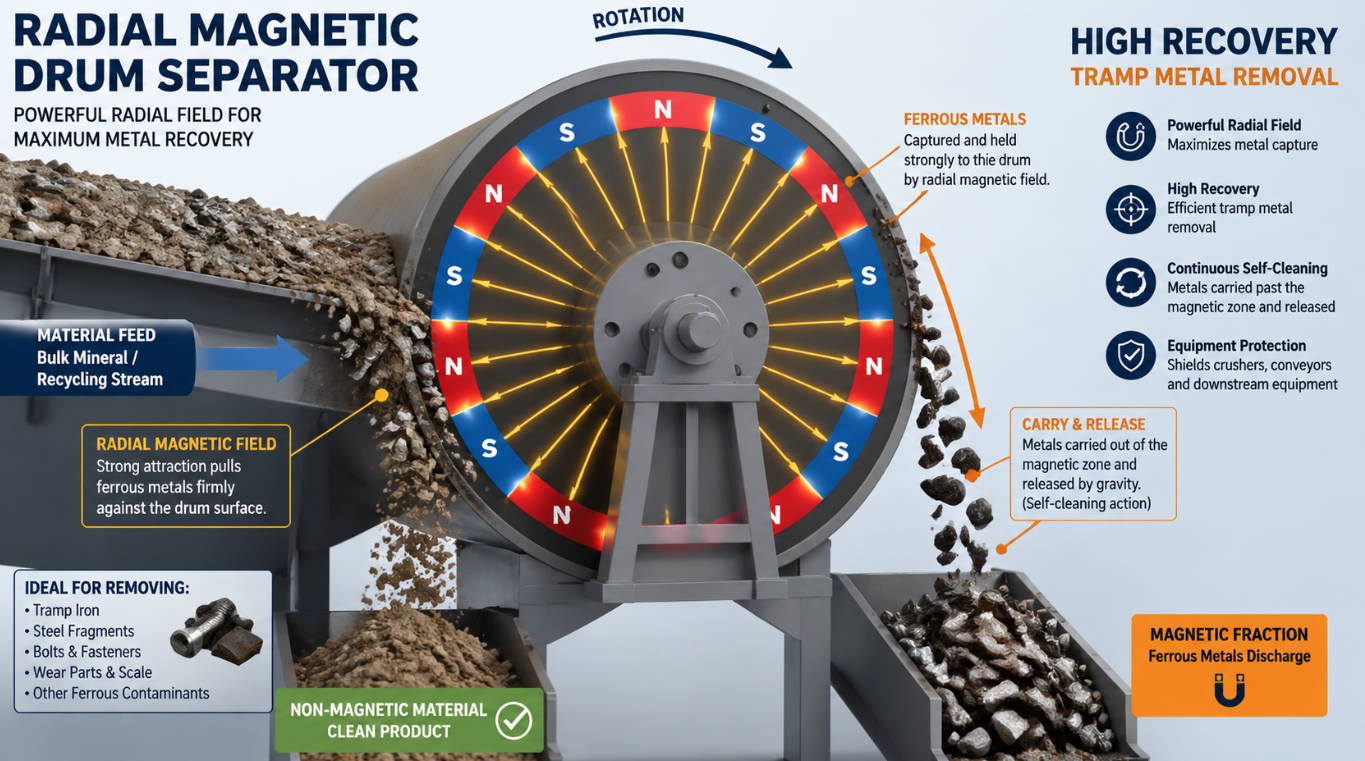
Key characteristics of radial fields: [recyclingproductnews]
– High recovery of magnetic metal from the burden.
– Greater risk of non‑magnetic entrapment in the magnetic fraction.
– Excellent for protecting downstream equipment and removing tramp metal.
Typical Radial Field Use Cases
You will usually choose a radial field when every gram of metal counts, or when tramp metal is a critical hazard:
– Mineral processing lines removing ferrous tramp from ores and concentrates. [recyclingproductnews]
– Glass, ceramics, and construction materials where steel fragments could damage kilns, crushers, mills or screw conveyors. [tymagnets]
– Waste and biomass fuel preparation where removing nails and bolts protects shredders and boilers. [recyclingproductnews]
In these lines, operators accept slightly lower product purity in the magnetic fraction because the main objective is to clean the product stream, not to sell the metal itself. [recyclingproductnews]
Axial vs Radial: Side‑by‑Side Comparison
Below is a practical comparison engineers often ask for during project discussions.
| Dimension | Axial Magnetic Field | Radial Magnetic Field |
|---|---|---|
| Primary objective | Maximize purity of recovered ferrous metal buntingmagnetics | Maximize recovery of magnetic metal buntingmagnetics |
| Typical applications | Auto scrap, high‑value metals, powder polishing recyclingproductnews | Minerals, tramp removal, bulk raw materials recyclingproductnews |
| Particle behavior | Tumbling, repeated capture and release buntingmagnetics | Strong radial hold, longer retention buntingmagnetics |
| Risk of non‑mag entrapment | Lower, better self‑cleaning buntingmagnetics | Higher, can reduce recovered metal purity recyclingproductnews |
| Ferrous recovery rate | Slightly lower overall recovery buntingmagnetics | Higher recovery, especially on coarse streams recyclingproductnews |
| Best for powders | High‑purity final product, fine powders archivemarketresearch | High‑throughput pre‑cleaning and tramp removal tymagnets |
How Powder Magnetic Separators Use These Fields
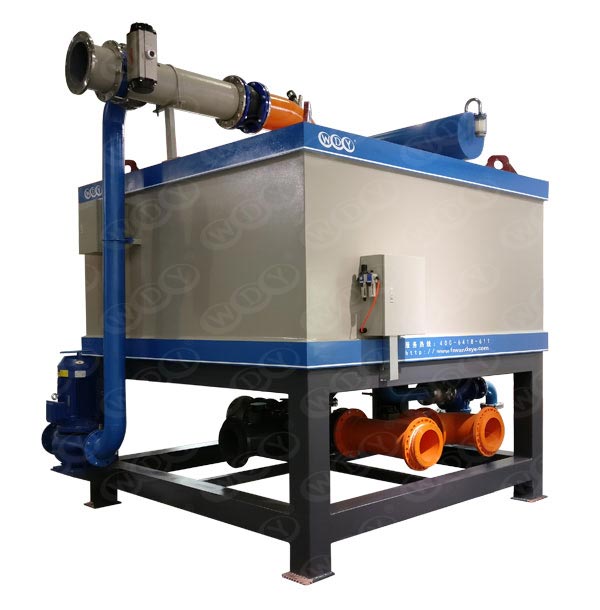
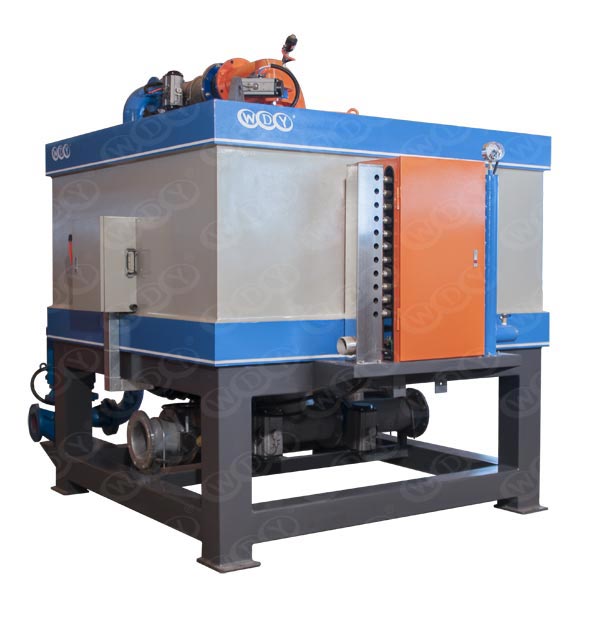
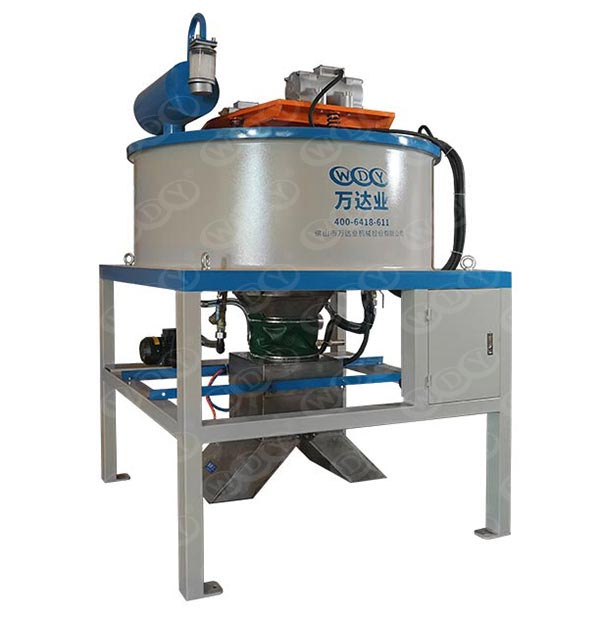
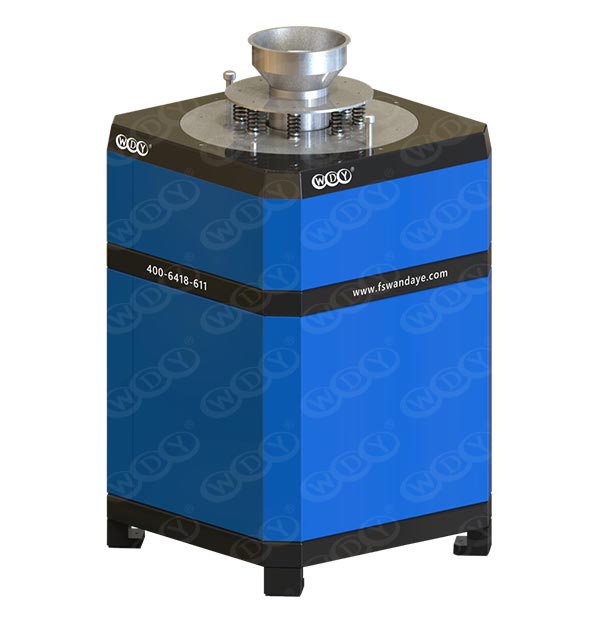
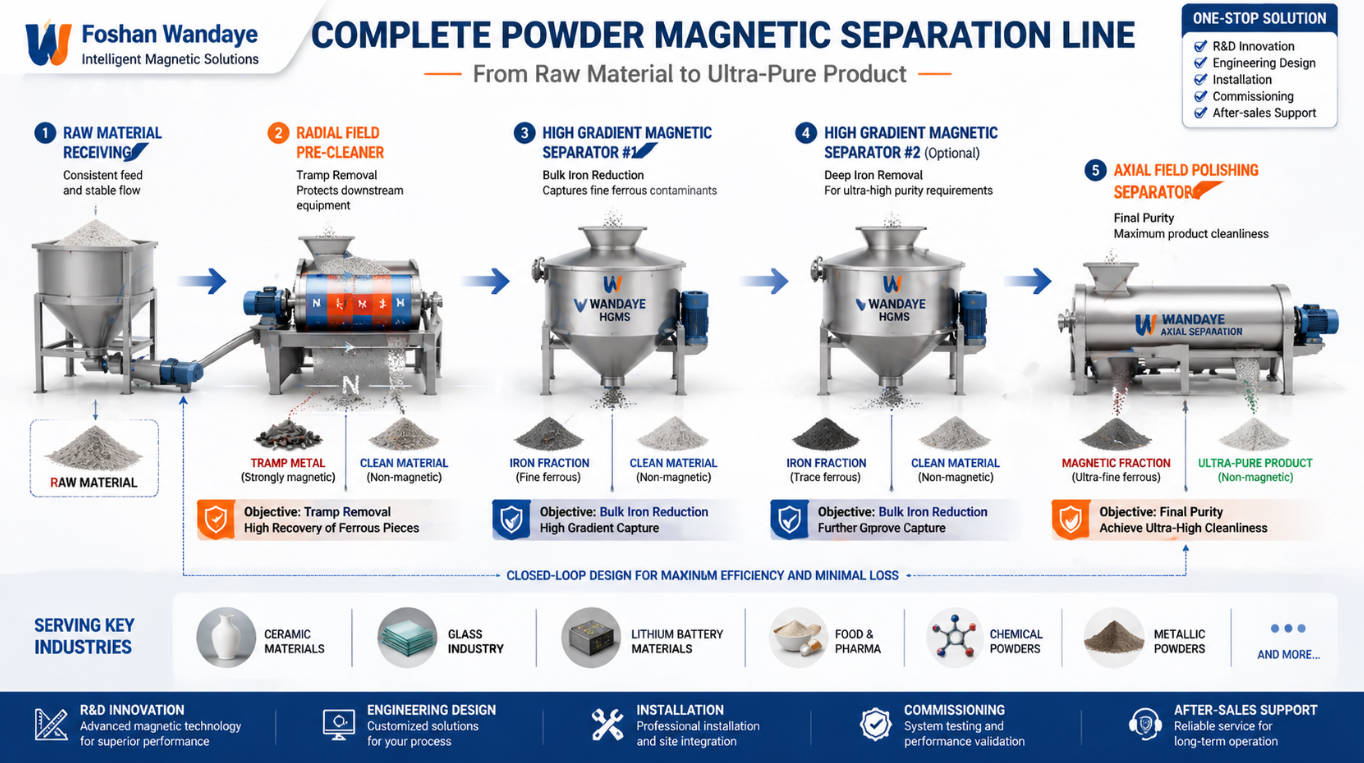
Foshan Wandaye specializes in powder magnetic separators that operate on non‑metallic powders such as ceramics, glass frits, plastics, and battery materials. In these processes, even a small amount of iron or stainless steel contamination can cause surface defects, color shifts, or electrical performance issues. [youtube]
In powder systems, we typically:
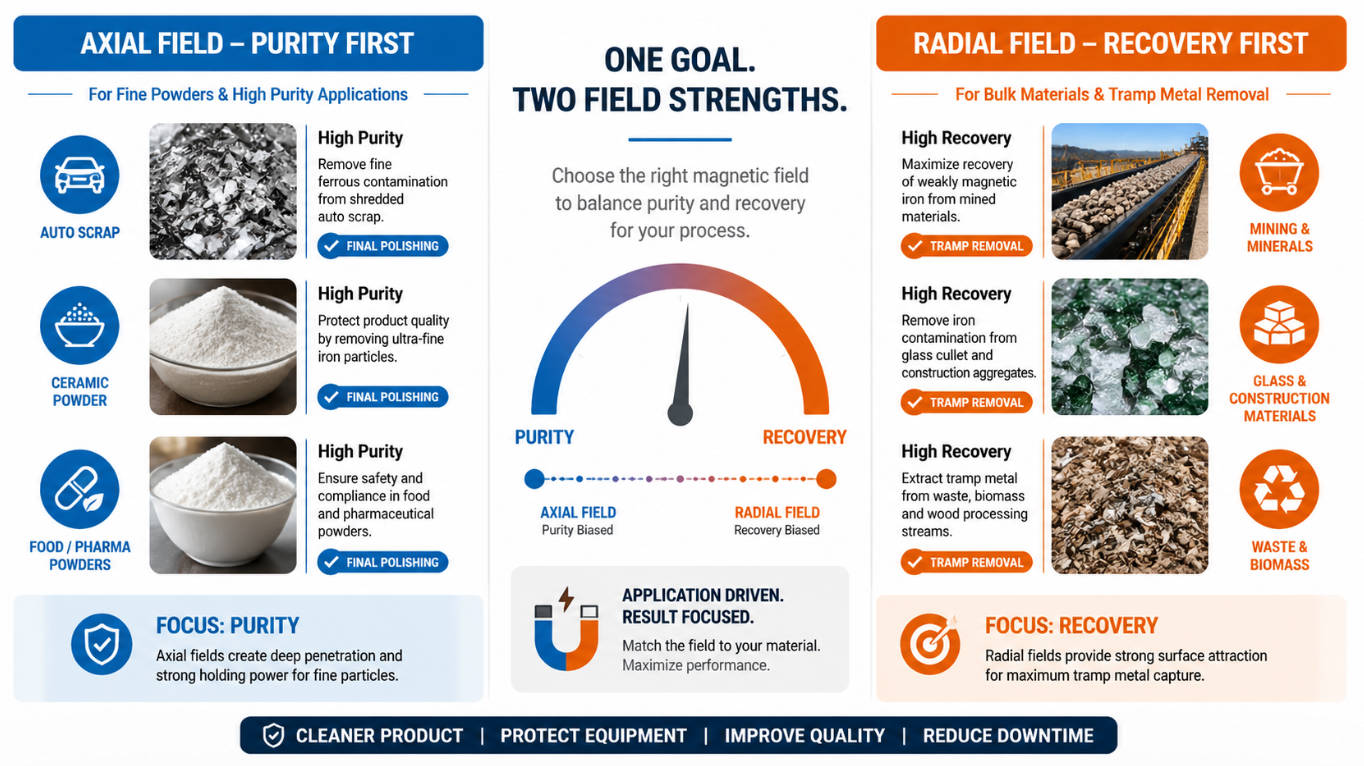
– Use axial fields in the final polishing stages where ppm‑level iron content targets must be achieved.
– Use radial or hybrid fields in upstream stages for high‑throughput pre‑cleaning, where the main goal is to reduce the bulk of ferrous contaminants before fine polishing. [wdymagnetic]
Permanent magnet systems are preferred because they offer stable field strength, low operating cost and minimal maintenance, especially when rare‑earth materials are used. [linkedin]
Permanent Magnetic Separators: Design and Market Trends
Industry data show that permanent magnet concentrators and separators are a growth market, driven by demand for higher purity and lower energy use. Modern designs rely on strong, durable rare‑earth magnets and smart mechanical layouts to maintain performance over long service lives. [lenoir-mec]
Key trends shaping design choices today include:
– Higher field intensity and gradients to handle ultrafine powders and slurries, particularly in battery, ceramics, and electronic materials. [linkedin]
– Integration with automation and sensor‑based controls, enabling real‑time adjustment of rotor speed, feed rate and splitter position for optimal separation. [linkedin]
– Adoption of Industry 4.0 features such as predictive maintenance and remote monitoring to reduce unplanned downtime. [lenoir-mec]
These trends make it increasingly important to select field geometry as part of a complete system design, not as a stand‑alone parameter.
How to Choose Axial vs Radial for Your Line
When I help a plant engineer choose between axial and radial, we follow a simple but rigorous framework:
1. Define your primary KPI
– If your most important metric is product purity (e.g., ppm of Fe in a ceramic powder), start by assuming an axial field at the final stage.
– If your priority is maximum metal recovery or equipment protection, start with a radial field. [archivemarketresearch]
2. Map the process stages
– Use radial fields in early stages for heavy clean‑up and tramp removal.
– Use axial fields closer to final product discharge for polishing. [tymagnets]
3. Check particle size and bulk density
– Fine powders and slurries benefit from high‑gradient permanent magnets with carefully controlled gap and flow channels.
– Coarser fractions tolerate more aggressive radial fields without excessive entrapment. [tymagnets]
4. Evaluate risk and cost of contamination
– In pharma and food, a single contaminated batch can cost more than an entire separator project, so axial, multi‑stage designs are justified. [archivemarketresearch]
– In mining, product purity thresholds are higher, so radial designs often deliver the best return on investment. [archivemarketresearch]
5. Plan for future performance
– Allow flexibility to adjust rotor speed, splitter position and feed rate as ore grade or raw material quality changes over time. [linkedin]
– Consider modular designs so axial and radial stages can be re‑configured as new products are added to the line. [wdymagnetic]
Real‑World Application Scenarios
1. Ceramic Powder Production
In a ceramic tile or sanitaryware plant, black specks from iron contamination create visible defects on glazed surfaces. A typical high‑performance scheme might be: [tymagnets]
– Upstream radial separator to remove coarse ferrous tramp from incoming minerals.
– Mid‑stream permanent magnetic separator with higher gradient to clean milled slurry.
– Final axial powder magnetic separator on spray‑dried granules, focusing on ultimate product whiteness and defect‑free surfaces. [wdymagnetic]
2. Battery Cathode and Anode Materials
For lithium battery plants, trace metallic contamination can cause safety issues and shortened cycle life. High‑intensity permanent magnetic separators with carefully engineered field geometry are used on: [archivemarketresearch]
– NMC, LFP or LNMO cathode powders.
– Graphite or silicon‑based anode materials.
Here, axial fields in the final stages help ensure extremely low particle entrapment and stable performance over long production runs. [wdymagnetic]
Design Considerations for High‑Performance Magnetic Systems
When specifying or upgrading a powder or permanent magnetic separator, field type is only one variable. To get the full benefit, engineers should also optimize:
– Magnet material and intensity: Rare‑earth magnets deliver strong, stable fields for fine particles and slurries. [lenoir-mec]
– Pole pitch and pattern: Pole spacing affects how strongly particles are attracted and how they move along the separator surface. [buntingmagnetics]
– Mechanical configuration: Feed chutes, vibratory dosing, splitter blades and housing design all influence performance, especially with light, dusty powders. [tymagnets]
– Cleaning and maintenance mechanisms: Automatic cleaning, quick‑open housings and safety interlocks are crucial for food, pharma and fine chemical applications. [wdymagnetic]
Specialist manufacturers like Foshan Wandaye combine these factors into complete systems that cover R&D, engineering design, line installation and commissioning across multiple industries. [youtube]
Call to Action: Get an Application‑Specific Field Design
If you are planning a new line or upgrading an existing one, the most effective next step is a process‑specific assessment. Share your material data (particle size, bulk density, target Fe level, capacity) and current challenges, and a specialist team can:
– Model whether axial, radial or hybrid field configurations best fit your goals.
– Recommend powder magnetic separator or permanent magnetic separator designs tuned to your process.
– Provide pilot testing or on‑site trials to validate expected gains in purity and recovery. [tymagnets]
This reduces guesswork and ensures your investment in magnetic separation produces measurable, plant‑wide benefits.
FAQs About Axial and Radial Magnetic Fields
1. How do I quickly tell if a separator uses an axial or radial field?
Check the orientation of the poles in the design documentation or technical drawing: if they run along the axis of rotation, it is axial; if they alternate around the circumference, it is radial. In many cases, the supplier can confirm the field pattern from the product code or nameplate. [buntingmagnetics]
2. Can I use both axial and radial fields in the same production line?
Yes, many high‑performance lines use radial fields for coarse pre‑cleaning and axial fields for final polishing stages. Combining both often delivers higher overall recovery and better end‑product purity than using only one field type. [wdymagnetic]
3. Are permanent magnetic separators strong enough for ultrafine powders?
Modern permanent magnetic separators using rare‑earth materials can achieve very high field strengths and gradients suitable for ultrafine powders. They also provide stable performance and low operating cost compared to electromagnets in many powder applications. [lenoir-mec]
4. How often should I clean a powder magnetic separator?
Cleaning frequency depends on contamination load, but powder lines with strict purity targets typically clean on a per‑batch or per‑shift basis. Automated cleaning mechanisms and good access design reduce downtime and help keep performance consistent. [tymagnets]
5. What information should I prepare before consulting a separator manufacturer?
Prepare data on material type, particle size distribution, bulk density, throughput, initial and target Fe levels, moisture content and process temperature. Sharing known contamination sources and existing equipment constraints also helps engineers recommend the right axial or radial configuration. [wdymagnetic]
References
1. Bunting Magnetics – “What is an Axial and a Radial Magnetic Field?” (accessed 2026).
https://buntingmagnetics.com/blog/what-is-an-axial-and-a-radial-magnetic-field [buntingmagnetics]
2. Recycling Product News – “How to tell the difference between axial and radial magnetic fields” (2020).
https://www.recyclingproductnews.com/article/34672/how-to-tell-the-difference-between-axial-and-radial-magnetic-fields [recyclingproductnews]
3. Industry analysis – “United States Dry Permanent Magnetic Separator Market Size 2026” (2025).
https://www.linkedin.com/pulse/united-states-dry-permanent-magnetic-separator-market-wgf0c [linkedin]
4. Market research – “Permanent Magnet Concentrator Strategic Insights: Analysis 2026” (2024).
https://www.archivemarketresearch.com/reports/permanent-magnet-concentrator-806286 [archivemarketresearch]
5. Foshan Wandaye Technology Co., Ltd – Product and news pages (accessed 2026).
https://www.wdymagnetic.com/news/page/3 [wdymagnetic]
6. Slurry magnetic separator working principle video – Foshan Wandaye Machinery (2018).
https://www.youtube.com/watch?v=AJU8NTtkd34 [youtube]
7. Technical overview of magnetic separators for industrial use (Chinese language resource).
https://tymagnets.com/zh-CN/磁力分离器让我们的世界更清洁 [tymagnets]
8. Electropermanent magnet guide – Lenoir-Mec (2026).
https://www.lenoir-mec.com/en/2025/12/09/electropermanent-lifting-magnet-complete-guide-2025-2/ [lenoir-mec]
Hot Tags: Diametric Magnets, Manufacturers, Customized, Custom, Suppliers, Buy, Cheap, Quality, Advanced, Durable, in Stock, Made in China, Price, Quotation