


Content Menu
● What Is a Switchable Magnet?
● The Physics Behind Switchable Magnets
● How Mechanical Switchable Magnets Work (Step‑By‑Step)
● Electro‑Permanent Magnets: On/Off Control Without Continuous Power
● Key Benefits of Switchable Magnets for Industrial Users
● Where Switchable Magnets Are Used Today
● How Switchable Magnet Concepts Improve Magnetic Separators
● Design Considerations: What Engineers Look At
● Industry Trends and New Developments
● Practical Guidelines When Choosing Switchable Magnetic Solutions
● Call To Action: Talk To a Magnetic Separation Specialist
>> FAQs
>> 1. What is the main difference between a permanent magnet and a switchable magnet?
>> 2. Are switchable magnets safe for lifting heavy steel plates?
>> 3. How does switchable magnet technology relate to magnetic separators?
>> 4. Can switchable magnets be used in high‑temperature environments?
>> 5. Which industries benefit most from switchable magnets and advanced magnetic separators?
When you work every day with magnetic separators, magnetic plates and rods, you quickly learn that switchable magnets are not just a clever trick – they are a practical tool that can make industrial processes safer, cleaner and much easier to control. As an engineer involved in designing and commissioning powder magnetic separators, permanent magnetic separators and magnetic plates at Foshan Wandaye Technology Co., Ltd., I have seen how understanding switchable magnet technology directly improves equipment performance in mining, ceramics, power, building materials, glass, environmental protection, rubber, plastics, pharmaceuticals, food and battery materials production. [hvrmagnet]
What Is a Switchable Magnet?
A switchable magnet (also called an on/off magnet or magnetic switch) is a magnetic device whose external magnetic field can be turned on or off mechanically or electrically, even though it is usually based on permanent magnets. Unlike standard permanent magnets that are always “on”, switchable magnets can hold ferromagnetic parts firmly when engaged, and then release them almost instantly when switched off. [industryupdate.com]
In industrial practice, we most often encounter switchable magnets in:
– Magnetic bases for clamping and positioning tools or workpieces. [hvrmagnet]
– Lifting magnets for plates, billets and profiles in steel fabrication. [magswitch]
– Quick‑change fixtures in welding, cutting, machining and assembly lines. [kjmagnetics]
From the perspective of a magnetic separator manufacturer, the same design logic behind switchable magnets also informs how we control magnetic circuits inside powder magnetic separators, magnetic plates, iron‑removal cabinets and magnetic rods to make cleaning easier and downtime shorter. [en.fswandaye]
The Physics Behind Switchable Magnets
At its core, any magnet is about magnetic flux – how magnetic field lines flow from a north pole to a south pole. In a switchable magnet, the “on/off” behavior is created by providing two different paths for this magnetic flux, and then using a mechanical or electrical mechanism to redirect it. [reddit]
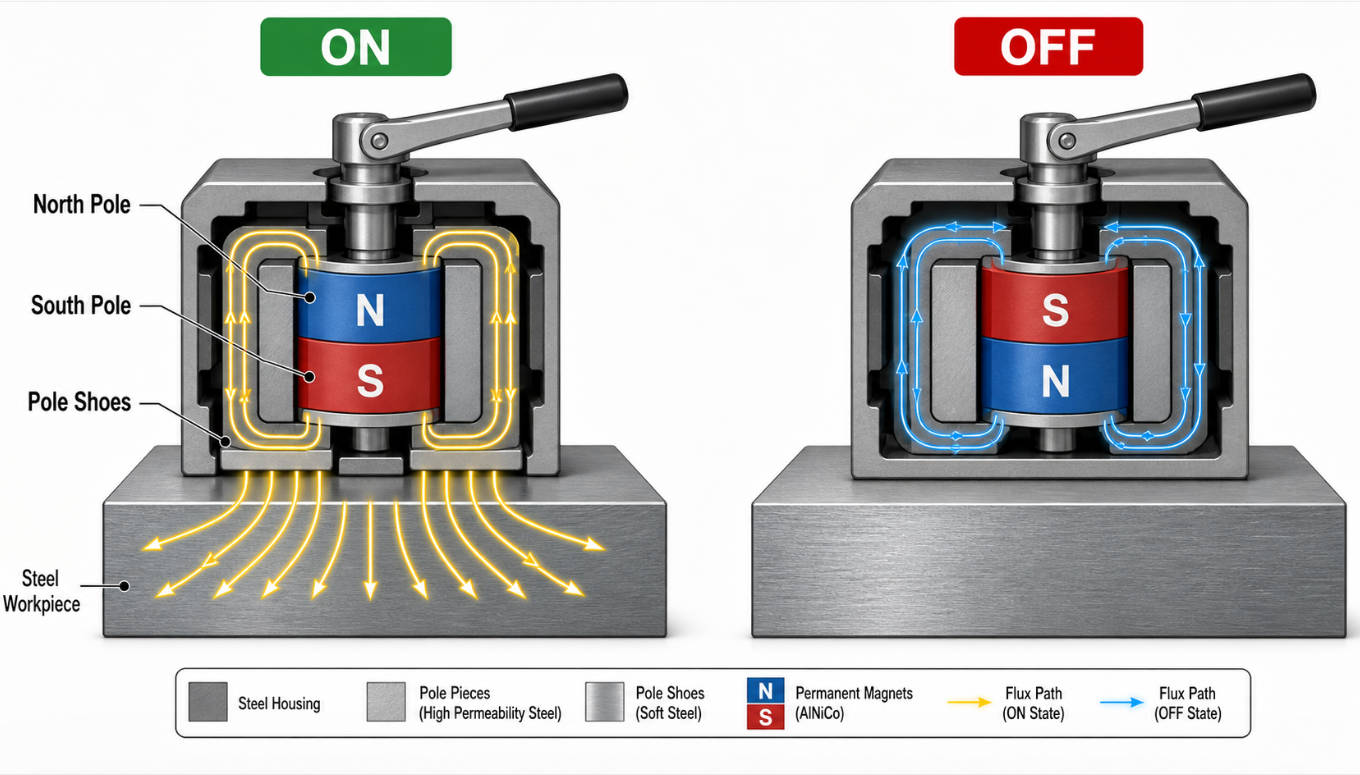
– In ON mode, the flux is forced to go out through the working face into the steel workpiece or load, creating strong holding force. [kjmagnetics]
– In OFF mode, the flux is “short‑circuited” inside the magnet housing, so very little field escapes to the outside. [reddit]
A widely used design uses two or more permanent magnets that can rotate relative to each other:
– When the magnets’ poles are aligned, their fields add together and flow through the external steel surface – the magnet is ON. [reddit]
– When they are misaligned by 180°, the flux closes inside the steel body of the device instead of leaving through the base – the magnet is OFF. [youtube]
This principle is also used in more advanced electro‑permanent magnets (EPMs), where a pulse of current magnetizes or demagnetizes a permanent magnet assembly, allowing on/off control without continuous power. [magswitch]
How Mechanical Switchable Magnets Work (Step‑By‑Step)
From the shop floor point of view, a typical mechanical switchable magnet is extremely simple to operate but very clever inside. [hvrmagnet]
1. Positioning the magnet
You place the magnet’s working face on a steel surface or close to the workpiece that needs to be held. [kjmagnetics]
2. Turning the knob or lever
A handle or knob rotates the internal magnet assembly, typically by 180°. [reddit]
3. Aligning the poles – ON state
– In the ON position, the north and south poles of the internal magnets align with the steel pole shoes at the base.
– Magnetic flux flows out of one pole shoe, through the workpiece, and back into the opposite shoe, completing a closed external loop. [kjmagnetics]
– This generates high clamping force with no electric power. [industryupdate.com]
4. Misaligning the poles – OFF state
– Rotating the magnets to the OFF position makes the field lines prefer a short internal path through the steel body of the magnet.
– The external field becomes very weak, and the magnet releases the workpiece easily. [hvrmagnet]
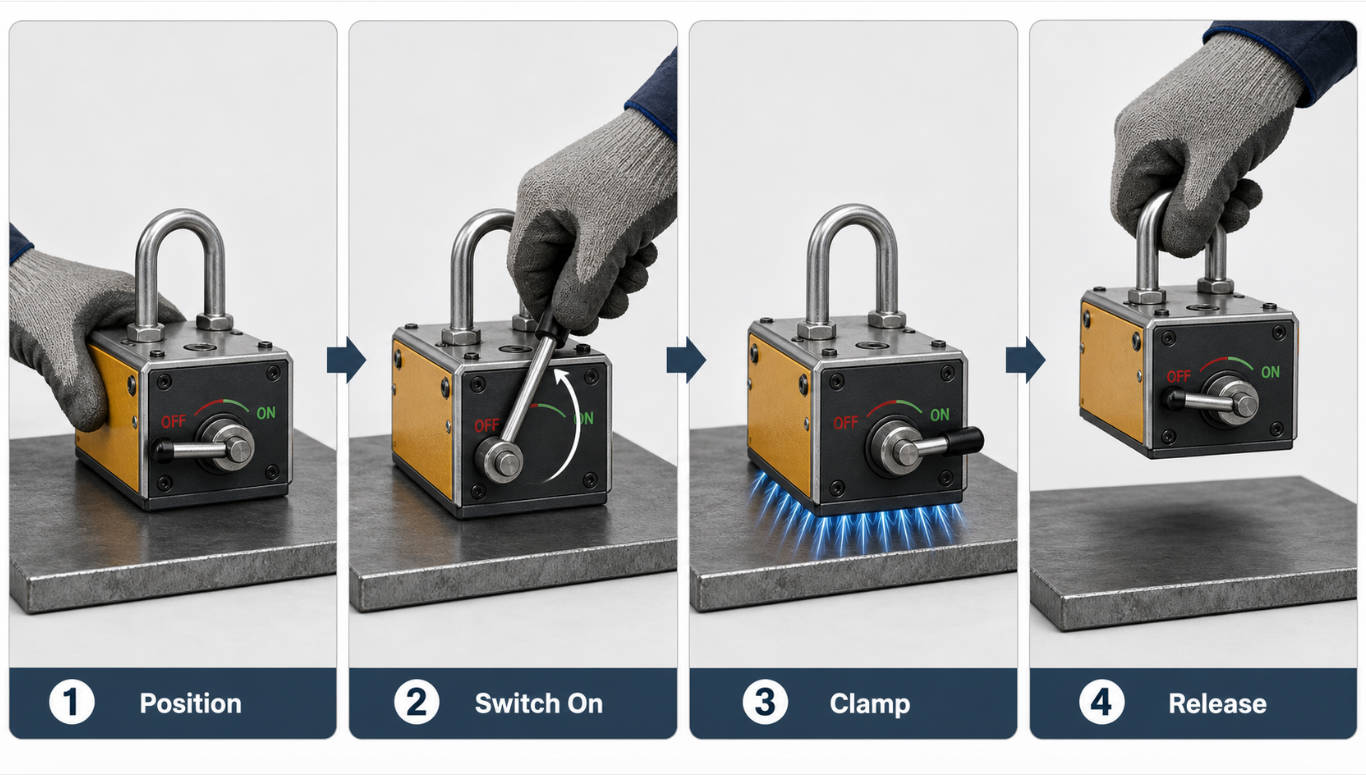
In practice, this design gives operators a high‑force, low‑effort clamping solution that is particularly valuable in welding, assembly and machining operations where workpieces are frequently repositioned. [magswitch]
Electro‑Permanent Magnets: On/Off Control Without Continuous Power
In many automated material‑handling systems, purely mechanical switching is not enough, especially when magnets must be controlled remotely. Here electro‑permanent magnets (EPMs) play a key role: [magnelinkinc]
– EPMs combine permanent magnets with electromagnetic coils, and use a short current pulse to change the magnetization state. [magswitch]
– Once switched ON, they do not need continuous power to maintain the holding force, improving safety in case of power failure. [industryupdate.com]
– A second pulse reverses or re‑routes the flux, switching the magnet OFF and releasing the load. [magswitch]
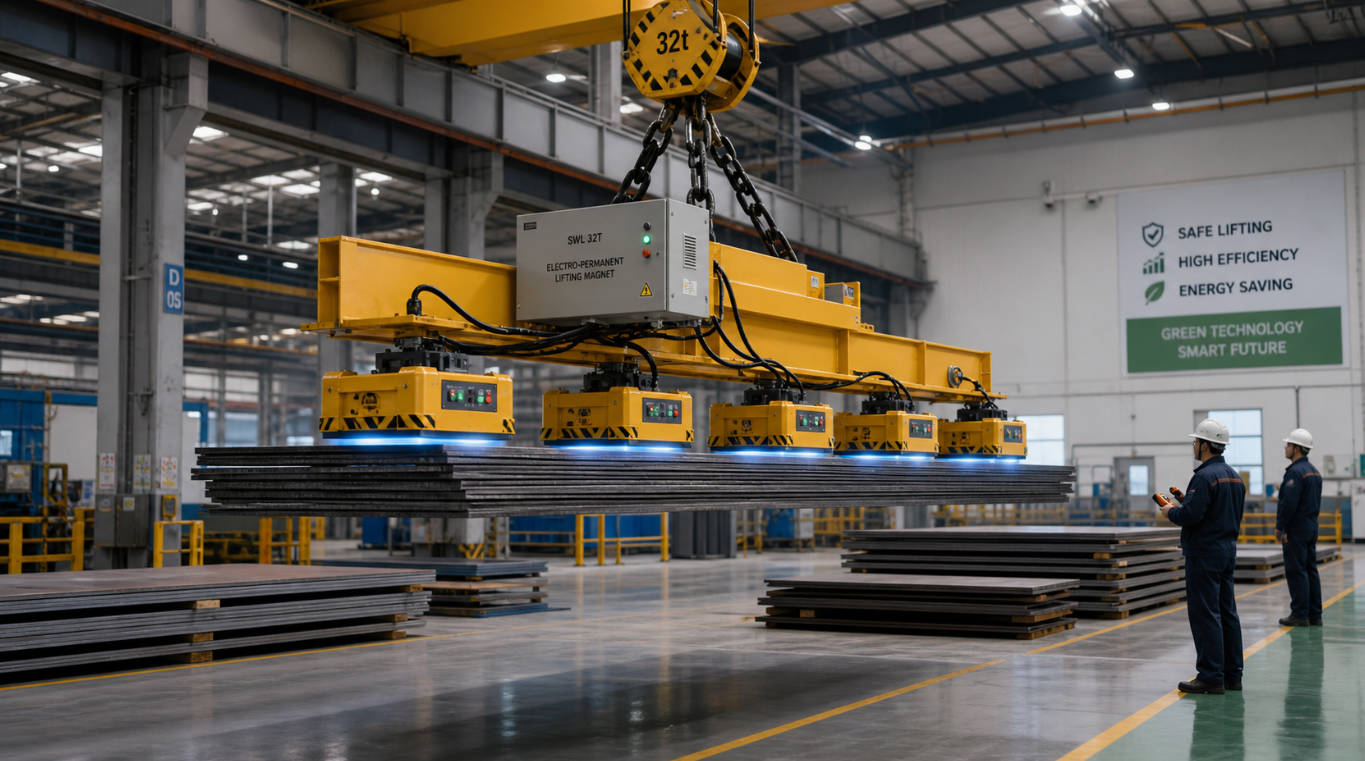
For customers in steel mills, shipyards and service centers, such EPM‑based lifting systems help reduce energy consumption and allow precise control of lifting, sorting and stacking operations. [magswitch]
Key Benefits of Switchable Magnets for Industrial Users
From our experience working with clients in mining, ceramics, glass, battery materials and food processing, the benefits of properly designed switchable magnetic systems are very clear. [wdymagnetic]
– Energy efficiency – Permanent and electro‑permanent switchable magnets do not require continuous power to hold loads.
– Safety – Non‑electric switchable clamps avoid the risk of parts dropping if power is lost. [industryupdate.com]
– Speed – Quick on/off operation dramatically reduces setup and changeover time in welding and machining fixtures. [industryupdate.com]
– Cleanability – Switchable logic is used in separators to let operators easily remove accumulated iron contaminants during cleaning cycles.
– Versatility – Switchable magnets can grip flat, round or irregular ferromagnetic surfaces, depending on pole design. [industryupdate.com]
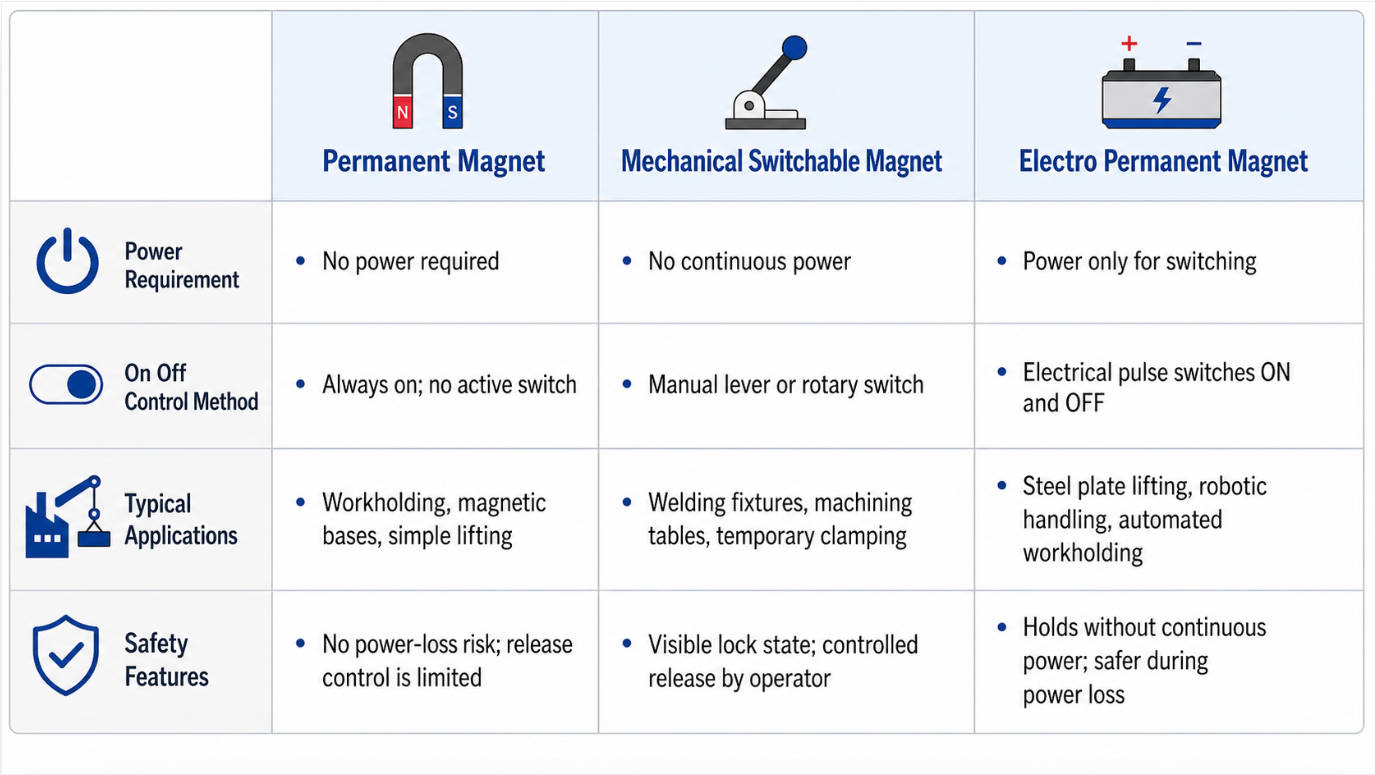
For magnetic separation, applying a switchable concept internally means strong magnetic fields during capture, followed by rapid release during cleaning, which is crucial for powders, slurries and fine contaminants.
Where Switchable Magnets Are Used Today
Modern switchable magnet technology is now common across many industries, often working together with magnetic separators, magnetic rods and plates as part of integrated process solutions. [wdymagnetic]
Typical applications include:
– Material handling and lifting – Plate and profile lifting, beam handling, automated stacking. [magswitch]
– Machine tool clamping – Workholding for milling, grinding, turning and EDM. [kjmagnetics]
– Welding and fabrication – Flexible angles and fixtures for tack welding and assembly. [kjmagnetics]
– Automation and robotics – Pick‑and‑place of ferromagnetic components, palletizing and depalletizing. [magnelinkinc]
– Process protection – Integrated into magnetic separation systems to control when and how captured iron is released during cleaning cycles.
As a manufacturer focused on powder magnetic separators, permanent magnetic separators, magnetic plates and magnetic rods, we see switchable magnet principles being increasingly demanded in:
– Ceramics and glass – To capture fine iron contaminants from glazes and raw materials while keeping cleaning fast and safe. [wdymagnetic]
– Battery materials (anode and cathode) – To protect high‑value materials from iron contamination that can affect cell performance. [en.fswandaye]
– Food and pharma – Where hygienic design and quick, tool‑free cleaning are essential for compliance and uptime. [wdymagnetic]
How Switchable Magnet Concepts Improve Magnetic Separators
Although many magnetic separators use permanent magnets that are always “on”, the operational behavior often mirrors the same ON/OFF logic as switchable magnets. From a separator design engineer’s viewpoint, this connection is very practical. [wdymagnetic]
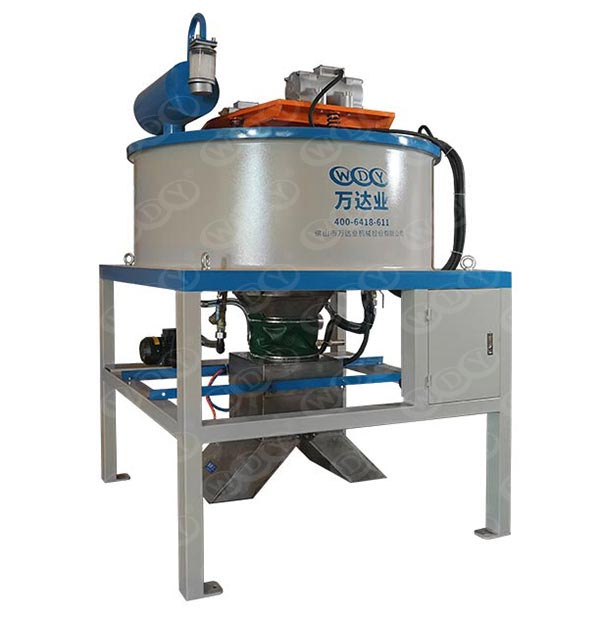
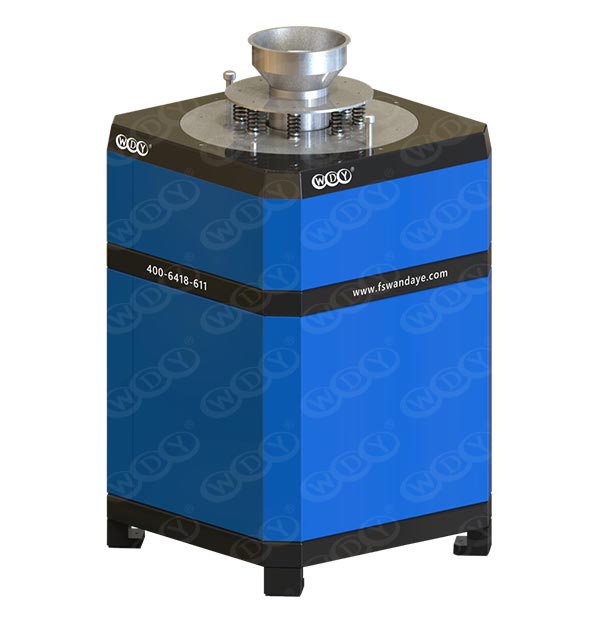
In powder magnetic separators, magnetic plates, iron‑removal cabinets and magnetic rods, we use:
– High‑gradient, rare‑earth permanent magnets to generate strong fields and deep capture zones inside the product stream. [en.fswandaye]
– Mechanical or structural switching (e.g., sliding sleeves, rotating cores, drawer‑type designs) to move the captured iron out of the active field for cleaning, achieving an effective “OFF” state in the cleaning zone.
– Modular magnetic rods and plates that can be quickly removed and wiped or washed, again using the idea of separating the magnetic field and the cleaning area in time and space.
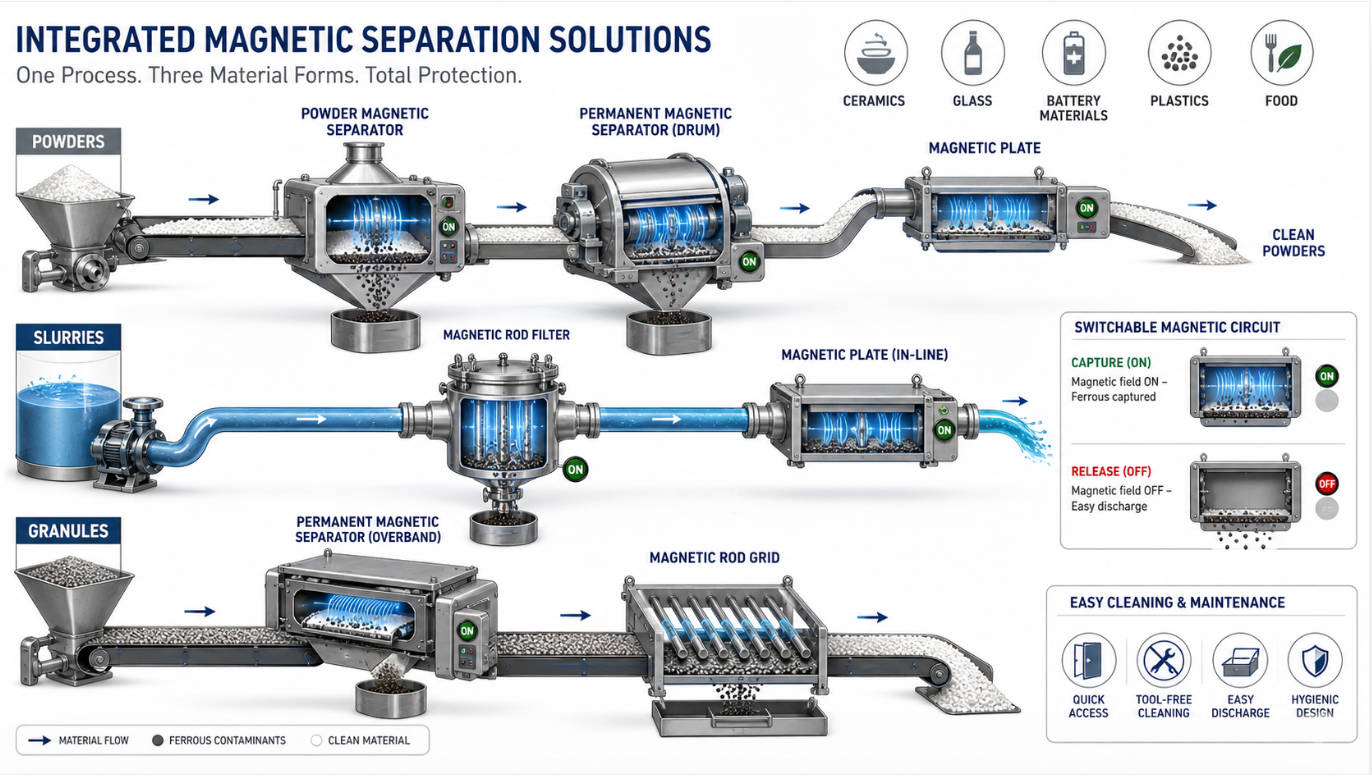
This approach is particularly important in:
– Powder handling – where caking and bridging must be minimized.
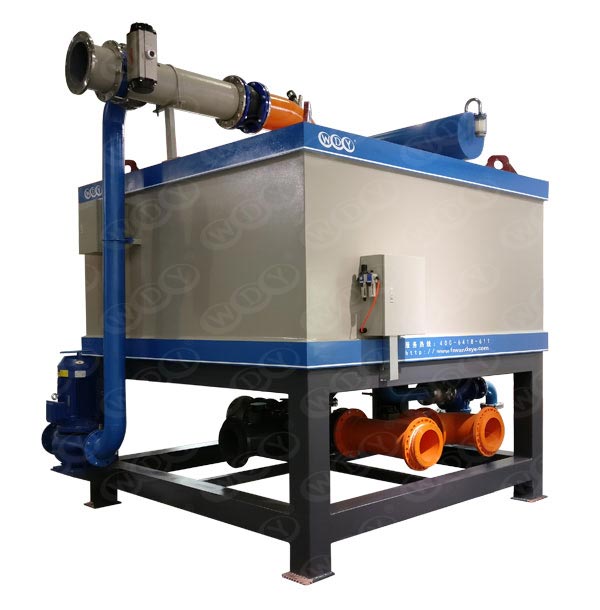
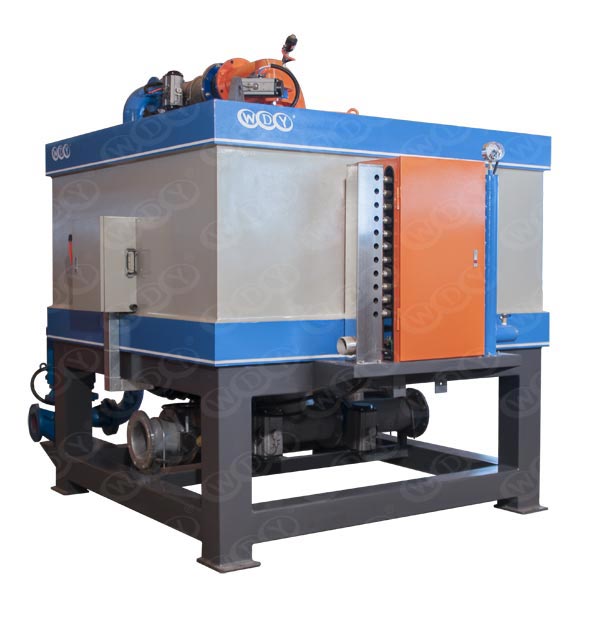
– Slurry processing – where a high‑gradient electromagnetic slurry machine uses controlled energization to change the magnetic field strength during operation and cleaning. [en.fswandaye]
Design Considerations: What Engineers Look At
When we help customers specify or upgrade magnetic systems that use switchable magnet concepts, several design parameters are critical. [hvrmagnet]
– Magnet material – Rare‑earth magnets (such as neodymium) provide very high energy density, essential for compact switchable designs and high‑gradient separators.
– Flux path geometry – Pole shapes, air gaps and housing materials must be optimized to maximize external flux in ON mode and minimize leakage in OFF mode.
– Switching mechanism durability – Handles, cams, bearings and seals must withstand frequent switching, contamination and mechanical shock.
– Thermal performance – Magnets must maintain performance over the expected temperature range in kilns, dryers, mills or reactors.
– Integration with process – For separators, switchable logic must align with process flow, cleaning schedules and safety interlocks.
A well‑designed system balances magnetic performance, mechanical reliability and operator safety, which is why engineering expertise and field feedback matter as much as theoretical calculations.
Industry Trends and New Developments
Recent years have seen several trends in switchable magnet and magnetic separation technology driven by automation, energy efficiency and product quality requirements. [pcshutteringmagnet]
– More electro‑permanent lifting systems – to reduce power consumption and improve safety in steel service centers and fabrication plants. [magswitch]
– Smarter sensors and controls – magnetic switches used in position sensing and safety interlock systems across machinery and process lines. [magnelinkinc]
– Higher gradient separators – especially for battery material, ceramics, plastics and food, where ultra‑fine contamination is unacceptable. [wdymagnetic]
– Compact multi‑pole magnets – providing high holding force in smaller footprints, making switchable fixtures easier to integrate in tight machine envelopes. [industryupdate.com]
For manufacturers like Foshan Wandaye, this means continuous R&D on high‑gradient electromagnetic slurry machines, powder magnetic separators, permanent magnetic separators and modular magnetic rods and plates that match these trends and can be customized for different industries. [wdymagnetic]
Practical Guidelines When Choosing Switchable Magnetic Solutions
Based on project experience in mining, ceramics, glass, battery and food plants, several practical points help end users choose the right switchable magnetic system. [wdymagnetic]
– Define the material and contamination problem clearly – particle size, throughput, temperature and chemical environment.
– Decide where ON/OFF control is really needed – lifting, clamping, or only during separator cleaning.
– Check load safety margins – especially for lifting tasks; always include a suitable safety factor.
– Plan for cleaning and maintenance – design the system so that operators can clean magnetic elements quickly and safely.
– Work with a specialist – choose a partner with R&D, engineering design and commissioning capability, not just a component supplier. [wdymagnetic]
This is exactly where our team has found the most value for clients: combining switchable magnet principles with custom magnetic separator designs to deliver stable, efficient and easy‑to‑operate production lines.
Call To Action: Talk To a Magnetic Separation Specialist
If your production line is struggling with iron contamination, inefficient clamping or slow cleaning cycles, it is time to review your magnetic system design. A well‑engineered combination of switchable magnetic fixtures and high‑performance magnetic separators can significantly improve product quality, uptime and workplace safety. [en.fswandaye]
Our engineering team at Foshan Wandaye Technology Co., Ltd. can help you evaluate your current setup, select suitable powder magnetic separators, permanent magnetic separators, magnetic plates and magnetic rods, and design integrated solutions for industries such as mining, ceramics, power, building materials, glass, environmental protection, rubber, plastics, pharmaceuticals, food and battery materials. [wdymagnetic]
Contact our technical team today to discuss your process, request a magnetic audit, or obtain customized recommendations for your next project.
FAQs
1. What is the main difference between a permanent magnet and a switchable magnet?
A standard permanent magnet is always “on”, continuously producing an external magnetic field, while a switchable magnet can redirect its magnetic flux internally so that the external holding force can be turned on or off as needed. In many designs this switching is done mechanically by rotating internal magnets, or by using electro‑permanent technology that relies on short current pulses rather than continuous power. [reddit]
2. Are switchable magnets safe for lifting heavy steel plates?
Properly designed switchable lifting magnets, especially non‑electric permanent models, are considered very safe when used within their rated capacity and with appropriate safety factors. Because they do not rely on continuous power to hold the load, they avoid sudden loss of force in the event of a power failure, but operators must still follow standard lifting procedures and guidelines. [industryupdate.com]
3. How does switchable magnet technology relate to magnetic separators?
The same principle of controlling when magnetic force acts on the material is used in magnetic separators to simplify cleaning. In powder separators, plates and rods, the magnets capture iron contamination during operation, and then the design allows the captured material to be moved or wiped away in a lower‑field region during cleaning, effectively reproducing an ON/OFF behavior inside the equipment. [en.fswandaye]
4. Can switchable magnets be used in high‑temperature environments?
Switchable magnets can be designed for elevated temperatures, but the choice of magnet material and housing is critical. For applications near kilns, dryers or hot reactors, engineers must ensure that the magnets remain below their maximum operating temperature to avoid demagnetization, and this is often addressed through material selection and thermal management in the overall system design. [hvrmagnet]
5. Which industries benefit most from switchable magnets and advanced magnetic separators?
Industries that handle ferromagnetic materials or are sensitive to iron contamination benefit the most, including mining, ceramics, glass, steel processing, automotive, shipbuilding, battery materials, plastics, food and pharmaceuticals. In these sectors, combining switchable clamping or lifting magnets with well‑designed magnetic separation equipment improves efficiency, product quality and compliance with safety and hygiene standards. [magnelinkinc]
References
1. Great Magtech. “How Do Switchable Magnets Work.” (Accessed 2026). [hvrmagnet]
<https://www.hvrmagnet.com/blog/switchable-magnet-on-off-magnet/>
2. K&J Magnetics. “Magnets with an OFF Switch.” (Accessed 2026). [kjmagnetics]
<https://www.kjmagnetics.com/blog/magswitch>
3. Reddit – r/AskEngineers. “How do these MagSwitch magnets work?” (2016). [reddit]
<https://www.reddit.com/r/AskEngineers/comments/55ni3q/how_do_these_magswitch_magnets_work/>
4. Magswitch. “How Magnetic Technology is Transforming Industrial Lifting Solutions.” (2025). [magswitch]
<https://magswitch.com/blogs/magswitch/how-magnetic-technology-is-transforming-industrial-lifting-solutions>
5. Industry Update. “Benefits of Non‑Electric Switchable Magnetic Clamps.” (2022). [industryupdate.com]
<https://www.industryupdate.com.au/article/benefits-non-electric-switchable-magnetic-clamps>
6. Magnelink Inc. “Your Complete Guide to Magnetic Switch Industry Applications.” (2024). [magnelinkinc]
<https://www.magnelinkinc.com/your-complete-guide-to-magnetic-switch-industry-applications/>
7. Foshan Wandaye Technology Co., Ltd. “Wandaye Magnetics – Magnetic Separator Machine Manufacturer.” (Company overview). [wdymagnetic]
<https://www.wdymagnetic.com>
8. Foshan Wandaye Machinery Equipment Co., Ltd. “Magnetic Separator | Magnetic Separation Equipment | Iron Removal Equipment.” (Product overview). [en.fswandaye]
<http://en.fswandaye.com>
9. Wandaye Magnetics. “Products – Wandaye Magnetics.” (Product list). [wdymagnetic]
<https://www.wdymagnetic.com/products>
10. YouTube. “Switchable Magnet Explained {Science Thursday Ep119}.” (2020). [youtube]
<https://www.youtube.com/watch?v=Fz7rEP7Y_c4>
Hot Tags: Switchable Magnet, Manufacturers, Customized, Custom, Suppliers, Buy, Cheap, Quality, Advanced, Durable, in Stock, Made in China, Price, Quotation