


Content Menu
● What Is a Magnetic Door Catch?
● Key Benefits of Magnetic Door Catches
● Types of Magnetic Door Catches
>> Surface-Mounted Magnetic Catches
>> Concealed Magnetic Door Catches
>> Thin Self-Adhesive Magnetic Catches
>> Magnetic Catches vs Mechanical Catches
● Where Magnetic Door Catches Work Best
● Tools and Materials Needed for Installation
● Step-by-Step: Installing a Surface-Mounted Magnetic Door Catch
>> Step 1: Choose and Mark the Installation Position
>> Step 3: Fix the Magnetic Catch to the Frame
>> Step 4: Attach and Align the Strike Plate
>> Step 5: Test and Fine-Tune the Door Closing
● Step-by-Step: Installing a Concealed Magnetic Door Catch
● Troubleshooting Common Magnetic Door Catch Issues
>> Reduced Holding Power Due to Dirt or Rust
● Routine Maintenance Tips for Long-Lasting Performance
● How to Select the Right Magnetic Door Catch
● Take the Next Step: Upgrade Your Doors with Professional Magnetic Solutions
● FAQs About Magnetic Door Catches
>> 1. Are magnetic door catches strong enough for full-size doors?
>> 2. Will a magnetic door catch demagnetize over time?
>> 3. Can magnetic door catches be used in humid or coastal environments?
>> 4. What is the difference between a magnetic latch and a magnetic catch?
>> 5. Do magnetic door catches work with soft-close hinges?
Learn how to choose, install, and maintain a magnetic door catch for smooth, quiet, and reliable door closing. Discover surface-mounted and concealed options, step-by-step installation tips, troubleshooting advice, and expert guidance for residential and commercial applications.
What Is a Magnetic Door Catch?
A magnetic door catch is a compact hardware device that uses magnetic force to keep a door closed without a traditional latch or bolt.
It typically consists of a magnet unit and a metal strike plate that align when the door closes, pulling the door gently into the frame and holding it in place.
Because there are no springs or rollers, magnetic catches operate with very low noise, experience minimal wear, and require little maintenance over their service life.
They are widely used on cabinet doors, interior swing doors, and lightweight entrance doors across homes, offices, hotels, and healthcare facilities.
Key Benefits of Magnetic Door Catches
Magnetic door catches offer a combination of quiet operation, clean aesthetics, and reliable holding power for everyday doors.
Compared with many mechanical latches and roller catches, they are easier to install and provide a smoother, more modern closing experience.
– Silent closing and opening: There is no sharp “click” from a latch, making them ideal for bedrooms, offices, libraries, and other noise-sensitive areas.
– Minimal wear and long life: With no moving mechanical parts, the magnets and plates experience very little friction, so performance remains stable for years.
– Modern, minimalist look: Concealed models sit inside the door and frame, so nothing interrupts the clean lines of contemporary interior design.
– Versatile applications: Different sizes and holding strengths are available for cabinet doors, closet doors, flush interior doors, and some heavier doors.
– Easy DIY installation: Most surface-mounted catches require only a few screws and basic hand tools, making them accessible even for first-time DIY users.
Types of Magnetic Door Catches
Choosing the right type of magnetic door catch ensures that your door closes reliably and looks exactly the way you want.
Surface-Mounted Magnetic Catches
Surface-mounted catches are fitted directly to the face or edge of the door and frame and remain visible after installation.
– Common on cabinet doors, closet doors, and light interior doors.
– Typically fixed with screws or sometimes with a thin adhesive backing.
– Available in plastic, zinc, or stainless housings to match different environments and budgets.
– Ideal for quick retrofits and replacements where an existing mechanical catch needs upgrading.
Concealed Magnetic Door Catches
A concealed magnetic door catch is recessed into the edge of the door and the jamb so that the hardware is hidden when the door is closed.
– Delivers a premium, seamless appearance on modern flush doors.
– Magnet assemblies are housed inside the door and frame, improving alignment and reducing noise.
– Many concealed systems include spacer rings or power packers to fine-tune holding force for different door weights.
– Often selected by architects and designers for high-end residential and commercial projects.
Thin Self-Adhesive Magnetic Catches
Thin self-adhesive catches are designed for narrow spaces and lightweight doors, panels, or access hatches.
– Installed with small screws, double-sided adhesive tape, or a combination of both.
– Suitable where drilling is difficult or where the substrate is very thin.
– Ideal for quick upgrades in rental properties or temporary installations.
Magnetic Catches vs Mechanical Catches
Magnetic catches differ from mechanical ball, roller, or spring catches because they rely purely on magnetic attraction rather than mechanical interlocking.
| Feature | Magnetic catch | Mechanical catch (ball/roller) |
| Operating noise | Very low, almost silent. | Noticeable click or clunk when engaging. |
| Wear and maintenance | Minimal wear, no springs or rollers. | Springs and rollers wear and may need adjustment. |
| Aesthetics | Can be concealed for a clean, flush look. | Usually visible strike plates and housings. |
| Installation | Simple DIY, few tools required. | Often requires more precise mortising and alignment. |
| Typical usage | Modern interiors, quiet rooms, light to medium doors. | Traditional hardware setups, some heavier doors. |
Where Magnetic Door Catches Work Best
Magnetic door catches can be used in both residential and commercial environments where doors need a reliable but non-locking closure.
– Home applications: Kitchen cabinets, wardrobes, pantry doors, bathroom doors, laundry rooms, and children’s rooms.
– Commercial spaces: Office storage, meeting room doors, hotel wardrobes, and healthcare cabinets that require frequent access.
– Special scenarios: Doors affected by drafts, doors with weak closers, or double doors that tend to creep open can be stabilized with the right magnetic catch.
For manufacturers and engineering-focused companies, advanced experience with magnet materials and protective coatings in industrial equipment can be leveraged to produce door catches with higher durability and better corrosion resistance in demanding environments.
Tools and Materials Needed for Installation
Before installing a magnetic door catch, prepare all tools and hardware to keep the process safe, efficient, and accurate.
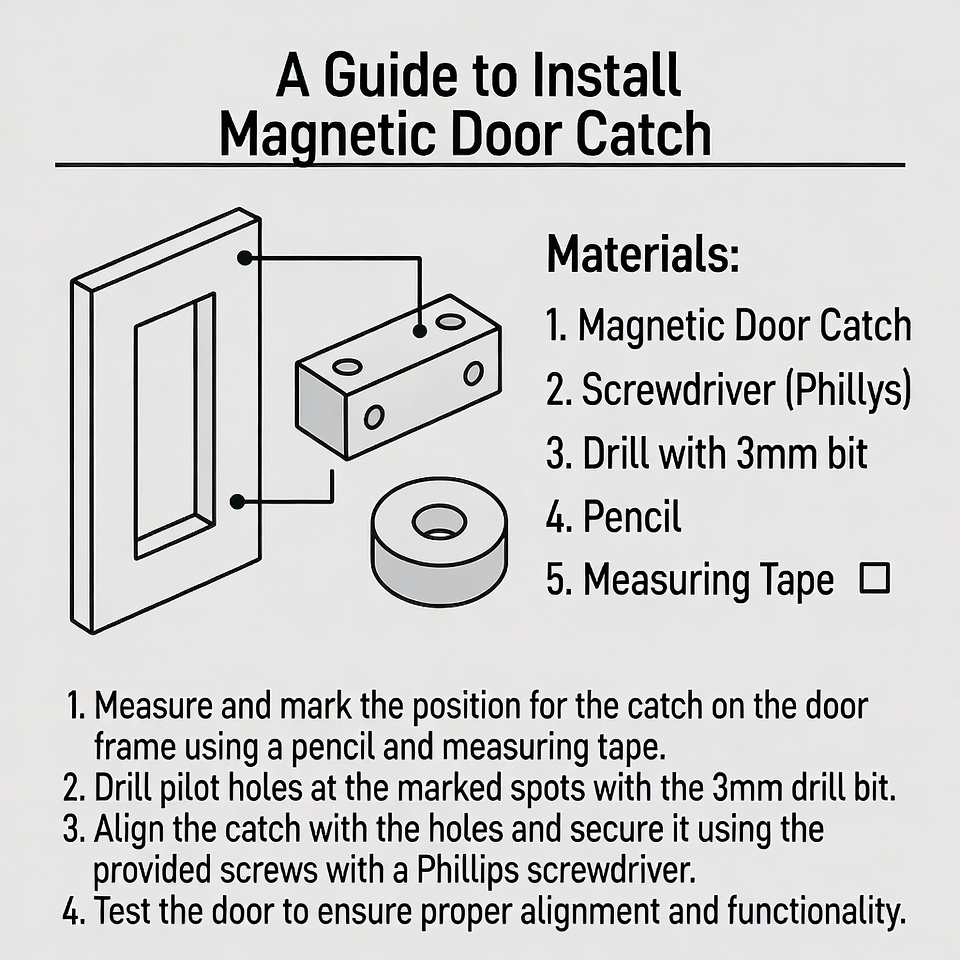
– Magnetic door catch kit (catch body, strike plate, screws, and any spacers or packers)
– Drill and suitable drill bits for pilot holes
– Measuring tape or ruler
– Pencil or fine marker for accurate marking
– Screwdriver (manual or powered)
– Optional: Level for alignment, fine sandpaper for surface preparation, wood glue or epoxy for repairing loose screw holes
Step-by-Step: Installing a Surface-Mounted Magnetic Door Catch
For most DIY users, a surface-mounted magnetic door catch is the fastest solution to upgrade a door that does not close reliably.
Step 1: Choose and Mark the Installation Position
Correct positioning ensures that the magnet and strike plate meet accurately when the door closes.
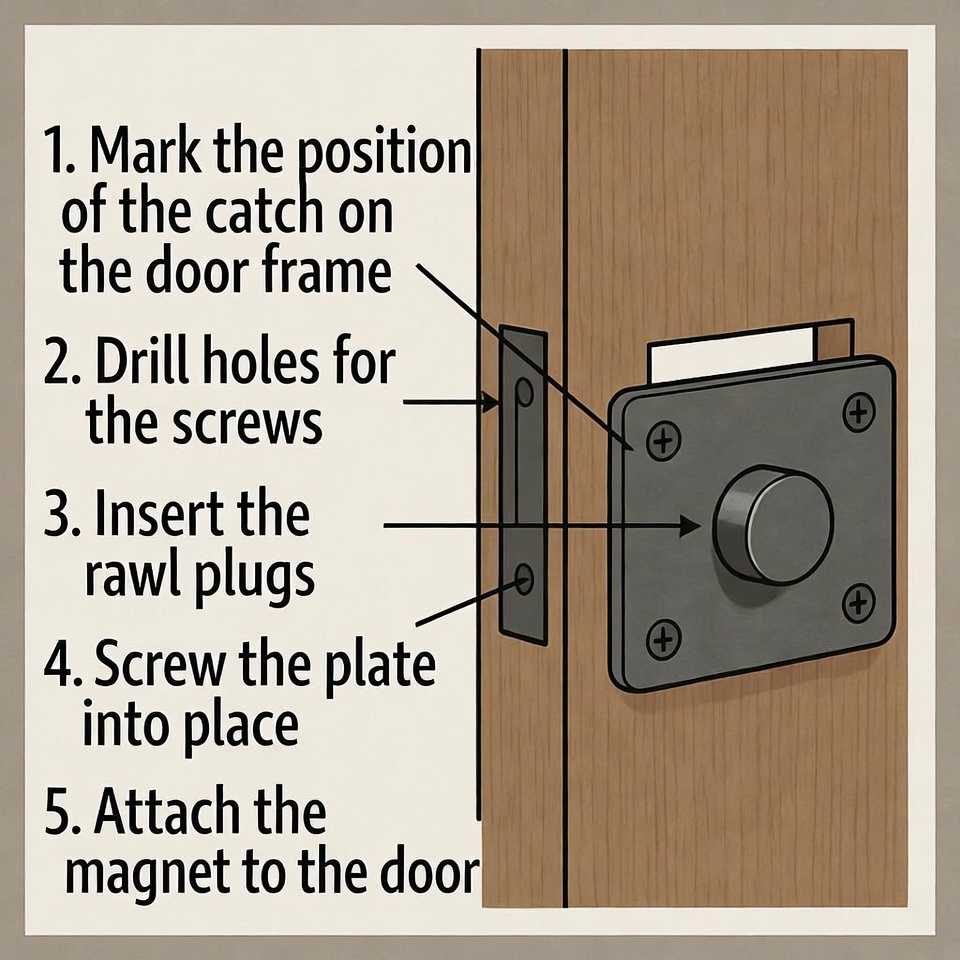
1. Close the door fully and decide where you want the catch located, commonly at the top or side opposite the hinges.
2. Measure the vertical centerline of the door edge and transfer this line to the frame so the catch and plate stay in line.
3. Use a pencil to mark the outline and screw positions of the catch on the frame and the corresponding strike plate positions on the door.
Step 2: Drill Pilot Holes
Pilot holes help prevent wood splitting and allow screws to drive in straight and secure.
1. Select a drill bit slightly smaller than the diameter of the supplied screws.
2. Drill straight, shallow pilot holes at each marked screw position on both the door and the frame.
3. Keep the drill steady and perpendicular to the surface to avoid chipping or oversizing the hole.
Step 3: Fix the Magnetic Catch to the Frame
Mounting the catch body on the frame first makes alignments easier.
1. Position the catch on the frame with its screw holes aligned to your pilot holes.
2. Insert the screws and tighten them until the catch sits firmly; do not overtighten to prevent stripping the holes.
3. Check that the face of the catch is flat and parallel to the door edge for consistent contact.
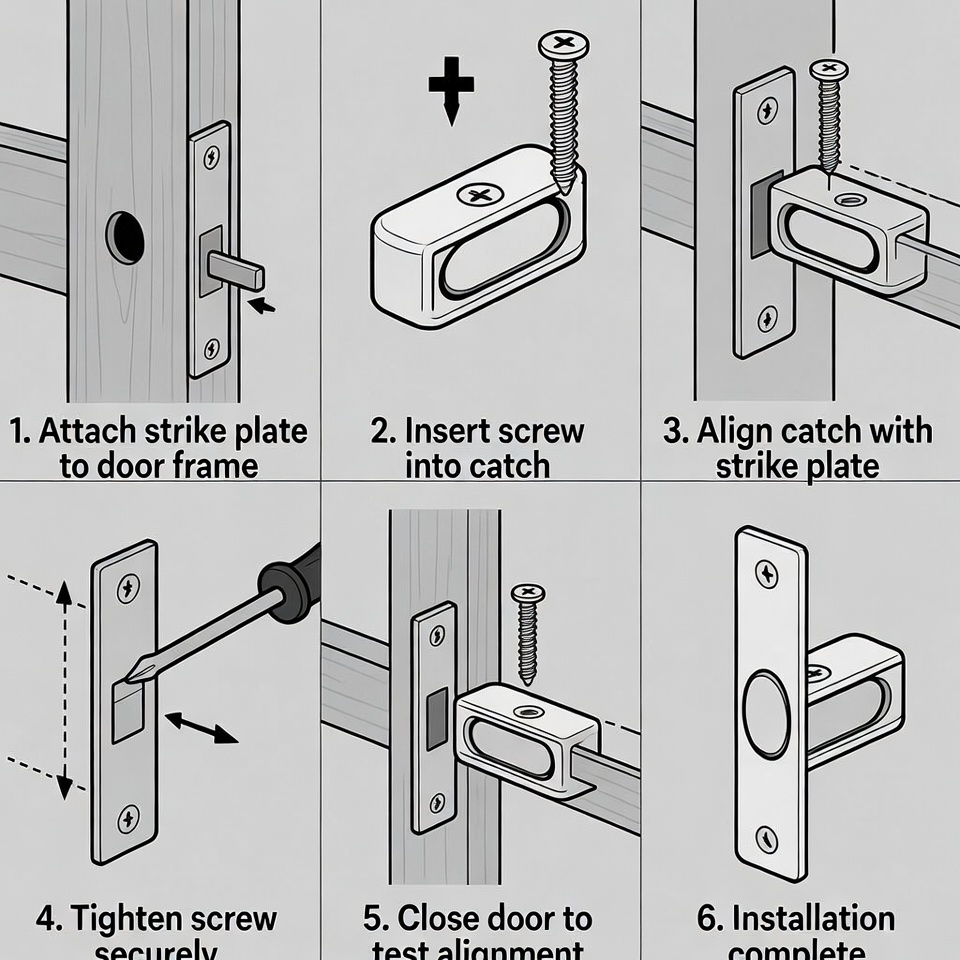
Step 4: Attach and Align the Strike Plate
Precise alignment between the strike plate and the magnet is essential for strong holding force and a clean close.
1. With the catch installed, gently close the door to see where the strike plate should meet the magnet.
2. Position the strike plate on the door edge so that its center aligns with the magnet when the door is closed.
3. Fix the plate with screws into the prepared pilot holes, tightening firmly without overtightening.
A practical trick with adhesive-backed plates is to temporarily stick the plate to the magnet, close the door, and press; when you open the door, the plate remains in the perfect position ready for permanent attachment.
Step 5: Test and Fine-Tune the Door Closing
Once both parts are installed, test the closing action several times and make adjustments if needed.
– The door should pull gently into the frame and stay closed under normal conditions.
– If the magnet does not engage, adjust the strike plate slightly up, down, or sideways until contact is reliable.
– If closing feels too strong or too weak, change to a catch with a different holding force or use spacer washers or packers, if provided, to tune the gap.
Step-by-Step: Installing a Concealed Magnetic Door Catch
A concealed magnetic door catch requires more precise carpentry but delivers a premium, flush finish on the door edge and frame.
1. Measure and mark recess locations
– Determine the position along the top or side edge of the door where the catch will sit.
– Transfer this measurement to the head jamb or side jamb so the recesses in the door and frame align accurately.
2. Drill or route the recesses
– Follow the dimensions in the product’s installation guide to drill or route cavities for the magnet housings.
– Ensure the depth allows each housing to sit flush with the surface for a clean fit.
3. Install magnet housings and spacers
– Insert any power adjustment spacers or packers if the door requires higher holding force or fine-tuning.
– Fix the magnet assemblies into the recesses and secure them with the supplied screws.
4. Fit cover plates and buffers
– Attach stainless steel cover plates and any rubber buffers to protect the edges and reduce impact noise.
– Confirm that when the door is closed, all catches and plates are hidden from view.
5. Test function and adjust holding power
– Open and close the door several times to ensure smooth engagement and reliable holding.
– If more or less force is needed, adjust the combination of spacers or packers according to the manufacturer’s recommendations.
Troubleshooting Common Magnetic Door Catch Issues
Even with correct installation, minor issues can appear over time, especially on high-traffic doors or in challenging environments.
Door Does Not Stay Closed
If the door does not stay closed, alignment and holding force are the first points to check.
– Verify that the center of the strike plate lines up with the center of the magnet when the door is shut.
– Tighten any loose screws on the catch or plate that may have shifted the components.
– For heavier doors, consider upgrading to a stronger magnetic catch or adding appropriate spacers to improve contact.
Screws Loosen Over Time
Repeated opening and closing can cause screws to loosen, particularly in softer wooden frames or doors.
– Remove the loose screw and inject a small amount of wood glue into the hole.
– Insert wooden matchsticks or dowel slivers into the glue-filled hole, allow it to dry, then trim flush.
– Reinsert the screw so it bites into the reinforced material and holds more securely.
Scratches or Rubbing Marks
Scratches or rubbing marks on the door or frame usually indicate that the strike plate is misaligned and rubbing on the catch housing.
– Loosen the screws on the plate, shift it slightly away from the contact area, and retighten.
– Check that the door is not sagging on its hinges, as hinge wear can also cause misalignment over time.
Reduced Holding Power Due to Dirt or Rust
Dust, paint overspray, or corrosion on the magnet or plate surfaces can weaken the holding force.
– Clean both surfaces regularly with a soft, dry cloth to remove dust and debris.
– For rust spots, gently sand with fine sandpaper, then apply a suitable rust-resistant protective spray.
Routine Maintenance Tips for Long-Lasting Performance
Regular maintenance keeps your magnetic door catch working quietly and reliably for many years.
– Perform a quick inspection every few months and retighten any loose screws, especially on high-traffic doors.
– Wipe the magnet and strike plate with a soft, dry cloth to remove dust and grime; avoid wet cloths on materials that might corrode.
– In coastal, humid, or exterior environments, protect exposed metal parts with a rust-resistant spray once or twice a year.
– Encourage household members or staff to close doors smoothly instead of slamming, which reduces stress on screws and hardware.
How to Select the Right Magnetic Door Catch
Choosing the correct specification is just as important as accurate installation, especially when doors are heavy or used frequently.
– Door type and weight: Lightweight cabinet doors can use smaller plastic or thin catches, while full-size doors may require concealed or heavy-duty models with adjustable power.
– Usage frequency: High-traffic doors benefit from robust housings, stainless hardware, and magnets that resist demagnetization.
– Environment: Kitchens, bathrooms, and coastal areas require corrosion-resistant materials and protective coatings to maintain performance.
– Design requirements: Modern minimalist interiors often favor concealed catches, while traditional settings may prefer matching visible hardware.
For industrial projects or specialized applications, you can rely on professional magnetic design and material expertise to specify high-grade magnets and engineered housings that deliver stable performance under vibration, temperature changes, and heavy usage.
Take the Next Step: Upgrade Your Doors with Professional Magnetic Solutions
If you are planning to upgrade doors across a home, office, or industrial facility, choosing high-quality magnetic door catches will significantly improve comfort, reliability, and aesthetics.
Combine expert-grade magnet technology with the right catch type, installation method, and maintenance plan to make every door close smoothly and stay securely in place.
Contact our technical team today to discuss your specific doors, environments, and performance requirements, and let us help you configure tailored magnetic door catch and magnetic equipment solutions that truly match your project.
Contact us to get more information!
FAQs About Magnetic Door Catches
1. Are magnetic door catches strong enough for full-size doors?
Yes, many concealed and heavy-duty magnetic catches are engineered for full-size interior doors, and their holding power can often be adjusted with spacers or packers to suit different door weights.
2. Will a magnetic door catch demagnetize over time?
High-quality magnetic catches use stable magnetic materials, and because the magnets typically do not strike each other directly, they are unlikely to demagnetize under normal household or office use.
3. Can magnetic door catches be used in humid or coastal environments?
Magnetic catches can be used in humid or coastal locations, but you should select models with stainless steel housings, protective coatings, or rust-resistant materials and maintain them with periodic cleaning and protective sprays.
4. What is the difference between a magnetic latch and a magnetic catch?
A magnetic latch is usually integrated into a locking or latching mechanism that may provide security, while a magnetic catch is designed primarily to hold a door closed without locking, focusing on smooth, quiet operation.
5. Do magnetic door catches work with soft-close hinges?
Yes, magnetic door catches can work very well with soft-close hinges by ensuring that the door fully engages and stays shut after the hinge’s damping motion finishes, especially on lightweight or slightly warped doors.
Citations:
1. https://hsmagnet.com/2024/07/03/magnetic-door-catch/
2. https://www.magfine.ca/blogs/general/how-magnets-are-used-in-door-applications
3. https://images.thdstatic.com/catalog/pdfImages/6d/6dc2495d-5ec9-450d-9e77-635ddb3c473e.pdf
4. https://www.hingeoutlet.com/blogs/news/how-to-install-a-magnetic-door-stop-in-6-simple-steps
5. https://hsmagnet.com/2024/07/03/magnetic-door-catch/
6. https://www.hardware-decor.com/blogs/news/magnetic-vs-mechanical-catches-which-is-right-for-you
7. https://www.hardwaresource.com/products/concealed-magnetic-door-catch-regular-duty
8. https://learn.reeb.com/knowledge-base/concealed-magnetic-door-catch/
9. https://www.hingeoutlet.com/blogs/news/how-to-select-the-right-cabinet-catch
Hot Tags: A Guide To Install Magnetic Door Catch, How To Install Magnetic Door Catch, How To Install A Magnetic Door Catch, How Do You Fix A Magnetic Door Catch, Magnetic Door Catch Installation Guide, Magnetic Door Catch Repair Tips, Cabinet Magnetic Door Catch Installation, DIY Magnetic Door Latch Setup, Magnetic Door Catch Replacement, Magnetic Cabinet Catch Hardware