


Content Menu
● What Are Pneumatic Inline Magnets in Animal Feed?
● Why Metal Contamination Is a Critical Risk in Animal Feed
● How Pneumatic Inline Magnets Work in Practice
● Key Design Features That Matter for Feed Plants
>> Pressure rating and line compatibility
>> Hygienic, food-grade construction
>> High-performance magnet materials
● Where to Install Pneumatic Inline Magnets in Animal Feed Lines
● Benefits for Quality, Safety, and OEE
>> Product safety and brand protection
>> Equipment protection and uptime
● Comparing Magnet Types Used in Animal Feed
● Best Practices for Specifying PIMs in Animal Feed Plants
● Practical Installation & Maintenance Tips From the Field
● Emerging Trends in Magnetic Separation for Animal Feed
● When to Consider Upgrading Your Existing Magnets
● Clear Call to Action: Design Your Next Pneumatic Inline Magnet Project
● FAQs
>> 1. How do pneumatic inline magnets differ from chute magnets in animal feed lines?
>> 2. What size of metal particles can inline magnets capture?
>> 3. How often should pneumatic inline magnets be cleaned in an animal feed plant?
>> 4. Are pneumatic inline magnets suitable for ATEX-rated dust environments?
>> 5. Do I still need other types of magnets if I install pneumatic inline magnets?
Pneumatic inline magnets have quietly become one of the most effective safeguards in modern animal feed plants, protecting both product quality and critical equipment. As someone who has spent years working with powder magnetic separators and pneumatic systems, I can say that when these magnets are selected and installed correctly, they pay for themselves many times over. [buntingmagnetics]
What Are Pneumatic Inline Magnets in Animal Feed?
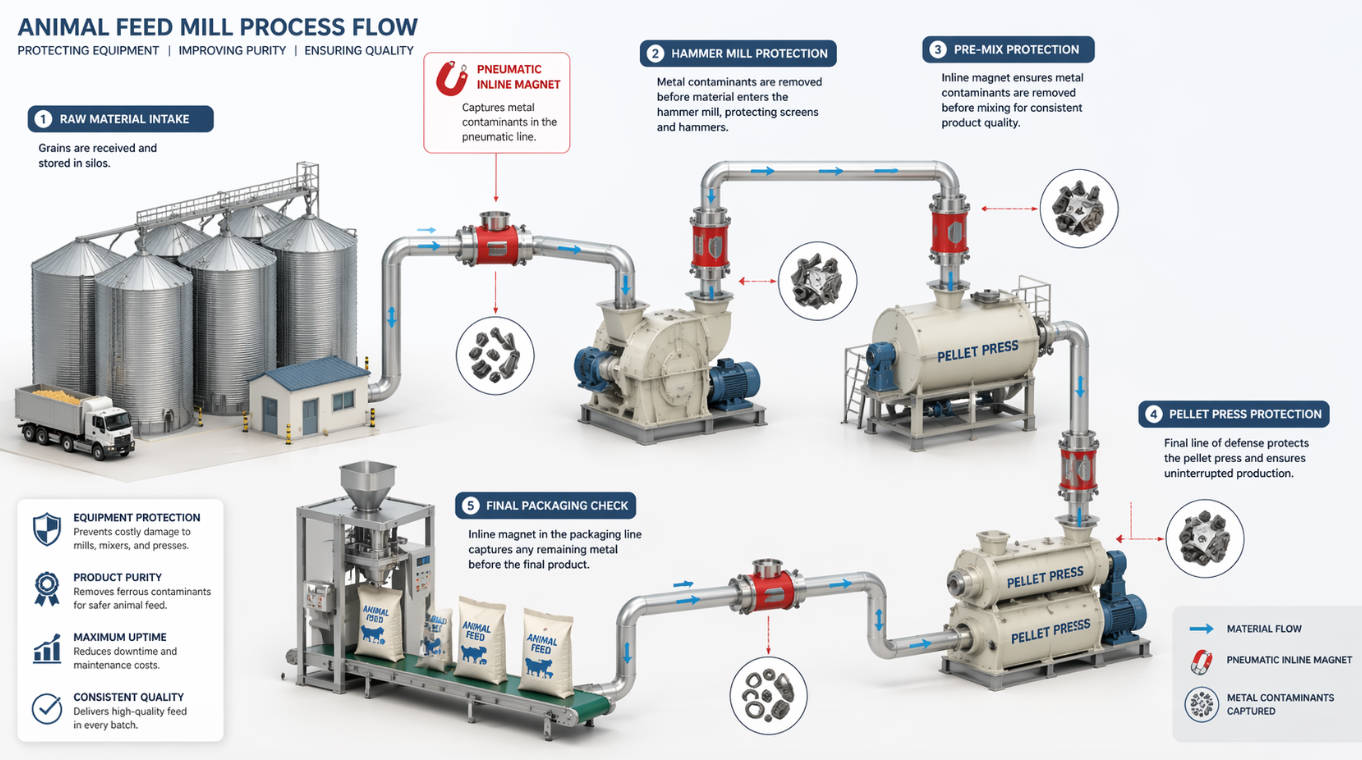
Pneumatic inline magnets (PIMs) are magnetic separators installed directly into pneumatic conveying lines to remove tramp ferrous metal and weakly magnetic particles from flowing animal feed. In a typical animal feed plant, these systems sit in 4–5 inch pipelines where feed is blown through under low pressure. [goudsmitmagnetics]
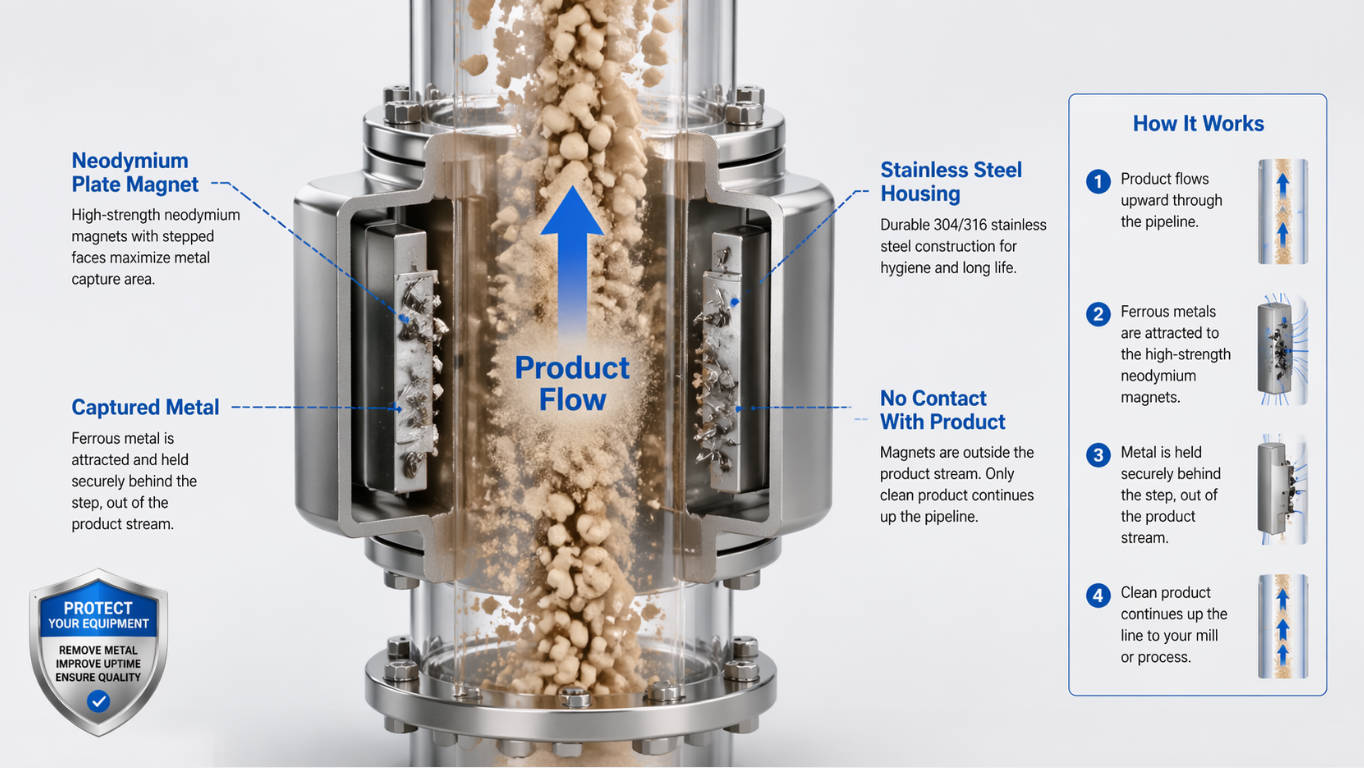
Inside the stainless-steel housing, high-strength neodymium plate magnets create an intense magnetic field that captures metal fragments as feed passes between them. This protects downstream hammer mills, pelletizers, mixers, and packaging equipment from damage and prevents metal-contaminated product from reaching farmers and pet owners. [magnattackglobal]
Why Metal Contamination Is a Critical Risk in Animal Feed
From a process engineer’s perspective, metal contamination is not a rare “edge case” – it is inevitable if you run a plant long enough. Common sources include: [processingmagazine]
– Worn machine parts (bolts, nuts, screen fragments, blades). [magnattackglobal]
– Incoming raw materials contaminated during harvesting, transport, or storage. [goudsmitmagnetics]
– Maintenance activities, such as welding and cutting near open process lines. [packagingtechtoday]
Even particles as small as 30–60 microns can damage sensitive equipment and compromise product quality. In the animal feed and pet food industries, this risk is compounded by: [buntingmagnetics]
– Stricter safety standards and HACCP requirements. [packagingtechtoday]
– Potential recalls, liability claims, and reputational damage if metal is found in finished feed. [puritanmagnetics]
Industry data shows that magnetic separator solutions for food and feed are growing at a strong pace globally, driven by these regulatory and brand-protection pressures. [linkedin]
How Pneumatic Inline Magnets Work in Practice
At one animal feed plant documented by Bunting, four pneumatic inline magnets were installed between 2020 and 2023 as production capacity increased. The system is a good illustration of how PIMs operate in real conditions. [buntingmagnetics]
Core operating principle
– The PIM housing is connected directly into 4″ (101 mm) and 5″ (127 mm) pneumatic pipelines. [buntingmagnetics]
– Animal feed is blown up through the center of the housing between two high-strength neodymium plate magnets. [buntingmagnetics]
– Each plate magnet uses a tapered step design, which traps captured metal behind a lip and out of the main product flow. [buntingmagnetics]
– Tramp ferrous metal and fine iron particles adhere to the magnet surface and remain securely held until cleaning. [buntingmagnetics]
A regular maintenance program is used to manually clean the plate magnets and remove captured metal. According to the site’s technical sales engineer, plant staff are often surprised by how much metal the PIMs collect, confirming that contamination is a continuous threat rather than an isolated event. [buntingmagnetics]
Key Design Features That Matter for Feed Plants
When I evaluate pneumatic inline magnets for animal feed applications, there are several critical design features I look for.
Pressure rating and line compatibility
Properly engineered PIMs are designed for dilute-phase conveying systems with pressure ratings up to around 15 psi. This ensures safe operation without air leaks or premature gasket failure. Matching the magnet housing to the exact line diameter (for example, 4″ or 5″) is essential to minimize pressure drop and avoid turbulence. [processingmagazine]
Hygienic, food-grade construction
For feed, pet food, and premix lines, stainless-steel construction with food-grade gaskets is now a baseline expectation. Key hygienic aspects include: [magnattackglobal]
– Smooth internal surfaces to avoid material build-up. [packagingtechtoday]
– Sealed designs suitable for dust-tight operation and, where needed, ATEX-rated environments. [buntingmagnetics]
– Easy access for cleaning with minimal dead zones. [bulkinside]
High-performance magnet materials
Modern systems use rare earth neodymium magnets to generate strong magnetic fields at the product interface. In some designs, magnets are engineered to capture not only standard ferrous particles but also weakly magnetic stainless steel above approximately 30 microns. This capability is particularly valuable for protecting high-speed mills and precision dosing systems. [magnattackglobal]
Where to Install Pneumatic Inline Magnets in Animal Feed Lines
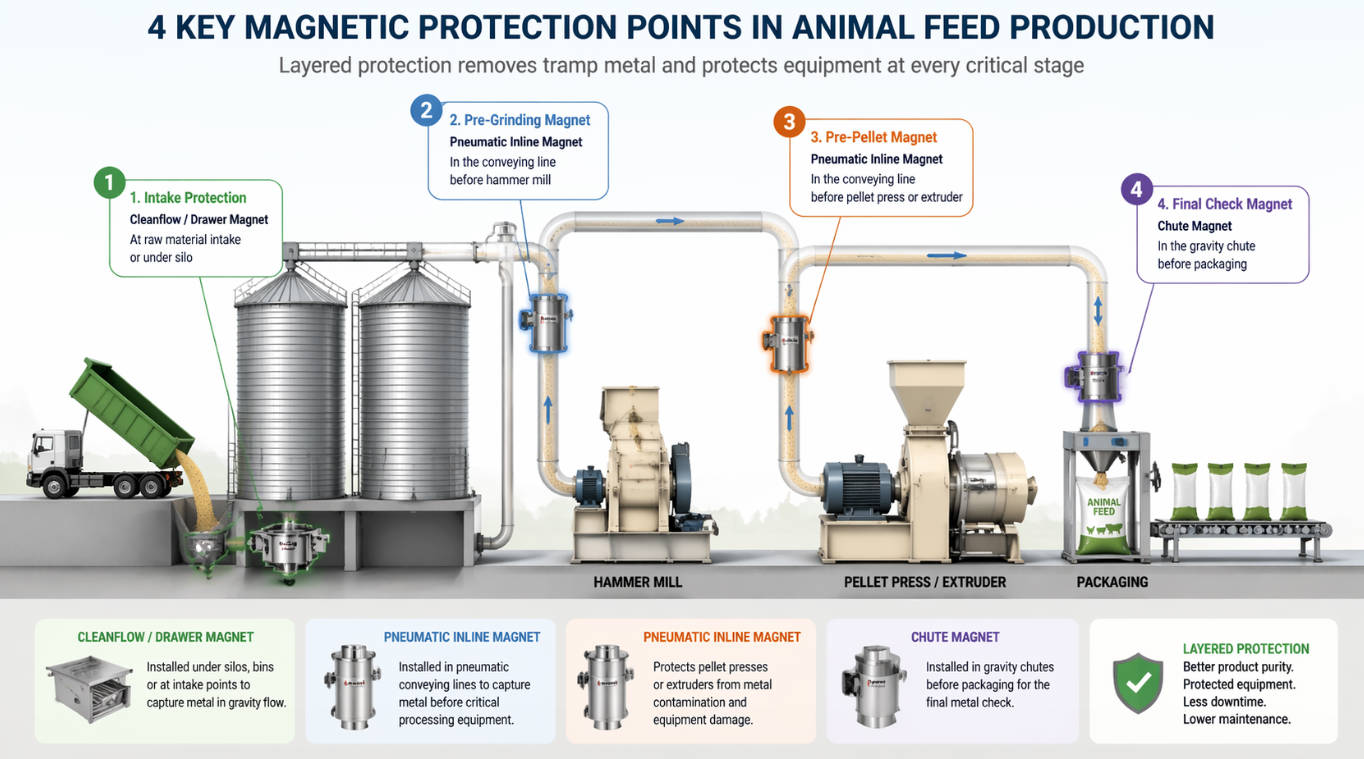
One of the most important decisions is where to place inline magnets in your process. Based on both manufacturer guidance and real plant projects, the most effective positions tend to be: [puritanmagnetics]
– Receiving lines for bulk ingredients
Install PIMs in pneumatic lines receiving grains, meals, and additives so you intercept metal before it enters silos or blending operations. [bulkinside]
– Before grinding and size reduction equipment
Protect hammer mills and crushers from bolts, screen pieces, or foreign ferrous parts. [goudsmitmagnetics]
– Ahead of pellet presses and extruders
Removing metal here reduces the risk of sudden mechanical failures and hot spots in high-pressure equipment. [goudsmitmagnetics]
– Before final packaging or bulk loading
A final “polishing” magnet helps verify product integrity and supports HACCP and customer audit requirements. [packagingtechtoday]
In more advanced designs, inline magnets may be combined with chute magnets, bullet magnets, or cleanflow magnets depending on the location (gravity, pneumatic, or vibratory flow). [bulkinside]
Benefits for Quality, Safety, and OEE
From a plant management perspective, pneumatic inline magnets deliver value in three main areas.
Product safety and brand protection
– They reduce the chance that farmers or pet owners will find metal in feed or pet food, which can damage both animals and brand reputation. [magnattackglobal]
– They support compliance with HACCP, GFSI, and industry best practice standards for metal control. [packagingtechtoday]
Equipment protection and uptime
– By capturing metal before it reaches hammer mills, pelletizers, and mixers, PIMs help avoid unexpected breakdowns, repair costs, and production stops. [processingmagazine]
– They reduce wear on rotating equipment and extend the lifespan of screens and tooling. [puritanmagnetics]
Process efficiency and ROI
– Improved process reliability translates into higher Overall Equipment Effectiveness (OEE) and smoother production planning. [processingmagazine]
– Compared with the cost of a single major recall or unplanned shutdown, inline magnets are a relatively low-cost insurance policy. [linkedin]
Comparing Magnet Types Used in Animal Feed
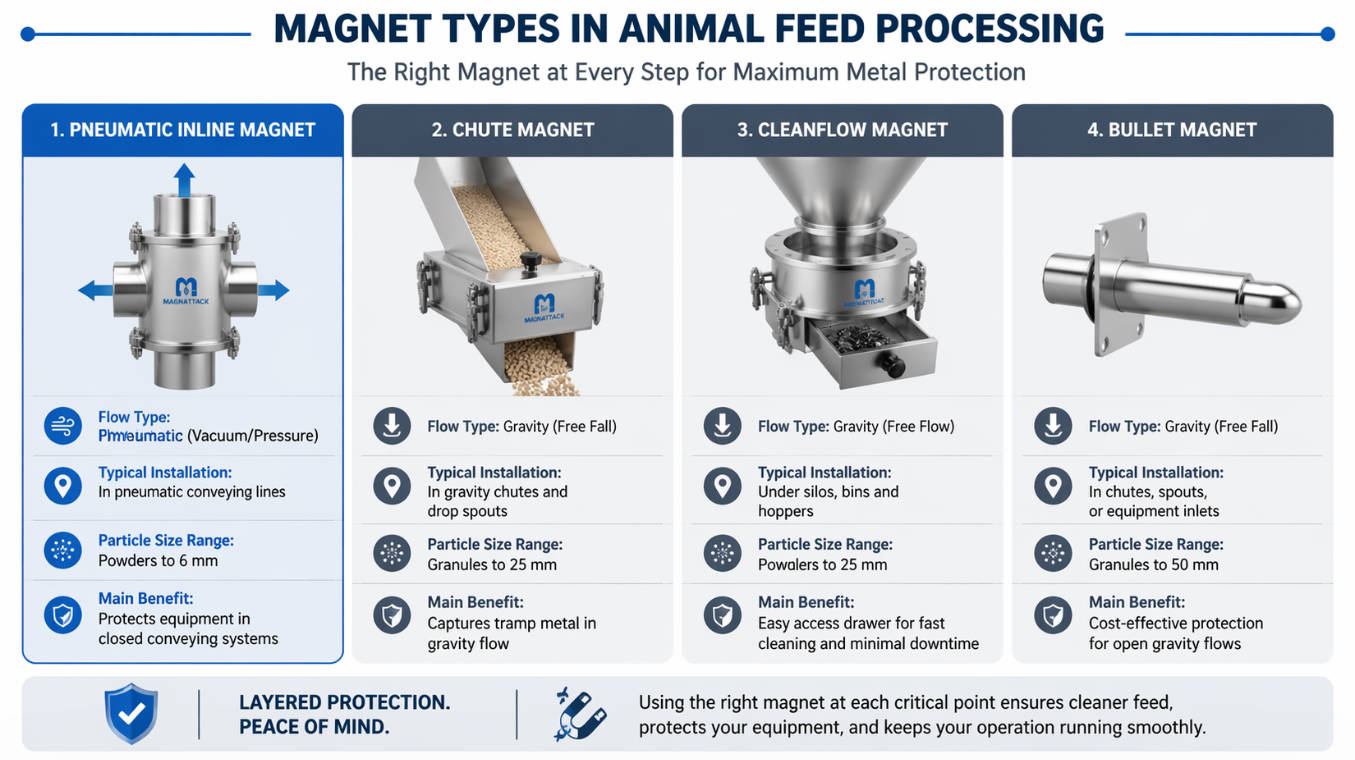
Below is a practical overview of how pneumatic inline magnets fit alongside other magnetic separation solutions commonly used in the cattle feed and animal nutrition industries. [bulkinside]
| Magnet type | Flow mode | Typical location in feed plant buntingmagnetics | Key advantages buntingmagnetics |
|---|---|---|---|
| Pneumatic inline magnet | Pneumatic (dilute) | In-line with 4–5″ conveying pipes, before mills, mixers, packaging buntingmagnetics | Continuous inline protection, low space demand, effective for fine ferrous contaminants buntingmagnetics |
| Chute magnet | Gravity / free-fall | In existing chutes or slides for powders and granules buntingmagnetics | Simple installation, strong Neodymium plates, effective for 60 µm–5 mm particles buntingmagnetics |
| Cleanflow / drawer magnet | Gravity or low-pressure | Under silos or above bagging lines buntingmagnetics | Captures iron and weakly magnetic stainless steel >30 µm, easy cleaning buntingmagnetics |
| Bullet / inline tube magnet | Pneumatic or gravity | Bulk and cattle feed transfer lines buntingmagnetics | Robust construction, suitable for high-capacity and ATEX zones buntingmagnetics |
Best Practices for Specifying PIMs in Animal Feed Plants
When advising customers or designing your own system, I recommend using a structured checklist before selecting a pneumatic inline magnet. [puritanmagnetics]
1. Define conveying conditions
– Line diameter, air velocity, and operating pressure. [processingmagazine]
– Material characteristics: density, particle size, abrasiveness, fat content, and temperature. [bulkinside]
2. Set performance targets
– What particle size do you need to capture (for example, 50–60 µm and above)? [magnattackglobal]
– Are you targeting only ferrous metal or also weakly magnetic stainless steel? [buntingmagnetics]
3. Check hygienic and regulatory needs
– Food or feed contact compliance, cleaning method (manual, clean-out-of-place, or clean-in-place). [packagingtechtoday]
– ATEX/Explosion safety requirements in dusty environments. [bulkinside]
4. Plan for maintenance and access
– Is there sufficient space to open the housing, loosen “T” bolts, and safely remove the magnets? [processingmagazine]
– Can you incorporate cleaning into existing shutdown schedules? [processingmagazine]
By addressing these points early, you ensure that the selected magnet integrates seamlessly and delivers the expected level of protection. [puritanmagnetics]
Practical Installation & Maintenance Tips From the Field
Over multiple projects with powder magnetic separators and magnetic systems in bulk handling lines, several practical rules of thumb have proven valuable. [wdymagnetic]
– Install magnets in accessible locations
Position PIMs where operators can safely reach and clean them, ideally at floor level or platform height rather than above head height. [processingmagazine]
– Ensure proper orientation and sealing
Respect the recommended orientation (vertical, horizontal, or angled) and torque guidelines for bolts to achieve proper gasket compression. [processingmagazine]
– Document cleaning intervals
Start with more frequent inspections, track how much metal is collected, and then optimize your cleaning schedule based on real data. [bulkinside]
– Verify magnet strength over time
Periodically test magnet strength and replace magnets that fall below your internal standard to maintain consistent performance. [magnattackglobal]
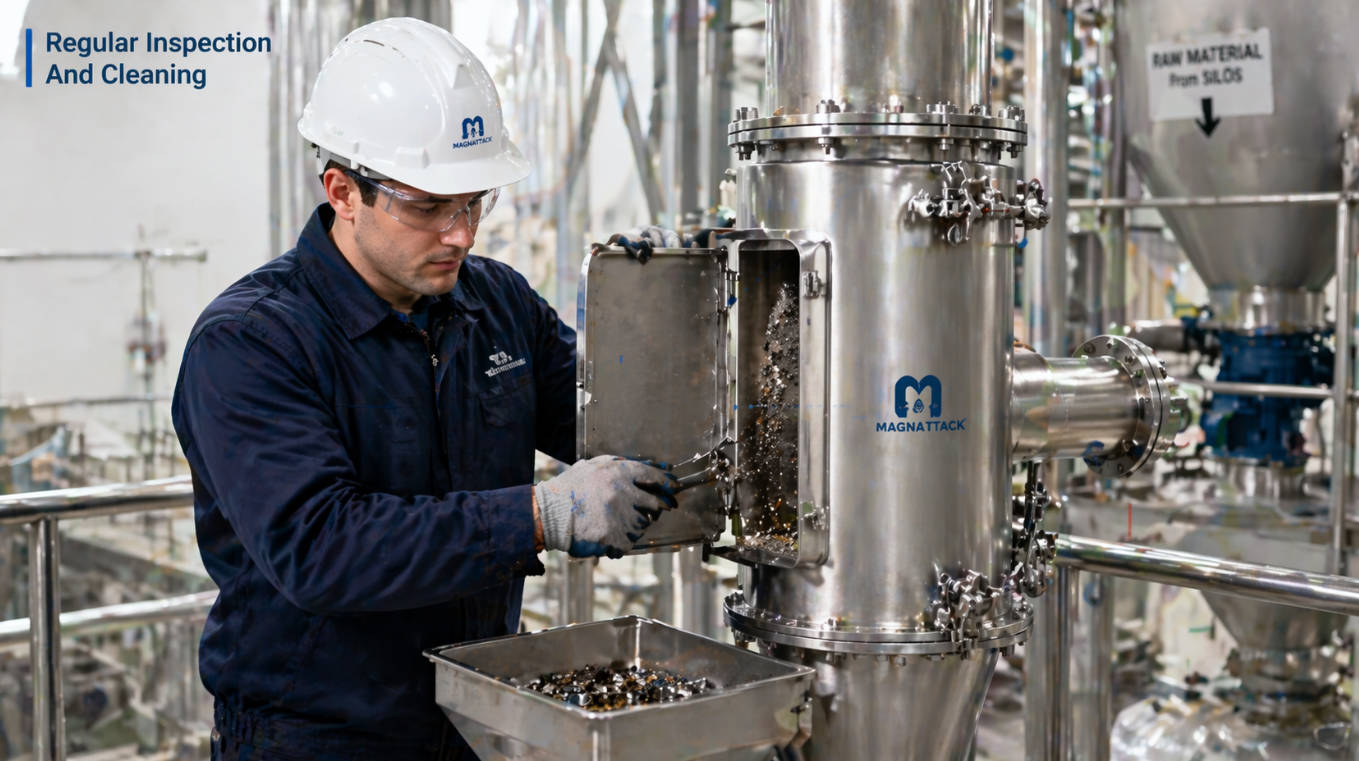
These steps align with global best practices for magnetic separation in food and feed industries and help maintain both safety and long-term reliability. [bulkinside]
Emerging Trends in Magnetic Separation for Animal Feed
The magnetic separation market for food and feed is expanding, and several trends are shaping the next wave of investments. [bulkinside]
– Higher expectations for documentation and validation
Auditors increasingly expect documented risk analyses, magnet test results, and clearly defined CCP/CP monitoring procedures. [packagingtechtoday]
– More hygienic and CIP-ready designs
Clean-in-place (CIP) and easy-clean systems are becoming more common to reduce manual handling in high-throughput facilities. [mpimagnet]
– Integration with digital quality systems
Plants are starting to log magnet inspection data into MES or QMS platforms for better traceability and continuous improvement. [linkedin]
For animal feed producers, this means that upgrading to modern inline magnet systems is not just about hardware, but also about aligning with evolving food safety culture and customer expectations. [linkedin]
When to Consider Upgrading Your Existing Magnets
If you already have some magnetic protection in place, it may still be time to review and upgrade. Based on industry experience, you should reassess your system if: [puritanmagnetics]
– You have experienced repeated equipment damage or unexplained bearing failures. [goudsmitmagnetics]
– Customer complaints or internal checks have occasionally detected metal in product. [magnattackglobal]
– Older magnets are difficult to clean, creating hygiene or ergonomic concerns. [bulkinside]
– Your facility is preparing for stricter audits or certifications. [packagingtechtoday]
A professional magnet audit can benchmark your current setup, identify gaps, and propose a roadmap that may include pneumatic inline magnets, chute magnets, and other solutions. [bulkinside]
Clear Call to Action: Design Your Next Pneumatic Inline Magnet Project
If you are planning a new feed line or upgrading an existing plant, this is the ideal time to rethink your magnetic separation strategy. Work with a specialist team experienced in powder magnetic separators, permanent magnetic separators, and full-line engineering to: [puritanmagnetics]
– Audit your current risk points and equipment. [bulkinside]
– Specify the right combination of pneumatic inline magnets and complementary systems. [bulkinside]
– Design, install, and commission a robust, compliant solution that protects both your machinery and your customers. [wdymagnetic]
A focused discussion using your plant layout, product mix, and quality requirements is usually enough to produce a tailored magnet layout and budget estimate. [puritanmagnetics]
FAQs
1. How do pneumatic inline magnets differ from chute magnets in animal feed lines?
Pneumatic inline magnets work directly in pressurized conveying lines, while chute magnets operate in gravity or free-fall sections of the process. PIMs are ideal for dilute-phase transport, whereas chute magnets are better suited for vertical drops or slides where product flows by gravity. [bulkinside]
2. What size of metal particles can inline magnets capture?
With modern neodymium plate designs, pneumatic inline systems can capture ferrous metal down to fine particles, often in the range of tens of microns, depending on design and product conditions. Other systems, like cleanflow magnets, are capable of capturing weakly magnetic stainless steel above approximately 30 microns. [buntingmagnetics]
3. How often should pneumatic inline magnets be cleaned in an animal feed plant?
Cleaning frequency depends on contamination levels and risk tolerance, but many plants start with daily or shift-based checks and then adjust based on how much metal is collected. Integrating cleaning into preventive maintenance schedules is a proven way to maintain performance without disrupting production. [processingmagazine]
4. Are pneumatic inline magnets suitable for ATEX-rated dust environments?
Yes, many inline magnet designs are compatible with ATEX zones and are built to be dust-tight and pressure rated for pneumatic systems. Always confirm the specific ATEX certification and gasket specifications with the equipment supplier. [bulkinside]
5. Do I still need other types of magnets if I install pneumatic inline magnets?
In most cases, yes: a layered approach is best practice. Pneumatic inline magnets complement chute, cleanflow, and bullet magnets to create multiple checkpoints throughout the process, from intake to final packaging. [goudsmitmagnetics]
References
1. Bunting Magnetics. “Pneumatic Inline Magnets for Animal Feed.”
<https://buntingmagnetics.com/blog/pneumatic-inline-magnets-for-animal-feed> [buntingmagnetics]
2. Goudsmit Magnetics. “Cattle feed & animal feed industry.”
<https://www.goudsmitmagnetics.com/en-us/applications-magnet-filters-for-cattle-feed-and-animal-feed-industry> [buntingmagnetics]
3. Magnattack Global. “Magnetic Separation for Pet Food and Animal Nutrition.”
<https://www.magnattackglobal.com/industries/food-processing/petfood-animal-nutrition/> [magnattackglobal]
4. BulkInside. “The Role of Magnets in Pneumatic Conveying Systems.”
<https://bulkinside.com/bulk-solids-handling/pneumatic-conveying/the-role-of-magnets-in-pneumatic-conveying-systems/> [bulkinside]
5. Processing Magazine. “Using separation magnets in pneumatic conveying systems.”
<https://www.processingmagazine.com/material-handling-dry-wet/conveyors/pneumatic—vacuum/article/55285404/industrial-magnetics-using-separation-magnets-in-pneumatic-conveying-systems> [processingmagazine]
6. Packaging Tech Today. “Ensuring Safety and Quality: Magnetic Separation in Pet Food Processing.”
<https://www.packagingtechtoday.com/featureds/ensuring-safety-and-quality-magnetic-separation-in-pet-food-processing/> [packagingtechtoday]
7. Puritan Magnetics. “Proper Magnet Selection.”
<https://www.puritanmagnetics.com/magnetic-separation-equipment/proper-magnet-selection/> [puritanmagnetics]
8. Sourcify China. “Comprehensive Guide to Magnetic Separation Equipment in China.”
<https://www.sourcifychina.com/magnetic-separation-equipment-guide-in-depth/> [sourcifychina]
9. Foshan Wandaye Technology Co., Ltd. “News – Magnetic Sheet Separator Installation.”
<https://www.wdymagnetic.com/news/page/3> [wdymagnetic]
10. Petfood Industry. “Bunting Magnetics Pneumatic In-Line Magnets.”
<https://www.petfoodindustry.com/pet-food-product-database/product/15462120/bunting-magnetics-pneumatic-in-line-magnets> [petfoodindustry]
Hot Tags: Pneumatic Inline Magnet, Manufacturers, Customized, Custom, Suppliers, Buy, Cheap, Quality, Advanced, Durable, in Stock, Made in China, Price, Quotation