


Content Menu
● What Is a Magnetic Liquid Trap?
● Why Magnetic Liquid Traps Matter in Modern Production
● How Magnetic Liquid Traps Work
● Core Components and Design Variants
● Typical Applications Across Industries
● Advantages Compared with Conventional Filtration
● Key Types of Magnetic Liquid Trap Designs
>> Main magnetic liquid trap types
● Expert Selection Guide: How to Choose the Right Magnetic Liquid Trap
● Step‑By‑Step: Installing a Magnetic Liquid Trap Correctly
● Operation and Maintenance Best Practices
● Automation and Sustainability
● Improving Ceramic Slurry Quality
● Why Choose a Specialist Manufacturer
● Practical Checklist Before You Buy
● Call to Action: Evaluate Your Liquid Lines Today
● FAQs on Magnetic Liquid Traps
>> 1. What types of contaminants can a magnetic liquid trap remove?
>> 2. How often should a magnetic liquid trap be cleaned?
>> 3. Will a magnetic liquid trap affect my flow rate or pressure?
>> 4. Are magnetic liquid traps suitable for food and pharmaceutical processes?
>> 5. What is the difference between a magnetic liquid trap and a permanent magnetic separator?
As an engineer working with permanent magnetic separators and slurry lines across ceramics, mining, and battery materials, I have seen how a well‑designed magnetic liquid trap can quietly decide whether a production line runs smoothly—or bleeds money through downtime and contamination. In this guide, I combine hands‑on industry experience with the latest insights on magnetic separation to show you how to choose, operate, and optimize magnetic liquid traps for modern liquid and slurry processes. [imt-inc]
What Is a Magnetic Liquid Trap?
A magnetic liquid trap (also called a magnetic trap or magnetic filter for liquids) is a sealed housing that uses high‑intensity permanent magnets to capture iron and ferromagnetic particles from liquids or slurries flowing in a pipeline. It is typically installed inline, allowing continuous filtration without stopping the process or changing disposable filter elements. [greatmagtech]
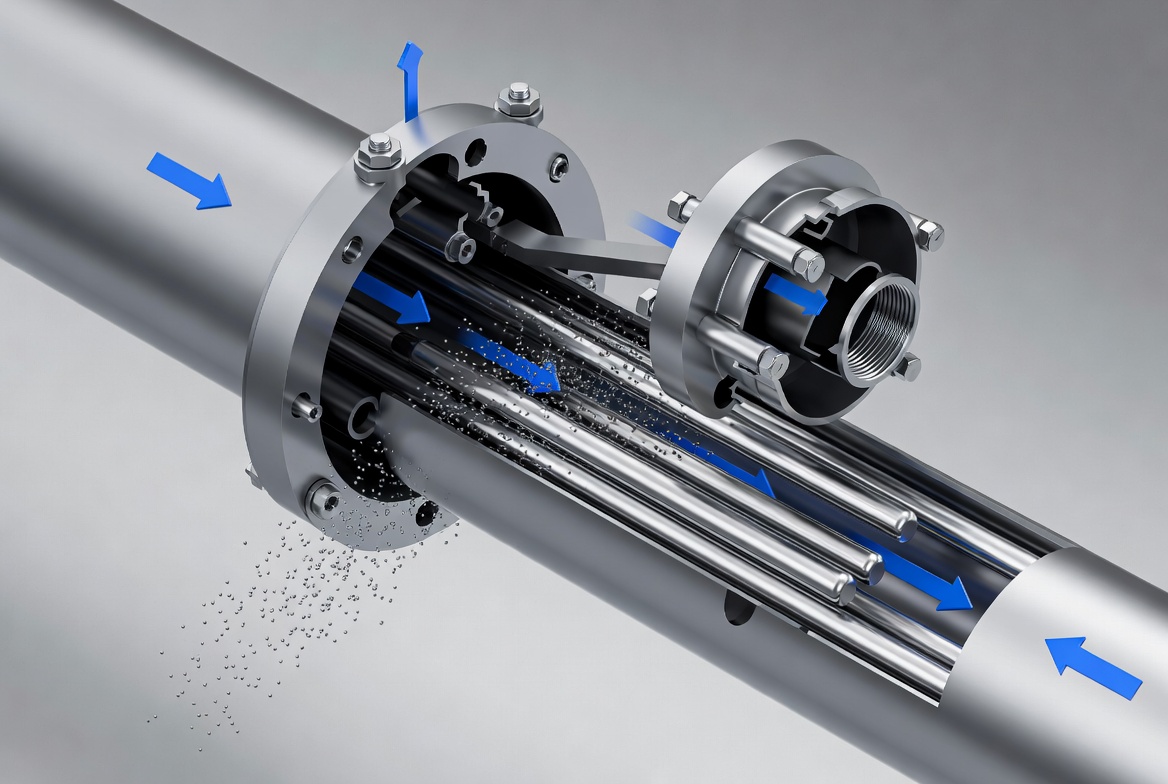
The magnets are usually arranged on rods, grids, or cartridges inside a stainless steel body so that the liquid must pass close to the magnetic field, where fine contaminants are pulled out of the flow. This prevents metal fines, rust, and tramp iron from reaching downstream equipment like pumps, valves, spray nozzles, spray dryers, presses, or filling machines. [buntingmagnetics]
Why Magnetic Liquid Traps Matter in Modern Production
From my experience with ceramic glaze lines and lithium battery slurry systems, the most expensive contamination problems often come from microscopic iron particles that ordinary strainers simply cannot catch. Magnetic liquid traps target exactly these particles, providing three key benefits for production facilities: [imt-inc]
– Product quality protection: Prevents black spots, pinholes, and surface defects in ceramics, glass, coatings, and food products.
– Equipment protection: Reduces wear, clogging, and damage in pumps, valves, heat exchangers, and spray nozzles.
– Regulatory & safety compliance: Helps food, pharma, and battery plants meet stricter contamination and quality standards. [linkedin]
In sectors like mining, ceramics, plastics, positive/negative electrode materials, chemicals, food, and environmental protection, these benefits translate directly into fewer complaints, less rework, and a more stable process window. [wdymagnetic]
How Magnetic Liquid Traps Work
At the heart of every magnetic liquid trap are high‑energy permanent magnets, often rare‑earth neodymium, mounted in rods or cartridges inside a pressure‑rated housing. When contaminated liquid flows through the housing, magnetic particles are attracted to the rods’ surface and held there until the system is cleaned. [mpimagnet]
Key working principles:
– High‑gradient magnetic field: By using poles, sleeves, or stepped rod profiles, the trap creates intense local fields that capture even sub‑micron iron fines. [buntingmagnetics]
– Engineered flow path: The housing is designed to slow and redirect the flow so that all liquid passes close to the magnetic elements without creating dead zones. [greatmagtech]
– Non‑intrusive separation: The liquid’s chemical composition and physical properties (pH, color, taste) remain unchanged because no consumables or chemicals are added. [greatmagtech]
Compared with cartridge filters or mesh strainers, a magnetic trap removes very fine ferromagnetic particles that are too small to be stopped by purely mechanical filtration—especially in viscous slurries.
Core Components and Design Variants
From field installations, the traps that perform best share a few structural features: [mpimagnet]
– Stainless steel housing (typically 304 or 316L) for corrosion resistance and food/pharma compatibility
– Magnetic rods or cartridges containing high‑energy rare‑earth magnets
– Inlet/outlet connections (flanged, threaded, clamp‑type) sized to match the process pipeline
– Removable magnetic assembly to simplify cleaning and inspection
Common design variants include: [mpimagnet]
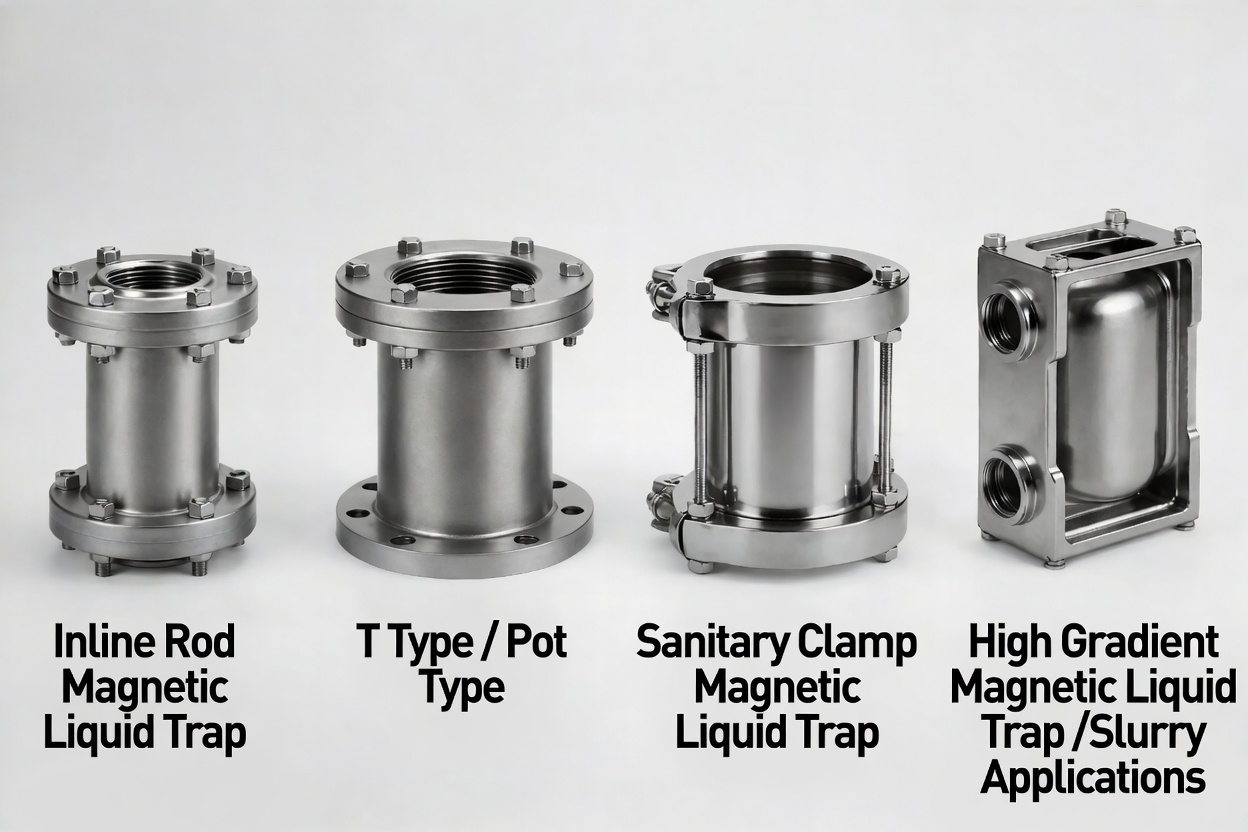
– Inline tube‑style traps for standard pipelines in food, beverage, and chemical plants
– T‑type or pot‑type traps with larger collection volume for high‑contamination or slurry applications
– Sanitary/hygienic traps with polished internal surfaces and clamp connections for dairy, beverage, and pharma use
For manufacturers like Foshan Wandaye, these designs are often combined with process‑specific engineering—for example, optimizing rod spacing and housing geometry for ceramic glaze viscosity or battery slurry solid content. [wdymagnetic]
Typical Applications Across Industries
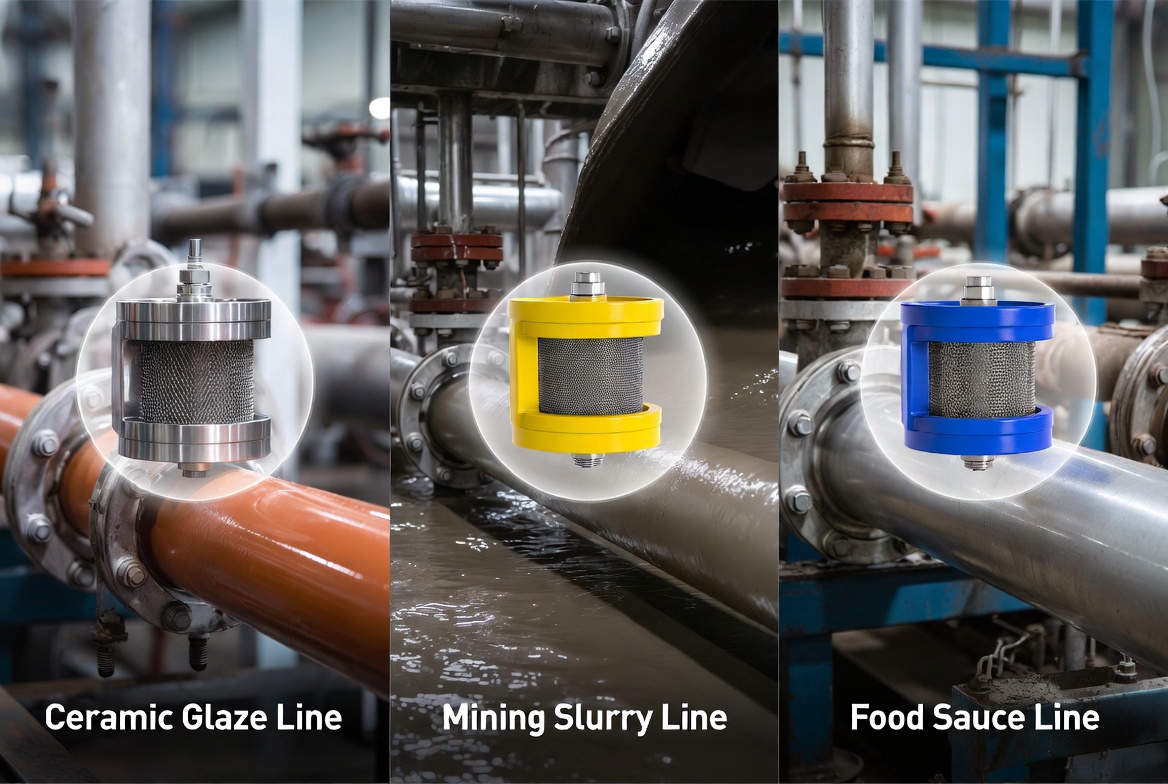
In practice, I see magnetic liquid traps deployed anywhere liquid or slurry can carry metal fines. Typical applications include: [imt-inc]
– Mining and mineral processing: Removing magnetic fines from process slurries before classification, flotation, or dense media separation. [dingsmagnets]
– Ceramics and glass: Cleaning glaze, slip, and glass frit slurries to prevent surface defects and black spots on tiles and glass panels. [wdymagnetic]
– Positive/negative electrode materials: Controlling iron contamination in lithium battery cathode/anode slurries to protect electrochemical performance. [linkedin]
– Food and beverage: Capturing metal fragments from chocolate, sauces, dairy products, and beverages to meet food safety standards. [greatmagtech]
– Plastics and rubber: Filtering additives, colorants, and liquid compounds to protect dies and extrusion equipment. [wdymagnetic]
– Environmental and wastewater: Removing ferrous particles from industrial effluents before discharge or recycling. [buntingmagnetics]
In many of these scenarios, magnetic traps are used together with other separation equipment (screens, hydrocyclones, permanent magnetic separators) to build a multi‑stage defense against contamination.
Advantages Compared with Conventional Filtration
From a total cost of ownership perspective, magnetic liquid traps often outperform disposable filters or strainers. Some key advantages include: [buntingmagnetics]
– No disposable elements: Cleaning and re‑using the magnetic assembly eliminates recurring filter cartridge costs and waste. [greatmagtech]
– Low pressure drop: Properly sized traps maintain smooth flow with minimal impact on system pressure, even in viscous slurries. [mpimagnet]
– Fine particle capture: Efficient removal of very small ferromagnetic particles that pass through standard mesh or cartridge filters. [buntingmagnetics]
– Stable performance: Permanent magnets provide consistent separation performance over many years without external power. [wdymagnetic]
In my experience, plants that switch from dense cartridge filter regimes to permanent magnetic traps often report shorter changeover times, fewer line stops, and cleaner process equipment at scheduled maintenance intervals.
Key Types of Magnetic Liquid Trap Designs
Below is a practical overview of commonly used trap types and where they fit best.
Main magnetic liquid trap types
| Trap type | Typical construction | Best suited for | Strengths |
|---|---|---|---|
| Inline rod trap | Cylindrical housing with multiple magnetic rods inline | Food, beverage, low–medium viscosity liquids | Hygienic, easy to install and clean greatmagtech |
| T‑type / pot‑type trap | Side‑entry housing with large volume and rod bundle | Ceramic glaze, mining slurries, battery slurries | High holding capacity for heavy contamination wdymagnetic |
| Sanitary clamp trap | Polished 316L body, tri‑clamp connections | Dairy, pharma, high hygiene processes | CIP‑friendly and easy to disassemble mpimagnet |
| High‑gradient slurry trap | Optimized rod spacing and high‑intensity magnets | Non‑metallic minerals, fine powders in slurry | Captures ultra‑fine ferromagnetic particles buntingmagnetics |
This is also where specialist manufacturers, such as Foshan Wandaye, differentiate by tailoring magnetic field strength, rod geometry, and flow design to each application’s rheology and contamination profile. [magnetii.goldsupplier]
Expert Selection Guide: How to Choose the Right Magnetic Liquid Trap
When I audit a line and recommend a magnetic liquid trap, we walk through a structured evaluation rather than just picking a nominal pipe size. The most important criteria are:
1. Process medium
– Liquid vs. slurry, solids content, viscosity, abrasiveness.
2. Contaminant characteristics
– Particle size distribution, load (ppm), type of ferromagnetic materials (rust, scale, wires, chips).
3. Process conditions
– Temperature, pressure, pH, cleaning chemicals, and hygienic requirements.
4. Line integration
– Pipe diameter, available installation length, orientation, and maintenance access.
For high‑value processes—such as battery materials, ceramics, or food—my expert recommendation is usually a high‑gradient permanent magnetic trap with rare‑earth magnets and a housing designed for easy, repeatable cleaning. Working with an experienced manufacturer allows you to translate these requirements into a specific model and configuration. [mpimagnet]
Step‑By‑Step: Installing a Magnetic Liquid Trap Correctly
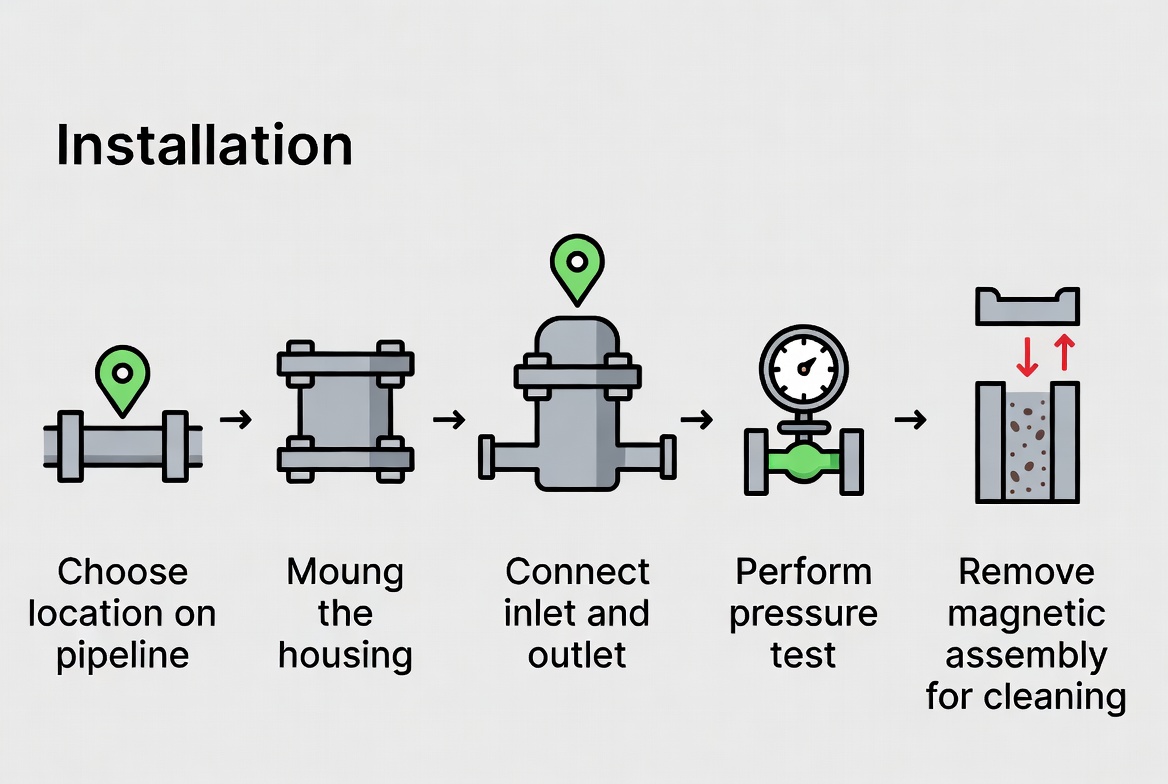
Poor installation can undermine even the best magnetic trap design. Based on multiple commissioning projects, I recommend this practical workflow:
1. Confirm the installation location
– Choose a straight pipe section with sufficient upstream and downstream length to ensure stable flow.
2. Check orientation and accessibility
– Install according to the manufacturer’s preferred orientation (horizontal/vertical) and leave clear space for removing the magnetic assembly.
3. Prepare connections
– Match flange ratings, clamp sizes, or threaded connections to existing pipelines and pressure class.
4. Verify sealing
– Use appropriate gaskets for process temperature, pressure, and chemical compatibility.
5. Pressure test and leak check
– Conduct a hydrostatic or operational pressure test before full‑scale production.
Well‑executed installation makes later inspection and cleaning cycles faster and safer, which is critical for plants running 24/7.
Operation and Maintenance Best Practices
From an operator’s standpoint, a magnetic liquid trap is relatively simple, but consistent procedures are essential for stable performance. General best practices include: [greatmagtech]
– Define cleaning intervals based on contamination load and product sensitivity, then adjust based on inspection results.
– Follow a standard cleaning sequence:
1. Safely isolate and depressurize the trap.
2. Remove the magnetic assembly.
3. Wipe or wash metal contaminants into a designated container.
4. Inspect rods for wear or corrosion.
5. Reassemble and verify seals.
– Record metal capture (weight/volume) to build a contamination trend over time.
Plants that treat magnetic trap cleaning as a regular, logged maintenance task typically see improved predictive maintenance and better understanding of upstream wear or corrosion sources.
Automation and Sustainability
Market data and industry reports show that demand for magnetic liquid traps continues to grow as manufacturers tighten contamination control and pursue more sustainable operations. Several trends stand out in current projects: [linkedin]
– Higher magnetic strength and temperature ratings to handle harsh slurries and elevated process temperatures. [mpimagnet]
– Automated or semi‑automatic cleaning systems that reduce manual handling time in high‑throughput lines. [linkedin]
– Integration with process monitoring—for example, logging cleaning frequency and captured metal volumes as quality indicators. [linkedin]
– Sustainability focus: Eliminating disposable filters and extending equipment life align with global ESG and cost‑reduction goals. [linkedin]
Manufacturers who adopt these new‑generation traps early often gain more stable quality, easier audits, and stronger positioning with high‑spec customers.
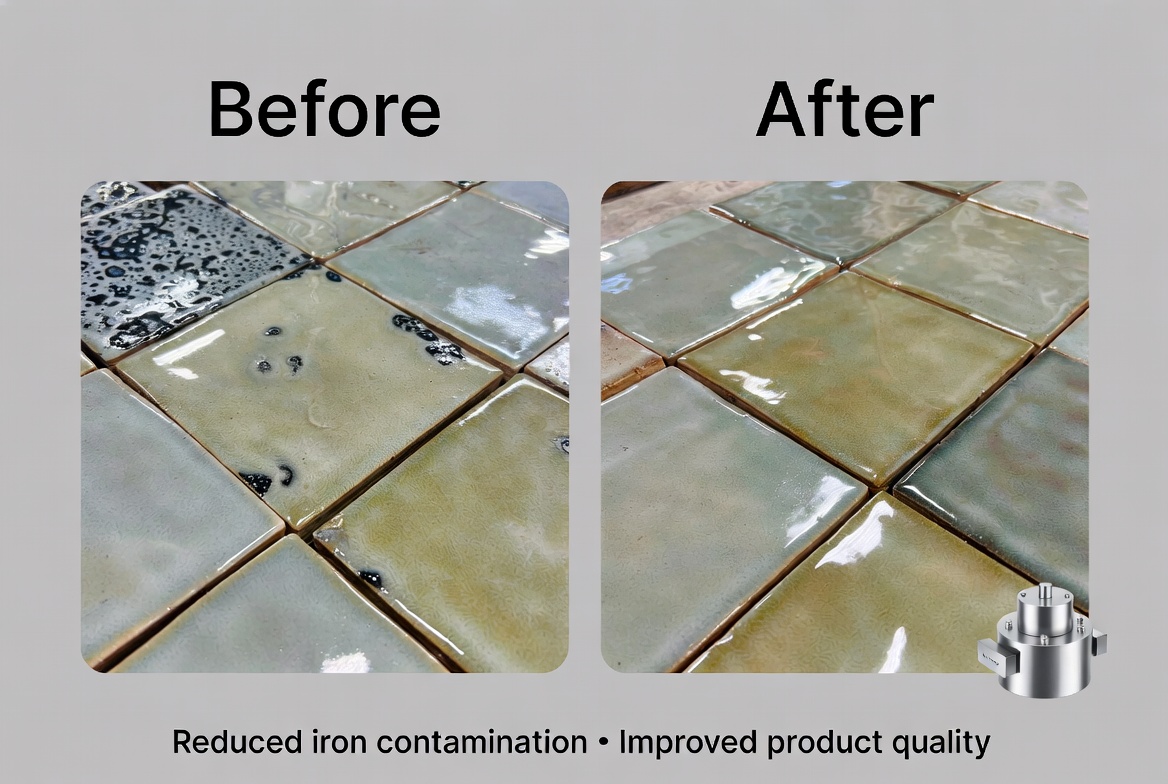
Improving Ceramic Slurry Quality
In ceramic tile and sanitaryware plants, it is common to see surface defects caused by invisible iron fines in glaze and slip lines. A typical upgrade path we implement looks like this: [wdymagnetic]
– Install high‑gradient magnetic slurry traps on glaze circulation loops and slip feed lines.
– Use rare‑earth permanent magnets to capture fine rust, scale, and steel wear particles.
– Monitor defect rate before and after installation, along with captured metal mass per cleaning.
Plants that implement this approach generally report a noticeable reduction in glaze pinholes and black spots, fewer nozzle blockages, and more stable firing quality, while also cutting down on disposable filter costs. [wdymagnetic]
Why Choose a Specialist Manufacturer
Because magnetic liquid traps must align closely with each process, working with a dedicated magnetic separation equipment manufacturer is critical. Companies like Foshan Wandaye Technology Co., Ltd. combine: [magnetii.goldsupplier]
– R&D and engineering design for permanent magnetic separators and magnetic liquid traps across mining, ceramics, electric power, building materials, glass, environmental protection, rubber, plastics, pharmaceuticals, food, and battery materials. [magnetii.goldsupplier]
– Production line installation and debugging to ensure equipment performance in real‑world process conditions. [wdymagnetic]
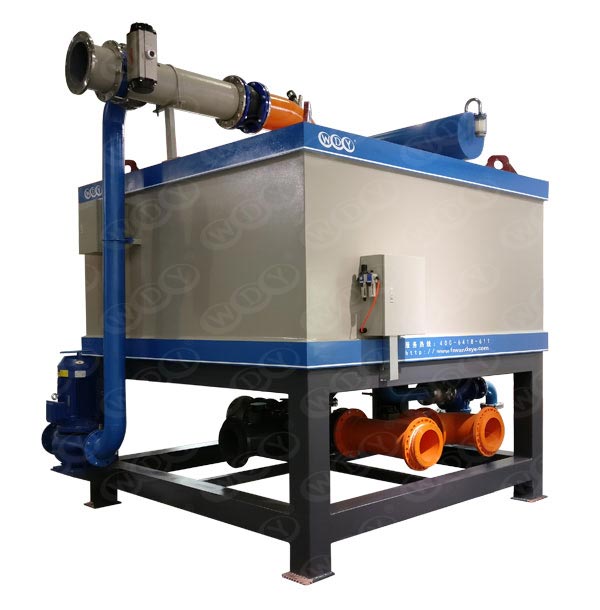
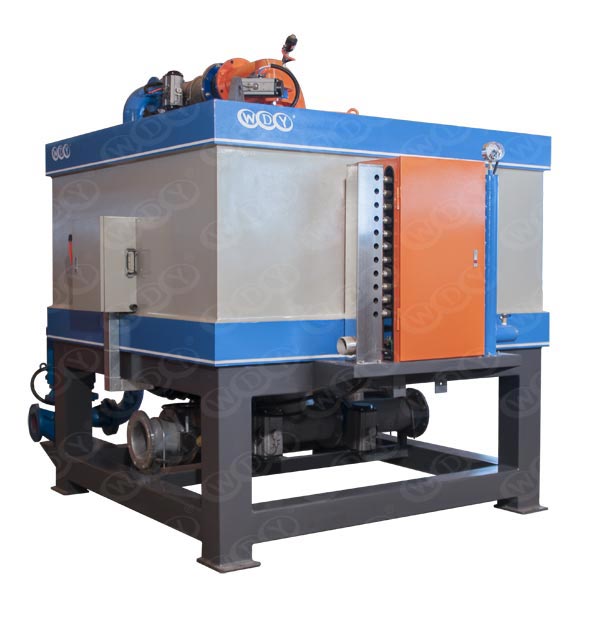
– Application‑specific solutions, including high‑gradient slurry separators and program‑controlled automatic electromagnetic separators for demanding non‑metallic mineral and slurry applications. [wdymagnetic]
From an expert perspective, this combination of application knowledge + magnetic design capability is what turns a “standard filter” into a long‑term reliability asset for your plant.
Practical Checklist Before You Buy
Before selecting or upgrading a magnetic liquid trap, I recommend answering these questions internally and with your supplier:
– What is the target maximum iron content after separation?
– Which downstream equipment or quality parameters are being protected?
– How often can the line be stopped for cleaning, and what level of automation is realistic?
– Are there hygienic, food‑grade, or GMP requirements?
– What is the expected service life and ROI timeframe for the trap?
Documenting these points will help your supplier design or recommend a solution that fits both technical and commercial expectations.
Call to Action: Evaluate Your Liquid Lines Today
If you are running liquid or slurry processes in mining, ceramics, glass, battery materials, food, or chemicals, it is worth asking a simple question: How much is hidden metal contamination costing you every year? By auditing your pipelines and integrating properly designed magnetic liquid traps, you can cut defects, protect critical equipment, and support your quality and sustainability goals. [imt-inc]
For engineered magnetic liquid trap and permanent magnetic separator solutions, consult with a specialized manufacturer capable of application analysis, custom design, and on‑site commissioning so your investment translates into measurable process performance.
FAQs on Magnetic Liquid Traps
1. What types of contaminants can a magnetic liquid trap remove?
A magnetic liquid trap primarily removes ferromagnetic contaminants, such as iron filings, rust, steel wear particles, and other iron‑based metal fragments suspended in liquids or slurries. It can also capture some weakly magnetic particles, depending on field strength and design, but it does not replace non‑magnetic filtration for sand or plastic particles. [buntingmagnetics]
2. How often should a magnetic liquid trap be cleaned?
Cleaning frequency depends on contamination load, product sensitivity, and process uptime requirements, but many plants start with daily or weekly cleaning and then optimize based on captured metal volume. High‑load mining or slurry applications may require more frequent cleaning, while cleaner processes can extend intervals once performance trends are understood. [imt-inc]
3. Will a magnetic liquid trap affect my flow rate or pressure?
When correctly sized and installed, a magnetic liquid trap introduces only a modest pressure drop and maintains stable flow, even in viscous liquids. If the trap is undersized or overloaded with metal contamination between cleanings, pressure drop can increase, so proper design and maintenance are essential. [greatmagtech]
4. Are magnetic liquid traps suitable for food and pharmaceutical processes?
Yes, many models are designed specifically for food, beverage, and pharmaceutical applications, using polished 304/316L stainless steel, sanitary connections, and hygienic sealing systems. For regulated environments, the trap should comply with applicable food‑contact or GMP guidelines and integrate into existing cleaning and validation procedures. [buntingmagnetics]
5. What is the difference between a magnetic liquid trap and a permanent magnetic separator?
A magnetic liquid trap is a type of inline magnetic separator optimized for liquids and slurries in closed pipelines. Permanent magnetic separators include a broader family of equipment—such as drum separators, plate magnets, and high‑gradient slurry separators—used on conveyors, chutes, and open slurry channels across mining, ceramics, and other industries. [imt-inc]
References
1. Great Magtech. “Magnetic Liquid Trap – All You Need to Know.” 2023. [Link] [greatmagtech]
2. IMT Inc. “Wet Drum Magnetic Separators Explained.” [Link] [imt-inc]
3. Bunting. “Magnetic Separation in Mining and Mineral Processing.” 2025. [Link] [buntingmagnetics]
4. MPI. “The Most Powerful Liquid Trap Magnet the Industry Has…” 2025. [Link] [mpimagnet]
5. Market report on Magnetic Liquid Traps 2026–2033 (industry trends and growth drivers). 2026. [Link] [linkedin]
6. Foshan Wandaye Technology Co., Ltd. Company and product information. [Link] [wdymagnetic]
7. Foshan Wandaye Technology Co., Ltd. Product portfolio and slurry separator details. [Link] [wdymagnetic]
8. Magnetic separation equipment listings related to Foshan Wandaye. [Link] [magnetii.goldsupplier]
9. Dings. “Magnetic Separation for Mining and Aggregate Production.” 2024. [Link] [dingsmagnets]
Hot Tags: Magnet Trap, Manufacturers, Customized, Custom, Suppliers, Buy, Cheap, Quality, Advanced, Durable, in Stock, Made in China, Price, Quotation