Content Menu
● What Are Neodymium Sphere Magnets?
● Key Magnetic Properties That Matter for Engineers
>> Uniform Magnetic Field Around the Sphere
>> Extreme Magnetic Strength in a Small Volume
● Material Composition, Grades, and Temperature Performance
>> Understanding Neodymium Grades (N35–N52, SH, UH, EH)
● Size, Geometry, and Design Flexibility
>> Sphere Size and Field Strength
>> Alternative Shapes for System Integration
● How Neodymium Sphere Magnets Work in Magnetic Separation
● Industrial and Research Applications
>> Applications in Magnetic Separation and Iron Removal
>> Additional Use Cases Beyond Separation
● Advantages Compared with Conventional Magnets
● Durability, Protection, and Long-Term Performance
>> Resistance to Demagnetization
>> Protective Coatings and Structural Integrity
● Practical Guidelines: Selecting the Right Sphere Magnets
>> Step-by-Step Selection Checklist
● Safe Handling and Storage Best Practices
● Where Magnetic Separation Specialists Add Value
● Example: Using Neodymium Sphere Magnets in a Ceramic Production Line
● Why Neodymium Sphere Magnets Are a Smart Investment
● Clear Call to Action: Upgrade Your Magnetic Separation System Now
● Frequently Asked Questions (FAQ)
>> 1. What makes neodymium sphere magnets better for magnetic separation than ferrite magnets?
>> 2. Which grade should I choose for high-temperature mining or ceramic applications?
>> 3. Do I always need a special coating for neodymium sphere magnets?
>> 4. Are neodymium magnetic balls safe to use around electronics and medical implants?
>> 5. How long do neodymium sphere magnets last in industrial service?
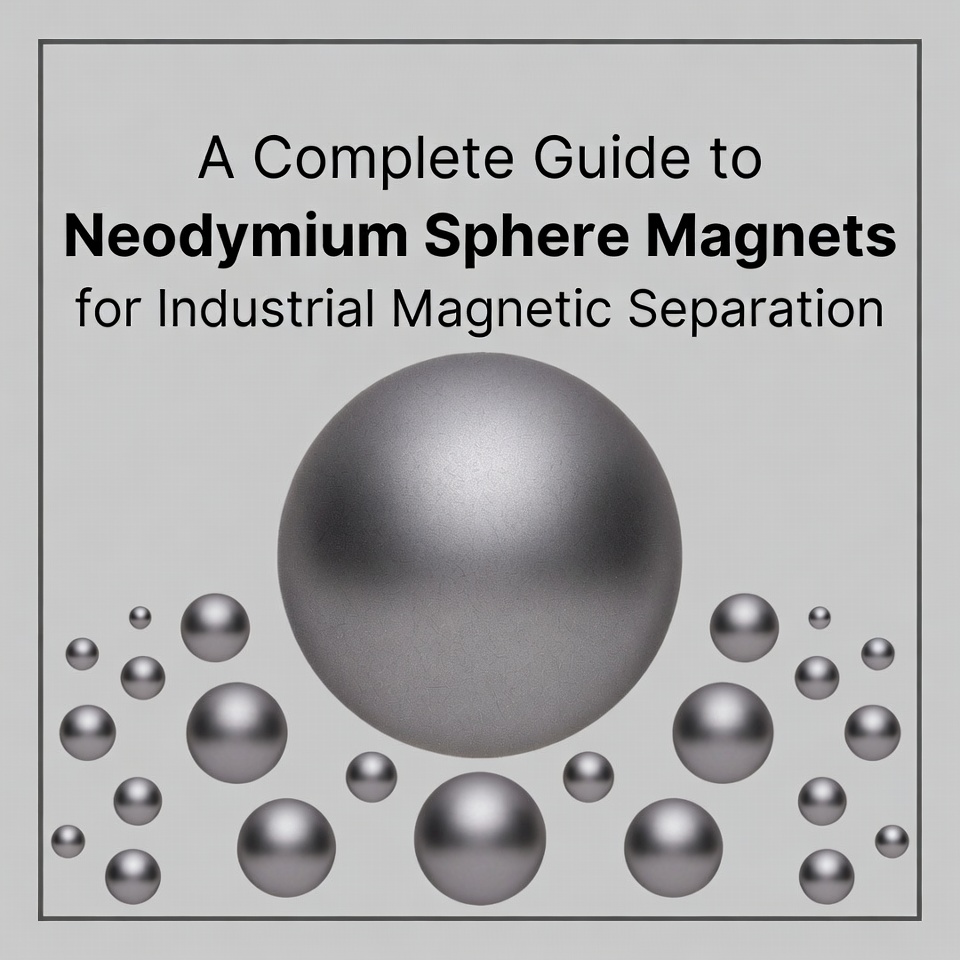
Neodymium sphere magnets, also called magnetic balls or rare earth ball magnets, are compact yet extremely powerful components used in magnetic separation, metal removal, and precision holding across mining, ceramics, food, and pharmaceutical production lines. This guide explains how they work, how to choose the right grade and size, and how they can enhance your magnetic separation and iron-removal systems.
What Are Neodymium Sphere Magnets?
Neodymium sphere magnets are solid balls made from NdFeB alloys, a combination of neodymium (Nd), iron (Fe), and boron (B), engineered to deliver high remanence and strong coercive force in a very small volume. Compared with traditional ferrite magnets, they provide significantly higher magnetic energy density, making them ideal for compact but powerful industrial designs.
Each sphere generates a strong, stable magnetic field that can be precisely controlled through its grade, size, and coating, which is why they are widely adopted in high-performance magnetic separation equipment and precision fixturing.
Key Magnetic Properties That Matter for Engineers
Uniform Magnetic Field Around the Sphere
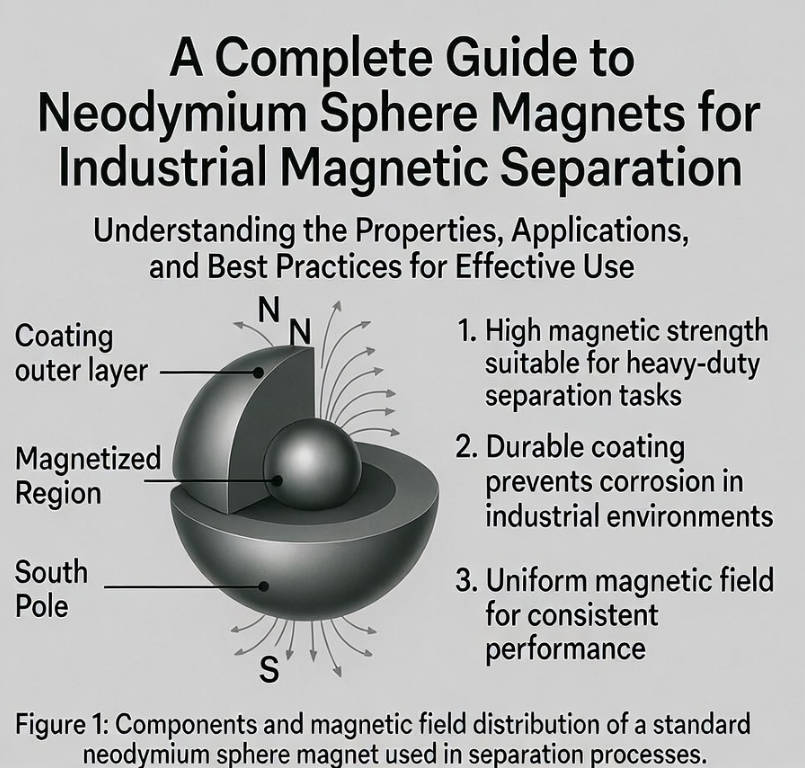
A major advantage of neodymium sphere magnets is their almost uniform magnetic field around most of the surface, which leads to predictable and repeatable performance in engineering applications. The magnetic field is strongest at the poles, where the internal North–South axis intersects the surface, and gradually weakens toward the equator region.
Because the sphere naturally aligns to its lowest-energy orientation, it tends to rotate until the poles lock into the strongest field direction, a behavior that is very useful for self-aligning couplings and dynamic magnetic assemblies.
Extreme Magnetic Strength in a Small Volume
Depending on grade and size, neodymium sphere magnets can reach surface field strengths up to around 5,000 Gauss, far beyond typical household or educational magnets. For comparison, a common fridge magnet is roughly 10–100 Gauss, while simple ferrite magnets used in school projects are typically 200–1,000 Gauss.
This intense field allows engineers to design compact magnetic separators, powerful holding fixtures, and miniature sensing devices without needing large, heavy magnet blocks.
Material Composition, Grades, and Temperature Performance
NdFeB Alloy and Coatings
Neodymium sphere magnets are produced from NdFeB alloy, where composition and processing control the magnet’s residual magnetism (remanence) and resistance to demagnetization (coercivity). Because neodymium is prone to corrosion, the spheres are usually plated with nickel, zinc, gold, or epoxy to protect against rust and surface damage in humid or chemically aggressive environments.
These coatings not only improve durability but also support long-term stability in demanding applications such as slurry-type magnetic separation or ceramic glaze filtration.
Understanding Neodymium Grades (N35–N52, SH, UH, EH)
Standard neodymium grades like N35–N52 define the magnet’s maximum energy product, with higher numbers representing stronger magnets per unit volume. For elevated temperatures, special high-temperature grades such as SH (Super High), UH (Ultra High), and EH (Extremely High) maintain magnetic performance better in hot industrial environments, including automotive and aerospace systems.
Choosing an appropriate grade is essential: general-purpose N35–N42 may be sufficient for room-temperature conveyors, while SH, UH, or EH grades are more suitable for high-temperature kilns, dryers, or hot product streams in mining and ceramics processing.
| Grade | Typical Use Case | Key Benefit |
|---|---|---|
| N35–N42 | General magnetic separation at room temperature | Balanced cost and strength |
| N45–N52 | Compact, high-intensity separators | Maximum magnetic force in small space |
| SH | Moderately high temperatures | Better stability in hot environments |
| UH / EH | Extreme industrial heat zones | Enhanced demagnetization resistance |
Size, Geometry, and Design Flexibility
Sphere Size and Field Strength
Neodymium magnetic balls are available from tiny 3 mm spheres for laboratory and educational uses up to 50 mm spheres for heavy-duty industrial or research applications. Larger spheres generate stronger fields and can attract ferrous contaminants from greater distances, but they are more challenging to manufacture and handle safely.
In high-throughput separation systems, engineering teams often balance magnet size against equipment geometry, safety margins, and maintenance requirements to achieve the optimum capture efficiency.
Alternative Shapes for System Integration
While spheres provide uniform fields and easy rotation, many systems also employ cylindrical, rectangular, or ring-shaped neodymium magnets to match specific mechanical designs. For example, bar or block magnets may be embedded in grates, drums, or chutes, while spherical elements can be used in self-aligning joints, checking devices, or dynamic field configurations.
This mix of shapes gives designers the flexibility to meet strict space constraints while still achieving targeted magnetic field distributions in separation and iron-removal equipment.
How Neodymium Sphere Magnets Work in Magnetic Separation
The magnetic field in each sphere arises from the aligned atomic dipoles inside the NdFeB alloy, creating a strong dipole field that interacts with ferromagnetic particles in the product stream. When these spheres are strategically arranged in magnetic separators, they generate high-gradient regions where fine iron particles are captured and held against process forces like gravity, vibration, or fluid flow.
As product passes through or around the magnets, the ferrous contaminants are attracted and trapped, and later removed during manual or automatic cleaning cycles to keep downstream equipment and products free from metal contamination.
Industrial and Research Applications
Applications in Magnetic Separation and Iron Removal
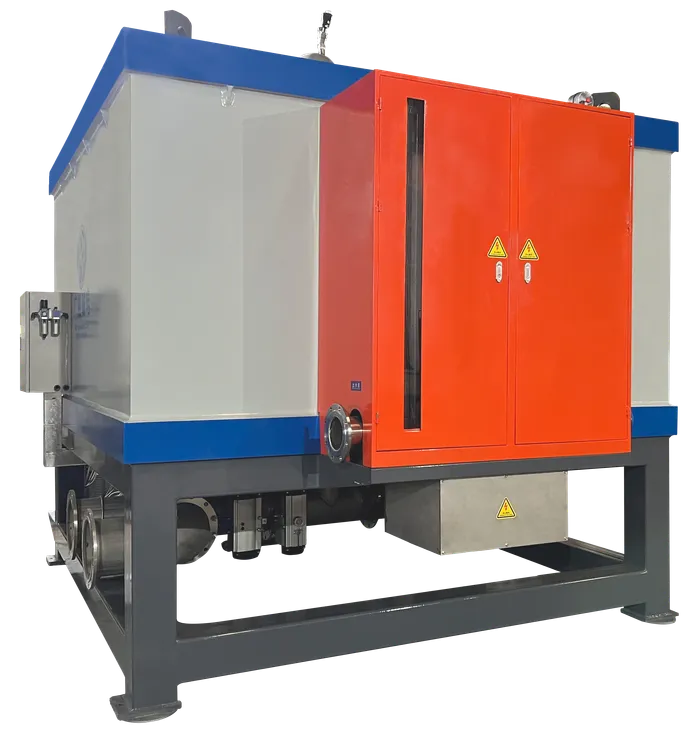
Neodymium sphere magnets are integral components in many magnetic separators used to remove metal contaminants from bulk materials in factories. They can be deployed in fixed grids, rotary separators, or custom housings in industries such as mining, ceramics, food, and pharmaceuticals where product purity is critical.
Beyond separation, they also support magnetic chucks for machining, where strong holding force is required to stabilize metal workpieces during cutting and grinding operations.
Additional Use Cases Beyond Separation
Thanks to their strength and compact size, neodymium magnetic balls are used in precast concrete formwork, where they help accurately position and secure steel reinforcements. They play an important role in physics experiments and STEM learning kits, enabling students and researchers to explore magnetism, field interaction, and material behavior.
Other uses include medical research, creative prototypes, magnetic toys, jewelry, heavy load lifting, and treasure-hunting tools for retrieving metal objects from lakes and rivers.
Advantages Compared with Conventional Magnets
Neodymium magnets are roughly ten times stronger than traditional ferrite magnets, allowing engineers to achieve the same or higher performance with a much smaller magnet volume. This means lighter equipment, smaller housings, and increased design freedom for compact production lines and integrated automation.
They also deliver long-term stability when properly coated and handled, offering a cost-effective solution for businesses that require durable, high-performance magnetic separation or holding systems.
Durability, Protection, and Long-Term Performance
Resistance to Demagnetization
Neodymium magnets have high coercive force, which allows them to resist demagnetization even when exposed to external magnetic fields or moderate heat within the specified grade limits. This stability is crucial in industrial environments where magnets may operate near motors, transformers, or other strong magnetic sources.
Protective Coatings and Structural Integrity
Because base neodymium is brittle and susceptible to corrosion, surface coatings such as nickel, gold, zinc, or epoxy are applied to improve mechanical robustness and environmental resistance. These coatings help prevent rust, chipping, and surface degradation, extending service life in wet, dusty, or chemically aggressive processes.
Advanced manufacturing techniques ensure that even though neodymium is inherently brittle, finished magnets have adequate structural integrity for demanding industrial applications when correctly specified and installed.
Practical Guidelines: Selecting the Right Sphere Magnets
Step-by-Step Selection Checklist
1. Define your application: Clarify whether the magnet will be used for magnetic separation, iron removal, holding, sensing, or experimental purposes.
2. Specify operating conditions: Identify temperature range, presence of moisture or chemicals, mechanical shock, and cleaning methods.
3. Choose grade and size: Select an N35–N52 or high-temperature grade (SH/UH/EH) and sphere diameter that provides sufficient field strength and reach for your target particle size.
4. Select coating: Use nickel or zinc for general industry, epoxy for highly corrosive environments, and gold where biocompatibility or premium appearance is needed.
5. Plan safety and maintenance: Ensure handling tools, guards, and cleaning procedures are defined to protect personnel and equipment.
Key Factors at a Glance
– Grade (N35–N52) – Determines maximum magnetic energy and force.
– High-temperature grade (SH/UH/EH) – Critical for high-heat processes in mining, ceramics, and metallurgy.
– Diameter (3–50 mm) – Impacts field reach, capture distance, and mechanical integration.
– Coating (nickel, gold, epoxy, zinc) – Influences corrosion resistance and surface durability.
Safe Handling and Storage Best Practices
Handling Safety
Because neodymium sphere magnets are extremely strong, they can snap together violently, potentially causing pinched fingers or chipped magnets if mishandled. They should be handled with care, preferably using non-magnetic tools and adequate spacing to prevent accidental collisions.
Strong fields can interfere with electronic devices, including credit cards, hard drives, and medical implants such as pacemakers, so it is essential to keep magnets at a safe distance from sensitive equipment and personnel.
Storage and Maintenance
Store magnets in a dry, clean environment to minimize corrosion and keep them separated by spacers or in designated storage blocks to prevent accidental contact. Periodic inspection of coatings, housings, and fixtures helps identify early signs of wear or damage, allowing scheduled replacement before performance declines.
With correct handling and basic maintenance, neodymium sphere magnets can remain effective for many years, even in challenging industrial conditions.
Where Magnetic Separation Specialists Add Value
Industrial users often need more than just individual magnets; they require engineered magnetic systems optimized for their specific products, throughput, and regulatory requirements. A specialized magnetic separation manufacturer can help design complete solutions that integrate neodymium sphere magnets into grates, drums, pipelines, and automatic cleaning systems for mining, ceramics, and pharmaceutical processes.
Expert partners provide application assessment, magnet configuration, housing design, and validation testing to ensure that the installed system achieves the necessary iron-removal efficiency while meeting safety and hygiene standards.
Example: Using Neodymium Sphere Magnets in a Ceramic Production Line
In a ceramic plant, fine iron particles in glaze or slip can cause defects, surface blemishes, or firing issues if not removed. By integrating high-grade neodymium sphere magnets into inline separators, manufacturers can capture very fine ferromagnetic impurities before they reach the forming or glazing stages.
This improves product quality, reduces scrap rates, and protects downstream equipment such as pumps and spray systems from wear or blockage caused by metal fragments.
Why Neodymium Sphere Magnets Are a Smart Investment
When purchased in bulk, neodymium sphere magnets offer a strong balance of performance, durability, and total cost of ownership for industrial users. They help prevent unplanned downtime from metal contamination, protect high-value equipment, and support compliance with strict quality and safety standards in regulated industries.
For manufacturers running large-scale mining, ceramics, or pharmaceutical lines, well-designed magnetic separation systems using neodymium spheres can deliver rapid payback through reduced scrap, fewer equipment failures, and improved product consistency.
Clear Call to Action: Upgrade Your Magnetic Separation System Now
If your operation relies on magnetic separation and iron removal to protect products and equipment, this is the right moment to review whether your current magnets and separators are providing the performance your process demands. Upgrading to high-grade neodymium sphere magnets and professionally engineered separation equipment can significantly increase capture efficiency, reduce contamination risk, and extend the life of your critical machinery. Contact a specialist magnetic separation equipment provider today to evaluate your production line, select the right magnet grades and configurations, and design a customized solution for your mining, ceramics, or pharmaceutical applications.
Contact us to get more information!
Frequently Asked Questions (FAQ)
1. What makes neodymium sphere magnets better for magnetic separation than ferrite magnets?
Neodymium magnets are about ten times stronger than typical ferrite magnets, allowing more efficient capture of fine ferrous particles with smaller, lighter hardware in separation systems.
2. Which grade should I choose for high-temperature mining or ceramic applications?
For elevated temperatures, high-temperature grades such as SH, UH, or EH are recommended because they maintain magnetic strength more effectively than standard N-series grades.
3. Do I always need a special coating for neodymium sphere magnets?
Yes, coatings like nickel, zinc, gold, or epoxy are important because raw neodymium is prone to corrosion, and coatings significantly extend service life in industrial environments.
4. Are neodymium magnetic balls safe to use around electronics and medical implants?
They should be kept at a safe distance from devices such as hard drives, credit cards, and medical implants like pacemakers, because their strong magnetic fields can cause interference.
5. How long do neodymium sphere magnets last in industrial service?
With proper handling, storage in dry conditions, and protective coatings, neodymium magnets can retain their magnetism for many years and are designed for long-term industrial use.
Citations:
1. https://www.greatmagtech.com/info/a-guide-to-neodymium-sphere-magnets-102837347.html
Hot Tags: Magnetic Stick Ball, Electro Magnetic Ball, Magnetic Balls Game, Magnetic Balls Toy, Neodymium Magnet Ball, Neodymium Magnet Sphere, Neodymium Sphere Magnets, Spherical Neodymium Magnets, Sphere Neodymium Magnets, Magnet Spheres