


Content Menu
● What Is A Magnetic Belt Conveyor?
● Core Working Principle: Magnetic Attraction On A Moving Belt
● Key Components Of A Magnetic Belt Conveyor
>> 2. Belt
>> 4. Drive And Control System
>> 5. Discharge And Cleaning Mechanism
● Permanent Magnet Vs Electromagnetic Belt Conveyors
● Typical Industrial Applications
>> 1. Mining And Mineral Processing
>> 2. Ceramics, Glass, And Building Materials
>> 4. Rubber, Plastic, And Recycling
>> 5. Battery, Chemical, And New Energy Materials
● Step‑By‑Step: How A Magnetic Belt Conveyor Is Integrated In A Line
● How To Choose The Right Magnetic Belt Conveyor
>> 1. Material Characteristics
● Maintenance, Safety, And Best Practices
● Where A Specialized Manufacturer Adds Real Value
● FAQ
>> 1. How is a magnetic belt conveyor different from a standard belt conveyor?
>> 2. Can a magnetic belt conveyor handle non‑magnetic materials?
>> 3. How do I decide between a permanent magnet and an electromagnet?
>> 4. What maintenance does a magnetic belt conveyor require?
>> 5. Is a magnetic belt conveyor suitable for fine powders such as battery materials?
As an engineer working with powder magnetic separators and permanent magnetic separation lines, I have seen magnetic belt conveyors turn chaotic, metal‑contaminated production into clean, stable, and traceable processes in mines, ceramics, food, and battery material plants. This guide explains in clear, practical language how a magnetic belt conveyor works, where it makes economic sense, and how to choose the right design for your production line. [greatmagtech]
What Is A Magnetic Belt Conveyor?
A magnetic belt conveyor is a material handling conveyor that uses hidden magnets beneath or inside the belt to firmly hold and transport ferrous materials such as iron chips, steel parts, iron‑contaminated powder, or metal contaminants. Unlike a standard belt conveyor, the material is not only moved by belt friction but also locked in place by magnetic force, allowing conveying on inclines, vertical sections, or under harsh vibration. [apexmagnets]
In many production lines I have audited, magnetic belt conveyors are installed either:
– Under chutes to capture ferrous contamination before it reaches critical equipment.
– Above or below transfer points to separate magnetic from non‑magnetic materials (e.g., ore, ceramic slurry, glass sand, battery powders). [minejxsc]
Core Working Principle: Magnetic Attraction On A Moving Belt
At its heart, a magnetic belt conveyor follows a simple principle: a moving belt passes through a fixed magnetic field, so ferrous materials are attracted to the belt and transported along with it. [greatmagtech]
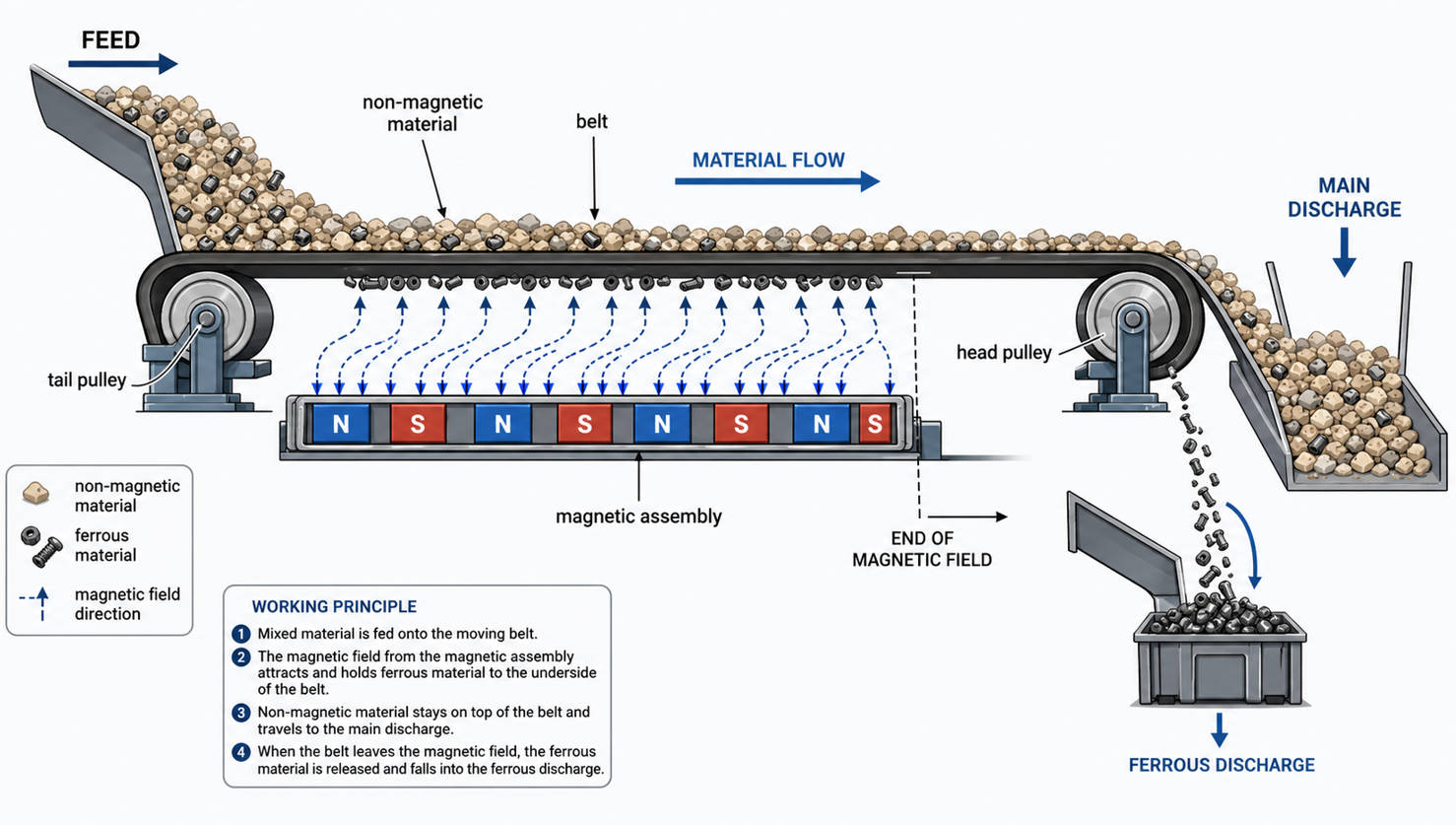
The process can be broken down into clear steps:
1. Loading
– Ferrous or metal‑contaminated material is fed onto the conveyor belt from a hopper, chute, or upstream equipment. [greatmagtech]
2. Magnetization
– Permanent magnets or electromagnets underneath the belt create a concentrated magnetic field through the belt cover. [guangdar]
– Ferrous particles are magnetized and experience an attraction force toward the magnet, pressing them against the belt surface. [apexmagnets]
3. Conveying
– The electric motor drives the belt via head and tail pulleys, carrying the magnetically held material along the conveyor path. [greatmagtech]
4. Separation / Discharge
– At the discharge end, the belt leaves the magnetic field; the magnetic force drops sharply, and the material releases due to gravity or mechanical assistance into a bin, chute, or downstream equipment. [dornerconveyors]
5. Continuous Operation
– The belt returns empty through the non‑working side, while the magnets remain fixed, allowing continuous, automated separation and conveying. [greatmagtech]
This simple physics makes the technology robust, low‑maintenance, and suitable for harsh industrial environments such as mining, ceramics, and building materials. [wdymagnetic]
Key Components Of A Magnetic Belt Conveyor
From my experience in designing and commissioning separation lines, every high‑performing magnetic belt conveyor has several non‑negotiable components. [dornerconveyors]
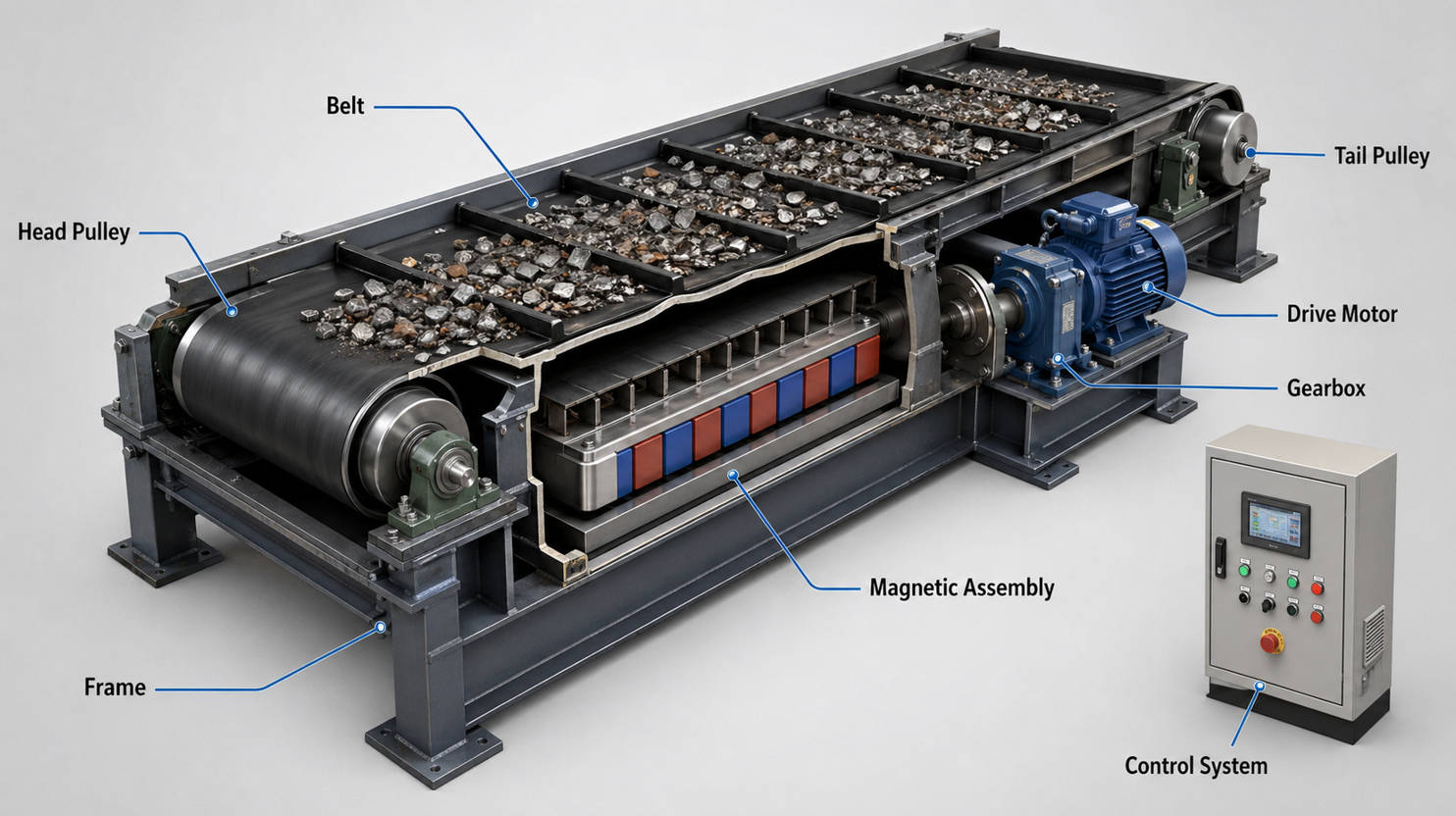
1. Frame And Bed
– Rigid frame built from steel profiles supports the belt, magnet assembly, drive station, and guards. [dornerconveyors]
– The conveyor bed (slider bed or idler rollers) is usually made from non‑magnetic or low‑magnetic stainless steel to allow the magnetic field to pass through efficiently while resisting wear. [apexmagnets]
2. Belt
– A continuous rubber or PVC belt runs over head and tail pulleys.
– For steeper inclines or vertical lifting, belts often include cleats or sidewalls so magnetically held parts cannot slide back. [youtube]
– In powder applications, we typically select wear‑resistant, anti‑static belts to avoid dust buildup and spark risks.
3. Magnetic Assembly
This is where the real separation happens:
– Permanent magnets
– Use ferrite or rare‑earth materials.
– Provide constant magnetic field without power consumption. [greatmagtech]
– Ideal for powder magnetic separators and lines that must run 24/7 with low operating costs. [wdymagnetic]
– Electromagnets
– Coils energized by electric current generate controllable magnetic fields. [greatmagtech]
– Magnetic intensity and field depth can be adjusted through current and coil turns. [greatmagtech]
– Preferred where variable product or different layer thicknesses require field tuning, e.g., switching from coarse ore to fine battery powder. [minejxsc]
The magnets can be configured as:
– Magnetic pulleys at the head of a conveyor.
– Magnetic rails/plates mounted under the belt along the conveying length. [apexmagnets]
4. Drive And Control System
– An electric motor with gearbox provides the torque to move the belt and load. [greatmagtech]
– Variable frequency drives (VFDs) or PLC‑controlled drives allow precise speed control, which is critical for:
– Adjusting residence time over the magnet.
– Optimizing separation efficiency at different feed rates. [africanmagnets]
– Modern systems integrate sensors and HMI for monitoring belt speed, motor load, and fault status. [africanmagnets]
5. Discharge And Cleaning Mechanism
– Depending on the application, the discharge end may include:
– Adjustable chutes for separated ferrous and non‑ferrous streams.
– Scrapers or brushes to keep the belt surface clean.
– In self‑cleaning types, a rotating magnetic pulley with a belt constantly removes accumulated metal from the magnet area. [youtube]
Permanent Magnet Vs Electromagnetic Belt Conveyors
Choosing between permanent and electromagnetic designs is a crucial engineering decision. Based on our project experience, here is a concise comparison.
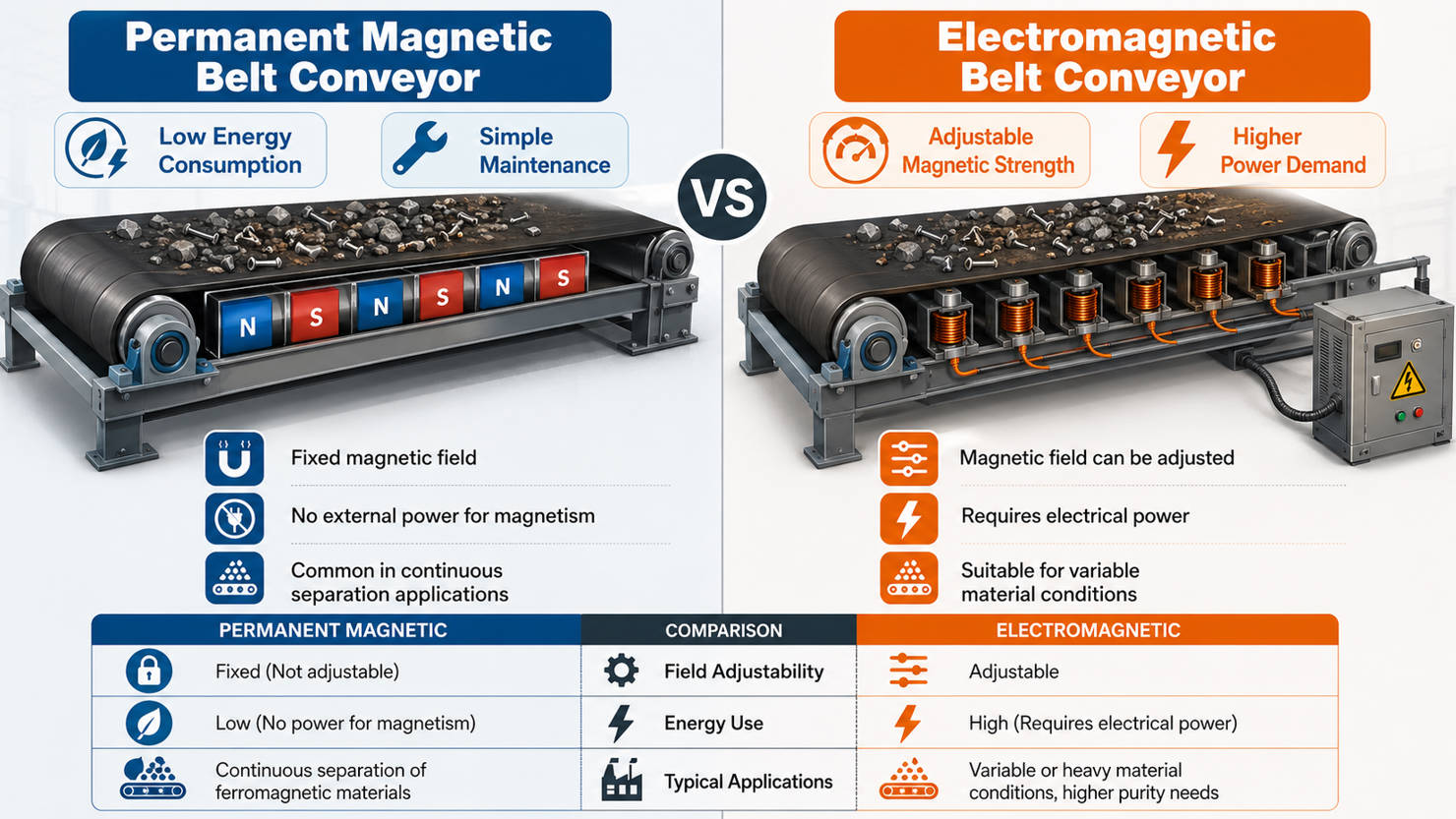
Comparison Of Magnet Types In Magnetic Belt Conveyors
| Aspect | Permanent Magnetic Belt Conveyor | Electromagnetic Belt Conveyor |
|---|---|---|
| Magnetic source | Fixed permanent magnets embedded or installed under belt greatmagtech | Electromagnets with energized coils under belt greatmagtech |
| Field adjustability | Essentially constant, not easily adjustable greatmagtech | Easily adjustable via current and coil design greatmagtech |
| Energy consumption | Very low during operation; no coil power apexmagnets | Requires continuous power, higher operating cost greatmagtech |
| Maintenance | Simple, fewer electrical parts; magnets demagnetize slowly over many years apexmagnets | More complex, needs coil, power supply, and thermal management greatmagtech |
| Typical use | Continuous lines, fixed material types (ceramics, glass, powders, building materials) greatmagtech | Variable feed, harsh mining or steel applications needing tunable separation greatmagtech |
In powder processing and ceramic raw material lines, we usually recommend permanent magnetic belt conveyors combined with powder magnetic separators to minimize energy consumption while meeting strict purity requirements. [guangdar]
Typical Industrial Applications
From a plant‑level perspective, magnetic belt conveyors are not just theory—they solve very specific pain points in real factories. [youtube]
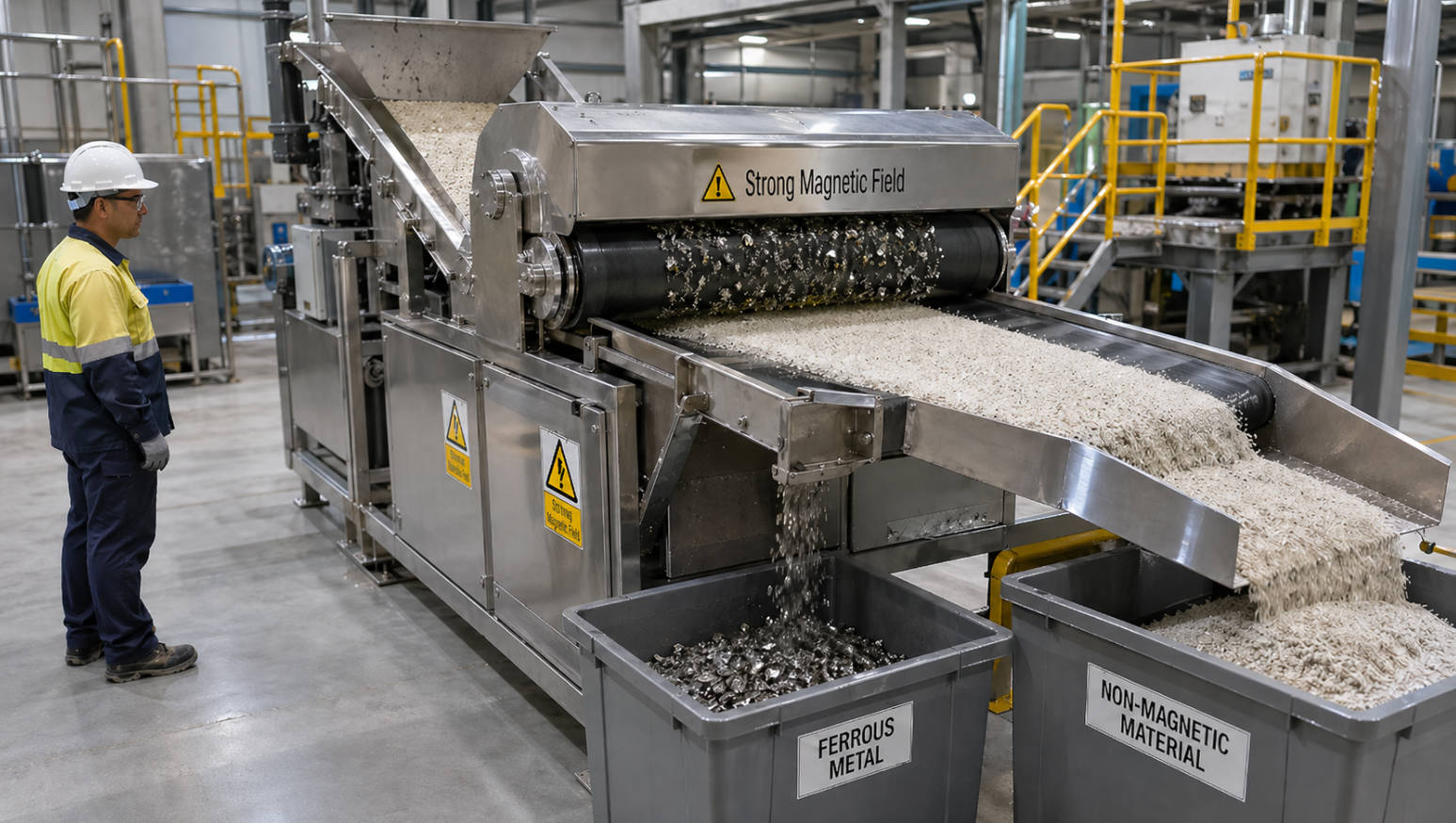
1. Mining And Mineral Processing
– Removing ferrous tramp metal from crushed ore, protecting crushers, mills, and downstream separators. [minejxsc]
– Feeding or discharging magnetic drums and belt separators in iron ore or heavy mineral plants. [guangdar]
2. Ceramics, Glass, And Building Materials
– Removing iron impurities from ceramic body powders, glazes, quartz sand, feldspar, and kaolin, to prevent black spots and defects in finished tiles or glass. [wdymagnetic]
– Combining powder magnetic separators with magnetic belt conveyors creates multi‑stage purification for high‑whiteness ceramic and glass products. [minejxsc]
3. Food And Pharmaceutical
– Inline installation above or below belt conveyors to catch ferrous contaminants from raw materials or packaged products. [africanmagnets]
– Compliance with food safety standards requires traceable, automated metal removal, and magnetic belt conveyors help achieve this without damaging the product stream. [africanmagnets]
4. Rubber, Plastic, And Recycling
– Capturing metal wires, screws, blades, and steel from plastic regrind or rubber granules before extrusion, pelletizing, or molding. [youtube]
– In recycling, magnetic conveyors separate ferrous from non‑ferrous and non‑metallic materials in mixed waste streams. [youtube]
5. Battery, Chemical, And New Energy Materials
– For positive and negative electrode materials, even trace iron contamination can cause safety and performance issues.
– Combining powder magnetic separators and magnetic belt conveyors ensures stable, low‑iron content in cathode/anode powders used in lithium battery manufacturing. [wdymagnetic]
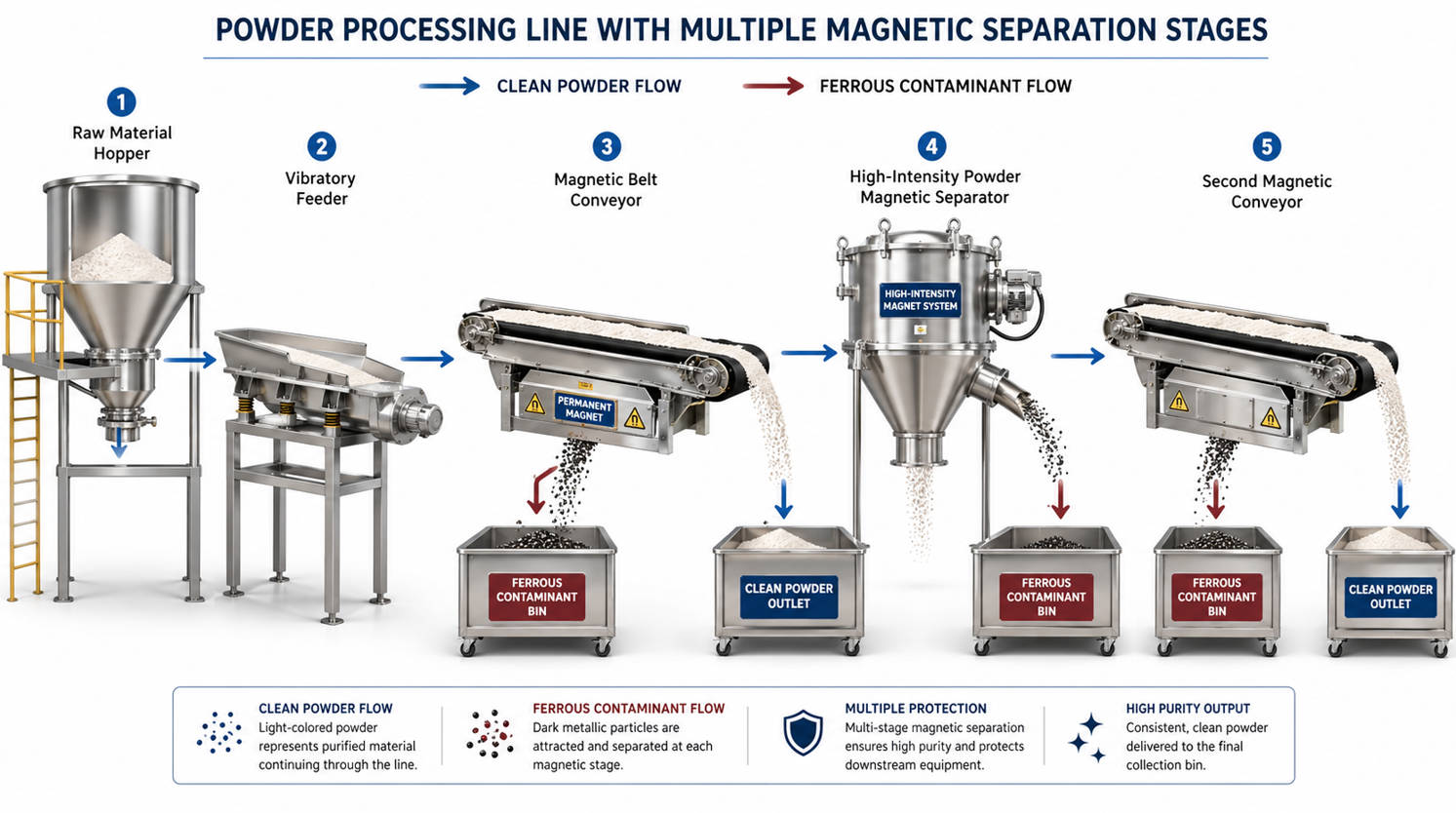
Step‑By‑Step: How A Magnetic Belt Conveyor Is Integrated In A Line
Based on commissioning projects for powder magnetic separators and permanent magnetic conveyors, a typical integration looks like this. [guangdar]
1. Bulk Material Preparation
– Raw material (ore, powder, chips, etc.) is crushed, screened, or milled to a suitable size distribution.
2. Even Feeding
– A vibratory feeder or screw feeder spreads material evenly across the conveyor width to avoid overloading one side of the magnet zone. [minejxsc]
3. Magnetic Conveying Zone
– The magnetic belt conveyor receives the material.
– Belt speed and magnet height/intensity are tuned so ferrous particles are fully captured while non‑magnetic material continues its path. [greatmagtech]
4. Discharge And Collection
– Ferrous fraction drops into a separate bin or chute when it leaves the magnetic field, while cleaned material continues to the next process (screening, mixing, packing). [greatmagtech]
5. Monitoring And Optimization
– Operators observe metal collection rate, belt load, and product quality indicators (e.g., iron content tests, product defects) to fine‑tune the system.
For many customers, the most visible improvement is reduced unplanned downtime—broken tools, damaged rollers, and contaminated batches become much less frequent once the magnetic belt conveyor is properly tuned.
How To Choose The Right Magnetic Belt Conveyor
From an engineering and ROI perspective, the right design depends on a few critical parameters that I always insist on clarifying before selection.
1. Material Characteristics
– Is the material ferrous, or only contaminated with ferrous particles?
– Particle size: powder, granules, or large pieces.
– Bulk density and layer thickness on the belt.
Finer powders and thin layers allow deeper and more complete magnet penetration, improving separation efficiency. [guangdar]
2. Capacity And Belt Speed
– Required throughput (e.g., tons per hour).
– Allowable residence time under the magnetic field.
Higher capacities often mean wider belts, stronger magnets, or slower belt speeds to maintain separation quality. [greatmagtech]
3. Installation Position
– Above an existing belt (as a suspended magnetic pulley).
– Below a chute or feeder.
– Integrated as part of a complete magnetic separation line with powder separators and metal detectors. [wdymagnetic]
The layout affects the choice of magnet length, field depth, and belt design.
4. Purity Requirements
– Ceramics, glass, food, and battery materials often require extremely low residual iron, and may need multi‑stage separation.
– Mining and bulk materials may prioritize equipment protection over ultra‑high purity.
In high‑purity applications, we typically design two to three magnetic stages with different intensities and geometries, rather than relying on a single conveyor pass.
Maintenance, Safety, And Best Practices
Well‑designed magnetic belt conveyors are reliable, but they still need disciplined maintenance to protect both equipment and staff. [dornerconveyors]
Best practices from the field:
– Routine inspection
– Check belt tension, tracking, and surface wear regularly.
– Inspect chute liners and non‑magnetic stainless beds for abrasion.
– Magnet performance checks
– Periodically verify magnetic field strength and separation performance through simple test pieces or standard test powders.
– Cleaning
– Keep the belt free of caked material and dust to maintain consistent magnetic contact and reduce motor load. [africanmagnets]
– Safety
– Clearly mark strong magnetic areas to protect workers with pacemakers or sensitive tools.
– Ensure lock‑out/tag‑out procedures are followed for maintenance on motors and drives.
A clean, well‑maintained magnetic conveyor not only removes metal but also prevents secondary contamination caused by accumulated metal and dust around the system. [africanmagnets]
Where A Specialized Manufacturer Adds Real Value
As a dedicated magnetic separation equipment manufacturer integrating R&D, engineering design, production line installation, and commissioning, we see many customers after they have tried “generic conveyors with add‑on magnets” and failed to get stable results. [wdymagnetic]
Working with a specialist team brings several advantages:
– Application‑specific design
– Matching magnet type, field intensity, and geometry to your material and purity target, instead of using one standard model.
– Turnkey integration
– Combining powder magnetic separators, permanent magnetic conveyors, and control systems into a complete line, not just supplying a standalone machine.
– On‑site commissioning
– Fine‑tuning belt speed, magnet gap, and discharge positions according to your real plant conditions and operator habits.
For industries such as ceramics, glass, new energy battery materials, food, and pharmaceuticals, this integration often makes the difference between a theoretical solution and a reliable, production‑grade one. [minejxsc]
Clear Call To Action
If you are currently facing metal contamination, unexpected equipment damage, or unstable product quality in powders, granules, or bulk materials, upgrading to a well‑designed magnetic belt conveyor plus powder magnetic separator can be one of the fastest ways to stabilize your line.
You can contact our engineering team with three key parameters—material type, capacity (t/h), and required iron content or metal removal goal—and we will propose a tailored solution including layout drawings, magnet configuration, and ROI estimation based on similar projects we have delivered in mining, ceramics, food, and battery material lines. [guangdar]
FAQ
1. How is a magnetic belt conveyor different from a standard belt conveyor?
A magnetic belt conveyor uses permanent magnets or electromagnets under the belt to attract and hold ferrous materials, while a standard belt conveyor relies purely on friction and cannot selectively separate metal contaminants. This makes magnetic conveyors suitable for both conveying and inline metal separation. [apexmagnets]
2. Can a magnetic belt conveyor handle non‑magnetic materials?
Yes. Non‑magnetic materials (such as plastics, glass, ceramics, or non‑ferrous metals) simply do not respond to the magnetic field and move by gravity and belt motion alone. The conveyor will transport them, but only the ferrous fraction is firmly held and separated. [dornerconveyors]
3. How do I decide between a permanent magnet and an electromagnet?
If your process has a fixed material type, stable capacity, and long running hours, a permanent magnetic belt conveyor offers lower operating cost and simpler maintenance. If you need adjustable field strength, such as in variable ore grades or changing product thickness, an electromagnetic design allows you to tune the separation performance via current control. [greatmagtech]
4. What maintenance does a magnetic belt conveyor require?
Typical maintenance includes checking belt tension and tracking, inspecting wear parts (belt, bed, chutes), cleaning accumulated material and dust, and periodically testing the magnetic field with standard test pieces. Electromagnetic systems also require checking coils, cooling, and power supply connections. [greatmagtech]
5. Is a magnetic belt conveyor suitable for fine powders such as battery materials?
Yes, provided it is properly designed and integrated with powder magnetic separators and suitable feeding equipment. Fine powders often benefit from multi‑stage magnetic separation with optimized belt speed and thin material layers to achieve very low residual iron levels demanded by battery and advanced material industries. [minejxsc]
References
1. Great Magtech. “How Does a Magnetic Belt Conveyor Work?” [greatmagtech]
2. Apex Magnets. “All About Magnetic Conveyors.” [apexmagnets]
3. Dorner Conveyors. “Magnetic Conveyors Customized for Efficiency.” [dornerconveyors]
4. Great Magtech. “How Does a Magnetic Conveyor Work?” [greatmagtech]
5. Guangdar. “Guide to Magnetic Separator: Definition and Working Principle.” [guangdar]
6. African Magnets. “How Magnetic Systems Can Help Maintain Clean and Efficient Conveyor Belt Operations.” [africanmagnets]
7. JXSC. “Unlocking the Power of Magnetic Separation Method.” [Link] [minejxsc]
8. Wandaye Magnetics. “Magnetic Separator Machine Manufacturer & Supplier in China.” [Link] [wdymagnetic]
9. Great Magtech. “Electromagnetic Separator: Working Principle Explained.” [greatmagtech]
10. YouTube. “Understanding Magnetic Belt Conveyors in Simple Steps at Cement …”[youtube]
11. YouTube. “Magnetic Conveyors EXPERTS Say Are the Future of …” [youtube]
Hot Tags: Magnetic Conveyor Belt, Manufacturers, Customized, Custom, Suppliers, Buy, Cheap, Quality, Advanced, Durable, in Stock, Made in China, Price, Quotation