Content Menu
● Understanding Crossbelt Magnetic Separators in Industrial Applications
>> Industries Benefiting from Crossbelt Technology
● Critical Installation Factor #1: Suspension Height Optimization
>> The Physics of Magnetic Field Degradation
>> Practical Solutions for Variable Material Volumes
>> Industry Standards and Specifications
● Critical Installation Factor #2: Magnet Width vs. Conveyor Width Matching
>> The Ferrous Metal “Catch and Release” Problem
>> Discharge Point Considerations
● Critical Installation Factor #3: Centerline Positioning Over the Conveyor
>> Magnetic Field Distribution Dynamics
>> Case Study: Asymmetric Positioning Impact
>> Alignment Verification Methods
● Advanced Optimization: Installation Method Selection
>> Cross-Belt Installation Configuration
>> In-Line Installation Configuration
● Safety and Compliance Considerations
>> Regional Certification Requirements
>> Industry-Specific Standards
>> Installation Safety Protocols
● Maintenance Best Practices for Sustained Performance
>> Daily Maintenance Activities
>> Monthly Maintenance Procedures
>> Annual Comprehensive Maintenance
● Common Installation Errors and Troubleshooting
>> Error #1: Installing Magnetic Separators Near Ferrous Structural Components
>> Error #2: Inadequate Consideration of Belt Speed
>> Error #3: Neglecting Material Burden Depth Variables
>> Error #4: Improper Discharge Point Configuration
● Measuring and Documenting Separator Performance
>> Magnetic Field Strength Measurement
>> Separation Efficiency Testing
>> Digital Monitoring Integration
● Future Trends in Magnetic Separation Technology
>> Electromagnetic Crossbelt Advancements
>> Hybrid Magnet Configurations
>> IoT-Enabled Smart Separators
>> Sustainable Materials and Design
● Implementing a Successful Crossbelt Magnet Installation
● Conclusion: Achieving Excellence in Ferrous Metal Separation
● Frequently Asked Questions (FAQ)
>> 1. What is the optimal suspension height for a crossbelt magnetic separator?
>> 2. How do I determine the correct magnet width for my conveyor system?
>> 3. When should I use cross-belt installation versus in-line installation?
>> 4. How often should I test magnetic field strength and what values indicate problems?
>> 5. What recovery rates should I expect from a properly installed crossbelt magnet?
As a magnetic separation specialist with over fifteen years of experience installing magnetic systems across mining, recycling, and aggregate processing facilities, I’ve witnessed firsthand how proper crossbelt magnet installation can mean the difference between 65% and 98% ferrous metal recovery rates. This comprehensive guide draws from my field experience and industry best practices to help you optimize your crossbelt magnetic separator performance while protecting downstream equipment and maximizing operational efficiency. [buntingmagnetics]
Understanding Crossbelt Magnetic Separators in Industrial Applications
Crossbelt magnetic separators represent one of the most versatile and widely deployed ferrous metal removal solutions in industrial material processing. These permanent magnetic systems feature a straightforward yet effective design: two pulleys mounted on a sturdy frame supporting a permanent magnetic block, with a continuously moving belt that automatically removes captured ferrous contaminants. Unlike stationary overhead magnets, crossbelt separators offer self-cleaning functionality, eliminating manual removal and reducing operational downtime. [buntingmagnetics]
The global magnetic separator market reflects the critical importance of these systems, valued at USD 245 million in 2024 and projected to reach USD 337 million by 2032, demonstrating a compound annual growth rate of 4.8%. This growth is driven by increasing demands for product purity, equipment protection, and regulatory compliance across multiple industries. [intelmarketresearch]
Industries Benefiting from Crossbelt Technology
Crossbelt magnetic separators serve critical functions across diverse sectors:
– Recycling facilities: Separating ferrous metals from municipal solid waste, construction debris, and electronic waste streams
– Aggregate and mining operations: Protecting crushers, screens, and conveyor systems from tramp iron damage that can cause catastrophic equipment failure
– Ceramic and glass manufacturing: Ensuring product quality by removing iron contamination that causes discoloration and defects
– Food processing: Meeting stringent safety standards by eliminating metal contaminants that pose health hazards and regulatory violations [magnattackglobal]
– Pharmaceutical production: Maintaining GMP compliance through effective contamination control [magnattackglobal]
– Battery materials processing: Protecting sensitive positive and negative electrode material production lines from ferrous contamination
Critical Installation Factor #1: Suspension Height Optimization
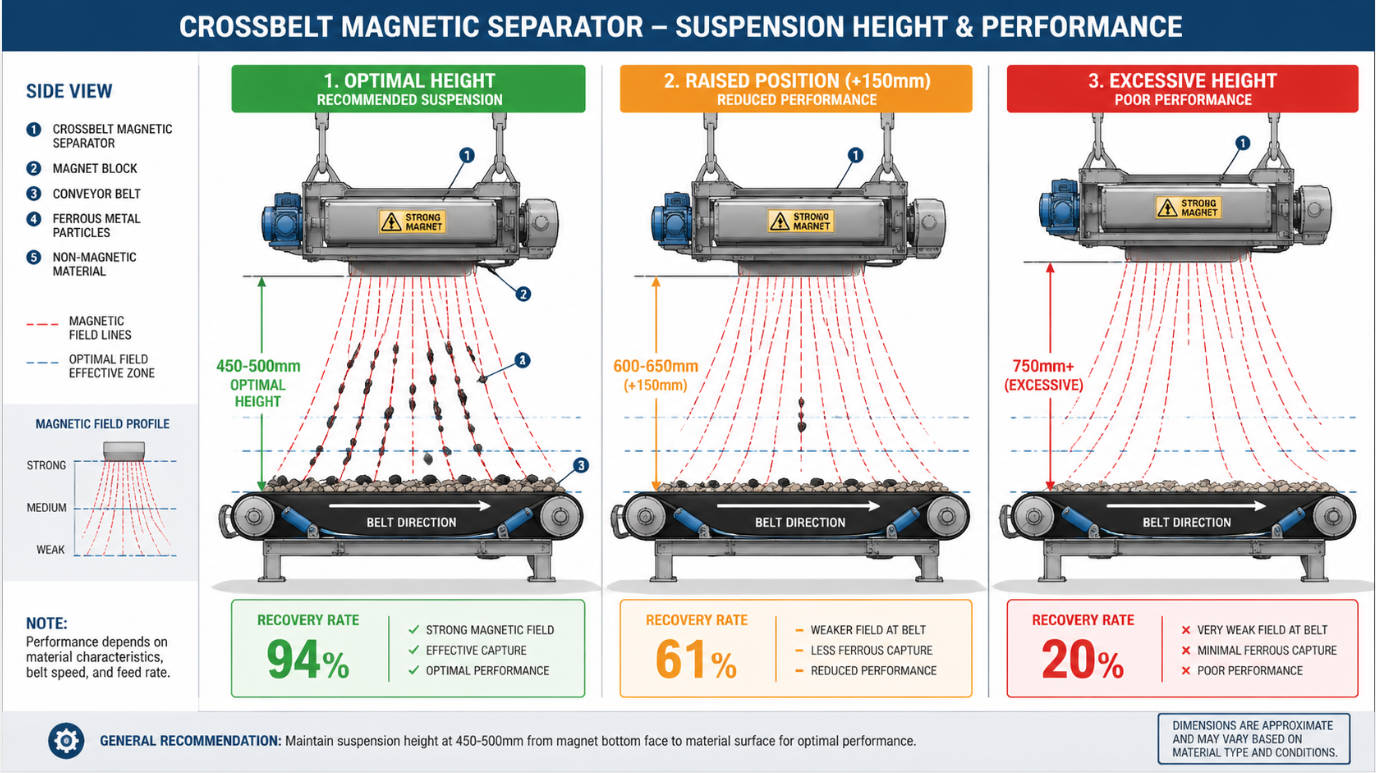
Suspension height is the single most influential variable affecting crossbelt magnet performance, yet it’s frequently overlooked during installation and operation. The magnetic field strength follows an inverse square law relationship—as distance from the magnet increases, field strength decreases exponentially, not linearly. [buntingmagnetics]
The Physics of Magnetic Field Degradation
When a crossbelt magnet is suspended at its designed optimal height (typically 450-500mm from the conveyor belt surface for standard applications), the magnetic field penetrates the material burden with maximum effectiveness. However, when operators temporarily raise the magnet to accommodate material surges and fail to return it to the original position, separation efficiency can decline by 30-50%. [scribd]
In my work with a granite quarry in 2024, we documented this phenomenon quantitatively. The facility had raised their crossbelt magnet by just 150mm (6 inches) to handle an unusually large rock surge three months prior. Operators forgot to lower it afterward. When we conducted field measurements, we found their ferrous metal recovery had dropped from 94% to 61%—a 33-percentage-point decline that translated to approximately $47,000 annually in crusher downtime and replacement parts.
Practical Solutions for Variable Material Volumes
If your operation frequently experiences material volume fluctuations that necessitate raising the magnet, consider these alternatives:
– Install a larger-capacity crossbelt magnet with deeper magnetic field penetration, allowing effective separation even at greater suspension heights [buntingmagnetics]
– Implement hydraulic or pneumatic suspension systems with preset position controls that automatically return the magnet to optimal height
– Deploy dual crossbelt systems where one operates at standard height for normal operations while a secondary unit handles surge conditions
– Utilize electromagnetic crossbelt separators such as the EBK model, which offers adjustable magnetic field strength to compensate for height variations [dingsmagnets]
Industry Standards and Specifications
For cross-belt installations over conveyor belts, industry specifications typically recommend maintaining a distance that balances effective separation with operational clearance. When conveyor speeds exceed 350 feet per minute (FPM), consider in-line installation methods where material passes approximately 2 inches from the magnet face near the center point, optimizing contact time within the magnetic field. [assets.magnetics]
Critical Installation Factor #2: Magnet Width vs. Conveyor Width Matching
Undersized magnet blocks represent the second most common installation error I encounter during facility assessments. This issue typically manifests when companies relocate existing crossbelt magnets to different conveyors without reassessing dimensional compatibility. [buntingmagnetics]
The Ferrous Metal “Catch and Release” Problem
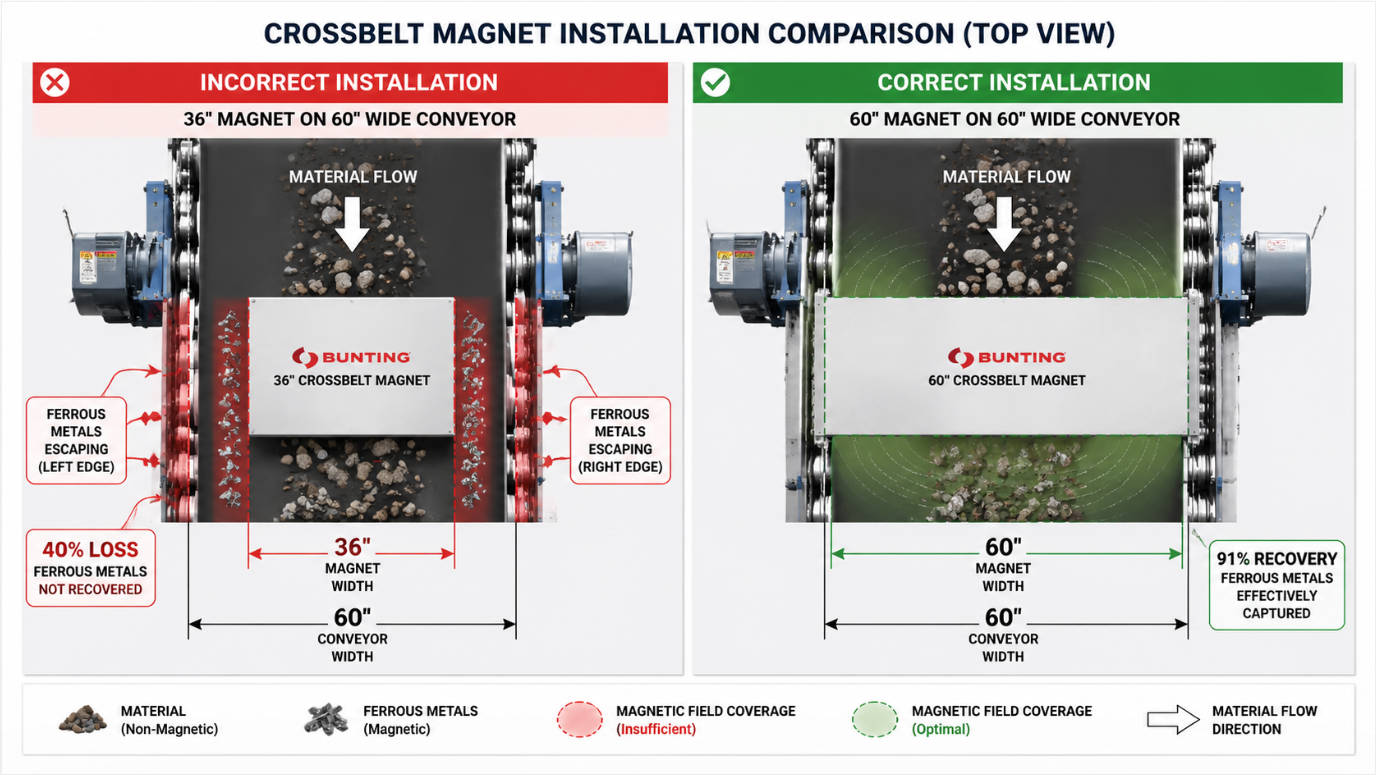
When a crossbelt magnet’s magnetic block is narrower than the conveyor belt width, ferrous metals positioned near the belt edges experience reduced magnetic attraction. These materials may be partially lifted from the burden, travel along the edge of the magnetic field, then drop back onto the conveyor beyond the discharge point—defeating the entire purpose of magnetic separation. [buntingmagnetics]
I documented this exact scenario at a C&D (construction and demolition) recycling facility in 2025. They had relocated a 36-inch crossbelt magnet from a 42-inch conveyor to a new 60-inch wide belt system. Video analysis revealed that approximately 40% of ferrous metals entering the magnetic field from the outer 12 inches on each side were being lifted 2-4 inches, traveling partially along the belt cleaning mechanism, then dropping back onto the conveyor. The solution required upgrading to a 60-inch magnet block, which immediately increased recovery rates from 58% to 91%.
Sizing Best Practices
When specifying crossbelt magnet width, follow these professional guidelines:
– Standard rule: Magnet block width should equal or exceed conveyor belt width by 10-15% to ensure complete coverage including belt edges
– For irregular material distribution: If material naturally concentrates toward one side of the belt, position a slightly narrower magnet to cover the material zone while ensuring the discharge point alignment
– Multiple magnet configuration: For extremely wide conveyors (over 72 inches), consider installing two parallel crossbelt systems rather than a single oversized unit, providing redundancy and maintenance flexibility
– Future-proofing considerations: When installing new systems, account for potential conveyor width increases or material handling changes over the equipment’s 15-20 year operational lifespan
Discharge Point Considerations
The ferrous metal discharge location must provide adequate clearance from the primary conveyor and direct captured materials into dedicated collection bins or secondary conveyors. Insufficient discharge clearance can result in metal debris falling back onto the process stream or creating hazardous accumulations beneath the magnet assembly. [buntingmagnetics]
Critical Installation Factor #3: Centerline Positioning Over the Conveyor
The third critical installation parameter involves lateral positioning of the magnet block centerline relative to the conveyor belt centerline. This factor becomes especially important given the magnetic field distribution characteristics of single-pole permanent magnet designs. [buntingmagnetics]
Magnetic Field Distribution Dynamics
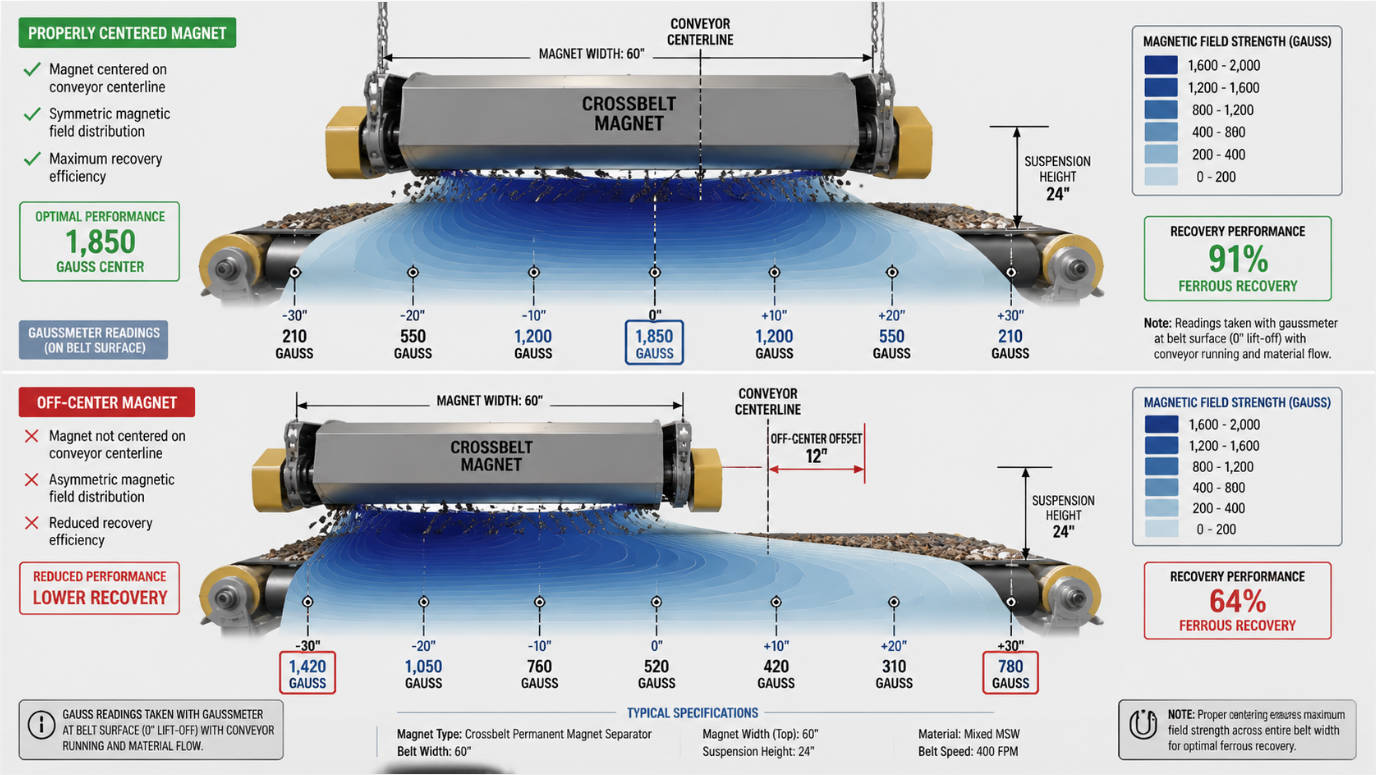
Most crossbelt magnets utilize a centrally located single-pole configuration, which projects the magnetic field downward toward the conveyor in a generally symmetric pattern. However, this symmetry exists only when the magnet centerline aligns with the conveyor centerline. The maximum magnetic attraction and separation occur along the central pole axis, with field strength diminishing progressively toward the outer edges. [buntingmagnetics]
When operators position the magnet centerline off-center—often shifting it closer to the discharge side—they create a significant asymmetry in separation performance. Material on the side opposite the discharge experiences substantially reduced magnetic field strength, allowing ferrous metals in that zone to pass through unseparated. [buntingmagnetics]
Case Study: Asymmetric Positioning Impact
During a 2025 installation audit at a glass cullet processing facility, I measured magnetic field strength across a misaligned crossbelt magnet using a gaussmeter. The magnet centerline was positioned 8 inches toward the discharge side of a 48-inch conveyor. Field strength measurements revealed:
– Center position (directly under pole): 1,850 gauss at material level
– 12 inches toward discharge: 1,420 gauss (23% reduction)
– 12 inches away from discharge: 780 gauss (58% reduction)
This asymmetry allowed small ferrous particles (nails, wire fragments, staples) on the far side to pass through unseparated, contaminating the final glass product and requiring expensive reprocessing. Repositioning the magnet to center alignment immediately resolved the issue.
Alignment Verification Methods
Ensure proper crossbelt magnet alignment using these professional techniques:
– Laser alignment tools: Project a vertical laser line from the magnet centerline to verify it intersects the conveyor belt centerline
– Physical measurement: Measure from each conveyor edge to the corresponding magnet edge, ensuring equal distances on both sides
– Field strength mapping: Use a gaussmeter to measure and map magnetic field distribution across the belt width, confirming symmetric field patterns
– Visual inspection markers: Install permanent alignment reference marks on the conveyor frame and magnet frame for quick verification during routine inspections
Advanced Optimization: Installation Method Selection
Beyond the three primary factors, selecting the appropriate installation configuration—cross-belt or in-line—significantly impacts separation efficiency based on your specific operational parameters. [okonrecycling]
Cross-Belt Installation Configuration
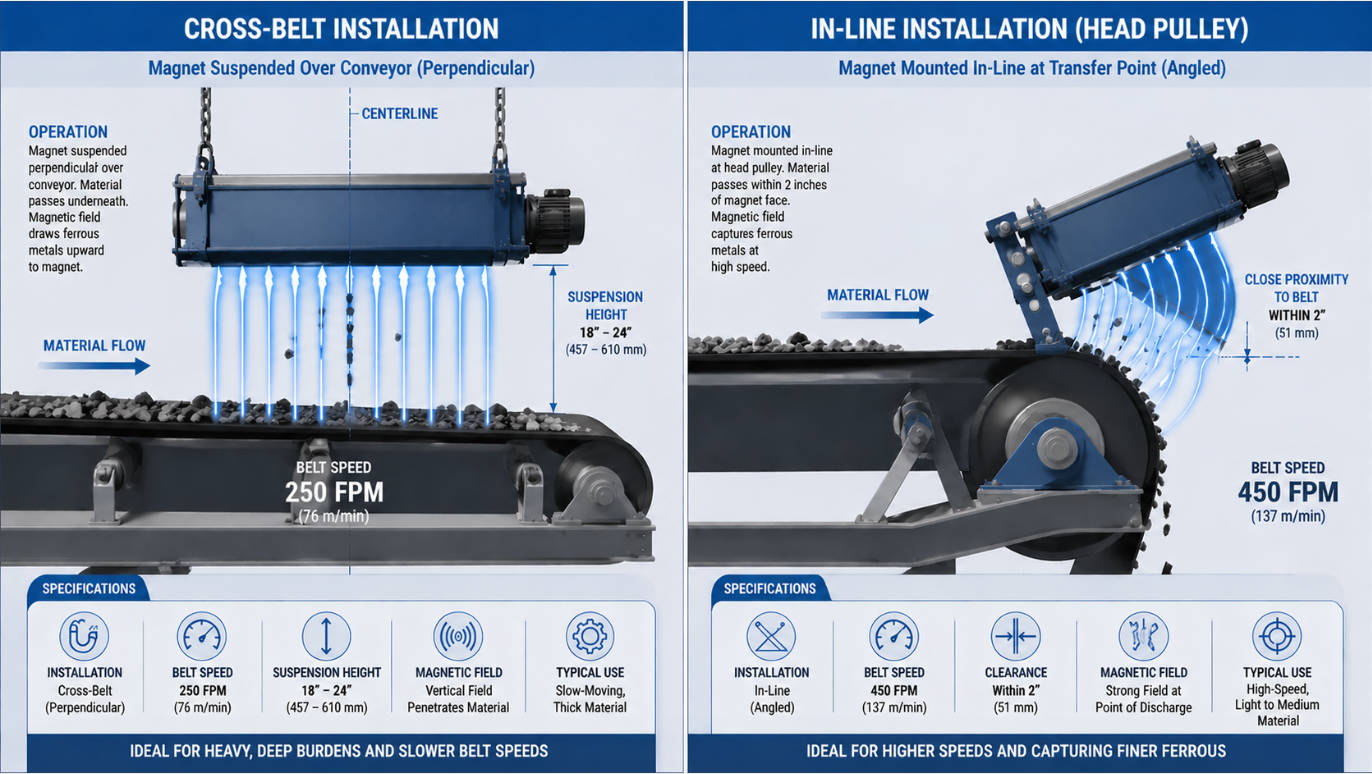
Cross-belt installation positions the magnet perpendicular to and directly above the conveyor belt, with material passing beneath the magnetic field. This configuration works optimally when: [assets.magnetics]
– Conveyor belt speeds remain below 350 feet per minute (FPM) [okonrecycling]
– Material burden depth is relatively uniform and moderate (less than 6 inches)
– Space constraints limit in-line installation options
– Applications require maximum portability and ease of relocation
The magnet should maintain the closest practical proximity to conveyed materials while allowing sufficient clearance for the self-cleaning belt to remove accumulated ferrous metals effectively. Industry guidelines recommend 18-24 inches of non-ferrous conveyor frame material on all sides beneath the magnet location to prevent unwanted magnetic attraction to the conveyor structure itself. [assets.magnetics]
In-Line Installation Configuration
In-line installation positions the magnet at an angle over the conveyor head pulley or transfer point, allowing material to pass very close (approximately 2 inches) to the magnet face. This configuration delivers superior performance when: [assets.magnetics]
– Conveyor belt speeds exceed 350 FPM [assets.magnetics]
– Material particle size varies significantly, requiring close proximity for effective small particle capture
– Maximum ferrous recovery rates are critical for product quality or equipment protection
– Non-ferrous head pulleys can be installed to eliminate competing magnetic attraction [assets.magnetics]
The in-line method provides increased contact time between material and the magnetic field despite high conveyor speeds, compensating for the reduced dwell time that would diminish cross-belt separation efficiency at higher velocities.
Safety and Compliance Considerations
Modern magnetic separator installations must address increasingly stringent safety standards and regulatory compliance requirements across various industries. As someone who has navigated installations in food-grade, pharmaceutical, and hazardous material environments, I cannot overemphasize the importance of incorporating compliance from the design phase. [magnattackglobal]
Regional Certification Requirements
Crossbelt magnetic separators deployed in different global markets must meet specific certifications:
– UL (Underwriters Laboratories) certification: Required for electrical safety compliance in United States installations [magnattackglobal]
– CE marking: Mandatory for equipment sold and operated within European Union member states [magnattackglobal]
– ISO 9001 and ISO 22000: Quality management and food safety management system certifications demonstrating manufacturer commitment to consistent quality [magnattackglobal]
When sourcing magnetic separation equipment, prioritize certified manufacturers that demonstrate compliance documentation. Avoid low-cost imported magnet assemblies that frequently fail to meet required safety standards, potentially exposing your operation to liability, regulatory violations, and catastrophic failure risks. [magnattackglobal]
Industry-Specific Standards
Different applications impose specialized requirements:
– Food and beverage processing: Must comply with FDA (Food Safety Modernization Act) in the U.S. or EFSA (European Food Safety Authority) regulations, requiring non-toxic materials and contamination-prevention design [magnattackglobal]
– Pharmaceutical manufacturing: Subject to GMP (Good Manufacturing Practice) standards with specifications for preventing contamination in drug production [magnattackglobal]
– HACCP compliance: Hazard Analysis and Critical Control Points programs require documented magnetic separator testing, monitoring, and maintenance protocols [magnattackglobal]
Installation Safety Protocols
Proper installation demands attention to worker safety and equipment security:
– Install crossbelt magnets using rated lifting chains and properly engineered suspension frames to support the combined weight of the magnet assembly and accumulated ferrous material [douglasmanufacturing]
– Ensure adequate clearance for maintenance personnel to safely access the system for cleaning, inspection, and service [douglasmanufacturing]
– Implement lockout/tagout procedures for maintenance activities, recognizing that permanent magnets maintain field strength even when power is disconnected
– Establish exclusion zones preventing unauthorized personnel from working beneath suspended magnetic equipment
Maintenance Best Practices for Sustained Performance
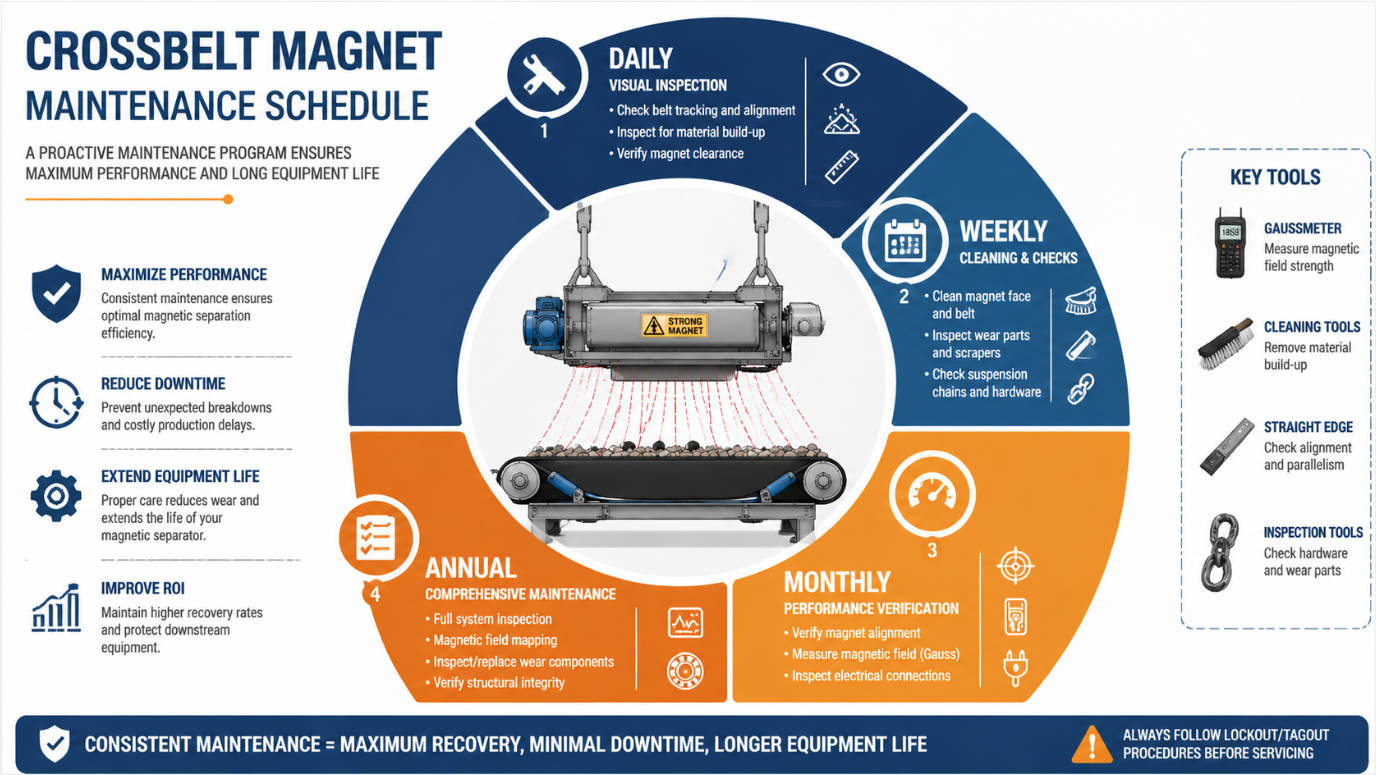
Even perfectly installed crossbelt magnets require systematic maintenance to sustain optimal ferrous recovery rates throughout their operational lifespan. Based on my experience developing maintenance protocols for multiple facilities, I recommend implementing a tiered maintenance schedule. [africanmagnets]
Daily Maintenance Activities
– Visual inspection: Verify the magnet belt is tracking properly and rotating without binding
– Accumulation monitoring: Check for unusual ferrous metal buildup that might indicate increased contamination levels or belt cleaning issues
– Alignment verification: Confirm the magnet position hasn’t shifted from reference marks
Weekly Maintenance Tasks
– Belt surface cleaning: Remove any adhered materials or buildup on the magnet belt surface that could reduce separation efficiency [africanmagnets]
– Discharge chute inspection: Ensure ferrous materials are properly exiting the system without obstruction
– Structural integrity check: Inspect suspension chains, frame components, and mounting hardware for wear or damage
Monthly Maintenance Procedures
– Alignment verification: Physically measure and confirm proper centerline positioning over the conveyor belt [africanmagnets]
– Magnetic field strength testing: Use a gaussmeter to measure field strength at standardized positions, comparing readings to baseline values to detect magnetic degradation [magnattackglobal]
– Bearing and pulley inspection: Examine belt pulley bearings for proper lubrication and wear
– Electrical connections: For electromagnetic units, inspect all electrical connections, insulation, and control systems
Annual Comprehensive Maintenance
– Complete disassembly and cleaning: Remove accumulated contamination from all components
– Magnetic block inspection: Examine permanent magnet blocks for physical damage, corrosion, or degradation
– Structural recertification: Verify suspension system load ratings and structural integrity
– Performance revalidation: Conduct thorough separation efficiency testing to confirm the system meets original performance specifications [magnattackglobal]
Regular maintenance documentation provides critical evidence for compliance audits while establishing performance trends that enable predictive maintenance strategies. [magnattackglobal]
Common Installation Errors and Troubleshooting
Throughout my career conducting magnetic separator assessments, I’ve encountered recurring installation mistakes that severely compromise performance. Understanding these errors helps you avoid expensive operational problems.
Error #1: Installing Magnetic Separators Near Ferrous Structural Components
Positioning crossbelt magnets near ferrous steel conveyor frames, structural supports, or equipment housing creates competing magnetic circuits that reduce field strength in the material separation zone. The magnetic field preferentially attracts to nearby ferrous structures rather than projecting downward into the material stream. [assets.magnetics]
Solution: Ensure conveyor sections directly beneath the magnet utilize non-ferrous materials (aluminum, stainless steel, or high-density plastics) extending 18-24 inches in all directions from the magnet perimeter. [assets.magnetics]
Error #2: Inadequate Consideration of Belt Speed
Many installations fail to account for the inverse relationship between conveyor belt speed and separation dwell time. Material traveling at 500 FPM spends significantly less time within the magnetic field compared to material moving at 200 FPM, reducing separation efficiency for weakly magnetic or small particles. [assets.magnetics]
Solution: Match installation configuration to operational belt speed—cross-belt for speeds below 350 FPM, in-line for higher velocities. Alternatively, reduce belt speed in the magnetic separation zone while maintaining higher speeds elsewhere in the process. [okonrecycling]
Error #3: Neglecting Material Burden Depth Variables
Thick material burden depths (over 8-10 inches) significantly reduce magnetic field penetration to lower material layers, allowing ferrous contamination in the bottom portions to pass through unseparated. [buntingmagnetics]
Solution: Deploy material leveling devices upstream of the magnetic separator to create uniform, moderate burden depths. For applications with inherently deep material beds, consider installing multiple crossbelt magnets in series to provide staged separation opportunities.
Error #4: Improper Discharge Point Configuration
Insufficient clearance between the magnet discharge point and the process conveyor allows separated ferrous materials to fall back onto the belt, completely negating separation efforts. [buntingmagnetics]
Solution: Design discharge systems with minimum 24-inch horizontal clearance from the main conveyor belt edge, directing removed materials into dedicated collection bins positioned well clear of the process stream.
Measuring and Documenting Separator Performance
Professional magnetic separator management requires quantitative performance measurement rather than subjective assessments. Implementing systematic testing protocols enables data-driven optimization and provides compliance documentation. [magnattackglobal]
Magnetic Field Strength Measurement
Use calibrated gaussmeters or teslameters to measure and record magnetic field strength at standardized positions:
– Magnet face surface: Baseline maximum field strength (typically 800-2,200 gauss for permanent magnets)
– Material contact plane: Field strength at the actual material surface distance (typically 400-1,200 gauss depending on suspension height)
– Lateral field distribution: Measurements across the belt width at 6-inch intervals to verify symmetric field patterns
Document all measurements with dates, equipment calibration status, and environmental conditions. Establish alert thresholds (typically 85% of original field strength) that trigger maintenance interventions before performance degrades significantly. [magnattackglobal]
Separation Efficiency Testing
Quantify actual ferrous recovery rates using controlled testing:
– Feed material sampling: Collect representative samples of incoming material and manually extract/weigh all ferrous content
– Tail material sampling: Collect samples of material exiting the separation zone and extract/weigh remaining ferrous content
– Recovery rate calculation: Recovery % = [(Feed ferrous weight – Tail ferrous weight) / Feed ferrous weight] × 100
Well-optimized crossbelt installations should achieve 90-98% recovery rates for ferrous particles larger than 3-4mm. Lower recovery rates indicate installation problems, magnetic degradation, or operational issues requiring investigation. [buntingmagnetics]
Digital Monitoring Integration
Modern operations increasingly deploy automated monitoring systems that provide continuous performance data:
– Load cells on discharge bins: Measure collected ferrous material weight, providing trending data on contamination levels
– Proximity sensors: Monitor belt rotation and detect operational anomalies
– Magnetic field sensors: Provide continuous field strength monitoring with automated alerts for degradation
– Integration with SCADA systems: Incorporate magnetic separator performance metrics into overall plant monitoring dashboards
Future Trends in Magnetic Separation Technology
The magnetic separation industry continues evolving with technological advancements that enhance performance and operational capabilities. Understanding emerging trends helps you make forward-looking investment decisions.
Electromagnetic Crossbelt Advancements
High-intensity electromagnetic crossbelt separators like the EBK model offer adjustable magnetic field strength, enabling operators to optimize performance for varying material characteristics and contamination levels. These systems provide maximum flexibility but require reliable electrical infrastructure and higher operating costs compared to permanent magnet alternatives. [dingsmagnets]
Hybrid Magnet Configurations
Manufacturers are increasingly offering hybrid designs combining permanent magnets for baseline separation with electromagnetic enhancement for challenging applications, delivering the reliability of permanent magnets with electromagnetic adjustability when needed.
IoT-Enabled Smart Separators
Internet of Things (IoT) integration enables remote monitoring, predictive maintenance alerts, and performance optimization through machine learning algorithms that analyze historical performance data to recommend operational adjustments.
Sustainable Materials and Design
Environmental considerations drive development of magnetic separators using sustainable rare earth magnet alternatives and designs facilitating end-of-life recycling. As regulations increasingly address electronic waste and material sustainability, equipment designed for disassembly and component recovery provides long-term value. [magnattackglobal]
Implementing a Successful Crossbelt Magnet Installation
Drawing from successful installations across diverse industries, I recommend following this systematic implementation approach:
Phase 1: Requirements Assessment (2-3 weeks)
– Analyze material characteristics, contamination levels, and separation objectives
– Measure conveyor dimensions, speed, and material burden depths
– Identify space constraints, structural support capabilities, and utility availability
– Define performance targets and compliance requirements
Phase 2: System Design and Selection (1-2 weeks)
– Specify magnet type (permanent vs. electromagnetic), size, and configuration
– Design suspension system, discharge arrangement, and collection infrastructure
– Verify manufacturer certifications and compliance documentation
– Develop detailed installation drawings with dimensional specifications
Phase 3: Installation Execution (3-5 days)
– Prepare installation site including structural supports and non-ferrous conveyor sections
– Install suspension system with proper load-rated components
– Position and align magnet assembly using precision measurement tools
– Implement safety barriers and operational signage
Phase 4: Commissioning and Optimization (1-2 weeks)
– Conduct baseline magnetic field strength measurements across all specified positions
– Perform separation efficiency testing with representative material samples
– Make fine-tuning adjustments to suspension height and lateral positioning
– Train operational and maintenance personnel on proper use and care
– Document as-built configuration and baseline performance metrics
Phase 5: Ongoing Performance Management (continuous)
– Implement systematic maintenance schedule with documented procedures
– Conduct regular performance testing and trending analysis
– Maintain compliance documentation for regulatory requirements
– Refine operational parameters based on performance data
Conclusion: Achieving Excellence in Ferrous Metal Separation
Crossbelt magnetic separator performance fundamentally depends on proper installation addressing the three critical factors: suspension height optimization, magnet width matching to conveyor width, and precise centerline positioning. Small adjustments to these parameters can dramatically improve ferrous metal recovery rates, protecting downstream equipment, enhancing product quality, and reducing operational costs. [buntingmagnetics]
By implementing the professional installation practices, systematic maintenance protocols, and performance measurement strategies outlined in this guide, you can achieve and sustain the 90-98% ferrous recovery rates that characterize world-class magnetic separation operations. Whether you’re installing a new system or optimizing existing equipment, attention to these fundamental principles will deliver measurable improvements in both operational efficiency and economic performance.
For complex applications or challenging material characteristics, consult with experienced magnetic separation specialists who can provide application-specific engineering and support. The investment in professional expertise during the installation phase pays substantial dividends through decades of reliable, high-performance operation.
Frequently Asked Questions (FAQ)
1. What is the optimal suspension height for a crossbelt magnetic separator?
The optimal suspension height typically ranges from 450-500mm (18-20 inches) between the magnet bottom surface and the conveyor belt top surface for standard applications. However, the specific optimal height depends on magnet strength, material characteristics, and burden depth. Larger, more powerful magnets can operate effectively at greater suspension heights while maintaining high recovery rates. The critical principle is maintaining consistent suspension height—even small increases from the designed position can reduce recovery rates by 30-50%. [scribd]
2. How do I determine the correct magnet width for my conveyor system?
The magnet block width should equal or exceed your conveyor belt width by 10-15% to ensure complete coverage including belt edges. If you’re relocating an existing magnet to a wider conveyor, verify the magnet width provides adequate coverage; otherwise, ferrous metals near the belt edges may be lifted but then discharged back onto the conveyor beyond the collection point. For conveyors wider than 72 inches, consider dual parallel crossbelt systems rather than a single oversized unit. [buntingmagnetics]
3. When should I use cross-belt installation versus in-line installation?
Use cross-belt installation (magnet positioned perpendicular to and above the belt) when conveyor speeds are below 350 feet per minute (FPM), as this configuration works optimally at moderate speeds. Choose in-line installation (magnet positioned at an angle near the head pulley with material passing very close to the magnet face) when belt speeds exceed 350 FPM, as this method provides increased contact time within the magnetic field despite higher velocities. In-line installations also perform better when maximum recovery of small ferrous particles is critical. [okonrecycling]
4. How often should I test magnetic field strength and what values indicate problems?
Test magnetic field strength monthly using a calibrated gaussmeter at standardized positions, recording measurements to track trends over time. Establish baseline values during initial installation, then monitor for degradation. When field strength falls below 85% of the original baseline reading, schedule maintenance intervention before performance significantly declines. Annual comprehensive testing should include complete field mapping across the entire separation zone to verify symmetric distribution patterns. [magnattackglobal]
5. What recovery rates should I expect from a properly installed crossbelt magnet?
Well-optimized crossbelt magnetic separator installations should achieve 90-98% recovery rates for ferrous particles larger than 3-4mm. Recovery rates for smaller particles (1-3mm) typically range from 75-90% depending on magnetic field strength, suspension height, and material characteristics. If your system achieves less than 85% recovery for particles above 4mm, investigate potential installation issues including suspension height drift, misalignment, inadequate magnet width, or magnetic field degradation. Quantitative recovery testing using controlled material samples provides the most accurate performance assessment. [buntingmagnetics]
References
1. Bunting Magnetics. (2021). “Three Things to Consider when Installing Crossbelt Magnets.” [link]
2. Industrial Magnetics, Inc. “Installation Manual – Suspended Permanent Magnet Systems.” [link]
3. Iron City Supply. (2025). “Cross Belt Magnets: The Unsung Hero of Material Processing.” [link]
4. African Magnets. (2024). “Using Cross Belt Magnets for Sale in Industrial Applications.” [link]
5. Okon Recycling. (2025). “Recycling Overband Magnets for Conveyors: A Technical Guide.” [link]
6. Douglas Manufacturing. “Safety, Operation, & Maintenance Manual – Cross-Belt Self-Cleaning Separator.” [link]
7. Magnattack Global. (2025). “How To Ensure Magnetic Separators Meet Compliance Standards.” [link]
8. Intel Market Research. “High Intensity Magnetic Separator Market Outlook 2025-2032.” [link]
9. Magnattack Global. (2026). “Guide to Brewery and Winery Magnetic Separator Maintenance.” [link]
10. Dings Magnets. (2024). “EBK Crossbelt Magnet | Electromagnetic Separator.” [link]
11. Umbrex. (2025). “Metals Recovery Rate Optimization and Byproduct Management.” [link]
12. Great Magtech. (2025). “Magnetic Separators in Food Industry.” [link]
13. Scribd. (2026). “Cross Belt Magnetic Separator Specifications.” [link]
14. Dadyar Machinery. (2025). “Magnetic Equipment Maintenance 2025 | Extending Lifespan.” [link]
15. AMR Consulting. (2022). “Choosing the right magnetic separator for an application.” [link]
Hot Tags: Crossbelt Magnet, Manufacturers, Customized, Custom, Suppliers, Buy, Cheap, Quality, Advanced, Durable, in Stock, Made in China, Price, Quotation