Content Menu
● Understanding Industrial Magnet Types and Their Storage Requirements
● Critical Environmental Factors for Magnet Storage
>> Temperature Control and Heat Management
>> Humidity and Corrosion Prevention
>> Chemical and Atmospheric Exposure
● Optimal Physical Storage Configurations
>> Spacing and Pole Orientation
>> Container Selection and Packaging
>> Magnetic Shielding for High-Volume Storage
● Safe Handling Procedures for Industrial Magnets
>> Personal Protection Equipment
>> Medical and Electronic Device Safety
● Preventing Mechanical Damage and Magnetic Loss
>> Impact and Vibration Management
>> External Magnetic Field Interference
● Application-Specific Storage Considerations
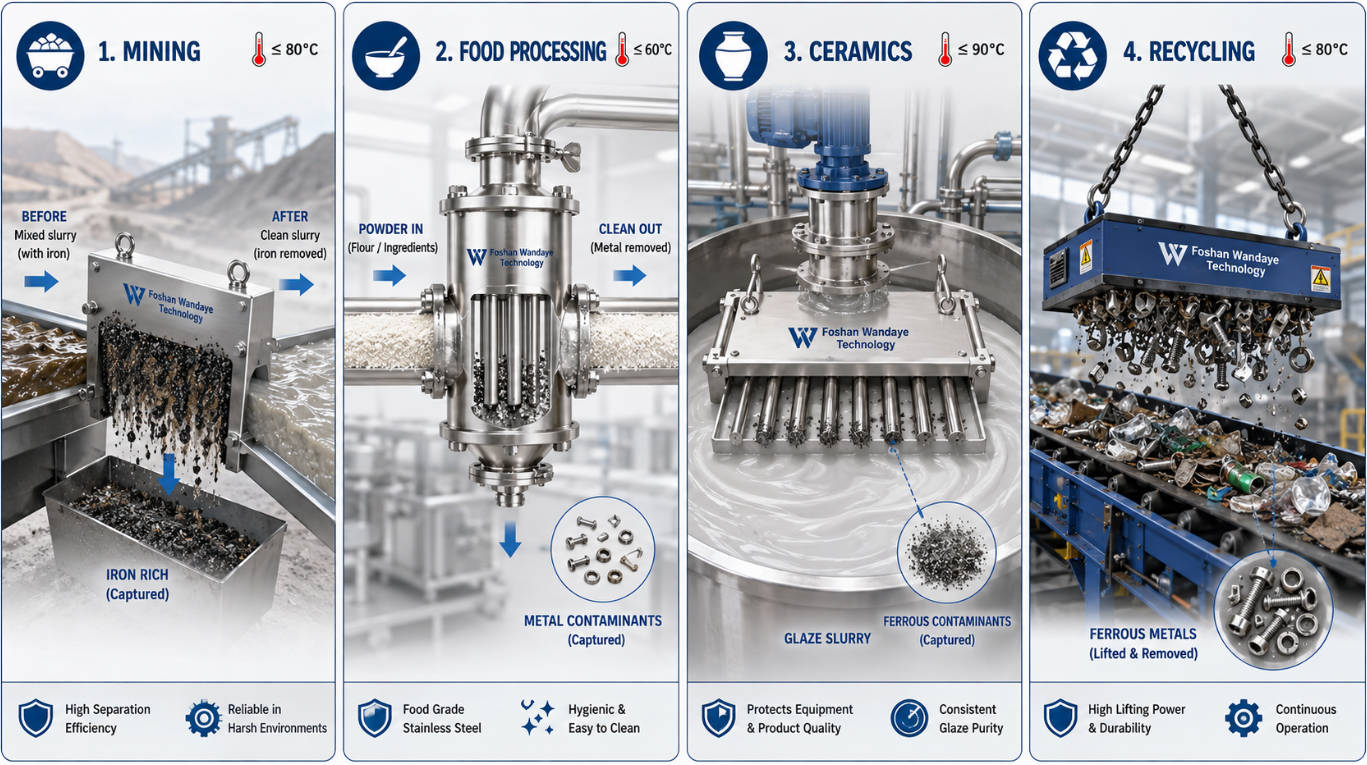
>> Magnetic Plates for Mining and Mineral Processing
>> Magnetic Rods for Food and Pharmaceutical Applications
>> Magnetic Separators for Recycling Operations
● Long-Term Maintenance and Remagnetization
>> Monitoring Magnetic Strength
● Emergency Response and Disposal
>> Swallowing and Ingestion Hazards
● Industry-Specific Applications and Storage Insights
>> Ceramic and Glass Manufacturing
>> Food Processing and Pharmaceutical Production
>> Environmental and Recycling Applications
● Conclusion: Maximizing Magnetic Equipment ROI
>> 1. How long can industrial magnets be stored before they lose significant strength?
>> 2. What’s the safest way to separate two strong magnets that have stuck together?
>> 3. Can magnets be stored on metal shelving without losing their strength?
>> 4. What temperature range is safe for storing neodymium magnets used in industrial applications?
>> 5. How should magnetic separators be prepared for long-term storage during seasonal shutdowns?
As a magnetic separation equipment manufacturer with over two decades of experience in designing and installing magnetic plates, magnetic rods, and industrial magnetic separators across mining, ceramics, food processing, and environmental industries, we’ve witnessed countless instances where improper magnet storage led to performance degradation, safety incidents, and costly replacements. This comprehensive guide combines our field expertise with industry best practices to help you maximize the lifespan and effectiveness of your magnetic equipment. [adamsmagnetic]
Understanding Industrial Magnet Types and Their Storage Requirements
Neodymium Iron Boron (NdFeB) Magnets represent the most powerful permanent magnets used in magnetic plates and magnetic rods, yet they’re also the most vulnerable to environmental damage. These rare earth magnets deliver exceptional magnetic flux density—critical for removing fine ferrous contaminants from materials like ceramic slurries, pharmaceutical powders, and food ingredients—but require meticulous storage protocols to maintain their performance. [holeep]
Ferrite and Alnico magnets, while less powerful than NdFeB variants, offer superior temperature stability and corrosion resistance, making them suitable for high-temperature applications in glass manufacturing and building materials processing. Understanding which magnet type your equipment uses determines your storage strategy and maintenance requirements. [adamsmagnetic]
Critical Environmental Factors for Magnet Storage
Temperature Control and Heat Management
Industrial magnets lose magnetic strength progressively when exposed to temperatures exceeding their operational limits, a phenomenon called thermal demagnetization. Standard NdFeB magnets begin losing magnetism at 80°C, while high-grade variants withstand up to 150°C before experiencing irreversible magnetic degradation. The Curie temperature—the point where magnets lose all magnetism—occurs around 310°C for neodymium magnets, though significant performance loss begins well before reaching this threshold. [okonrecycling]
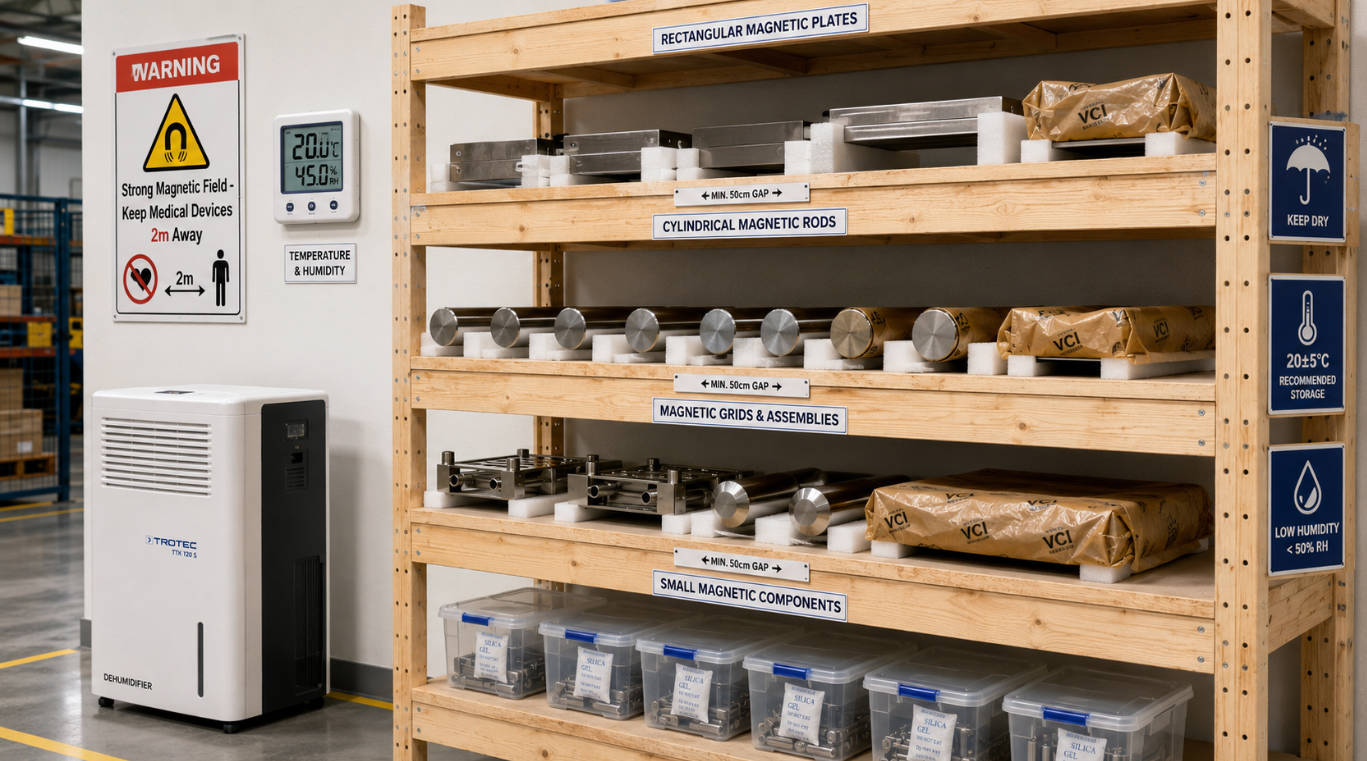
Store magnets in climate-controlled environments maintaining 15-25°C (59-77°F) for optimal longevity. For facilities without temperature control, position magnetic equipment away from heat sources such as furnaces, dryers, and direct sunlight exposure. We’ve observed that magnets stored in uncontrolled warehouse environments during summer months can experience 5-15% magnetic strength reduction within a single season. [apexmagnets]
Humidity and Corrosion Prevention
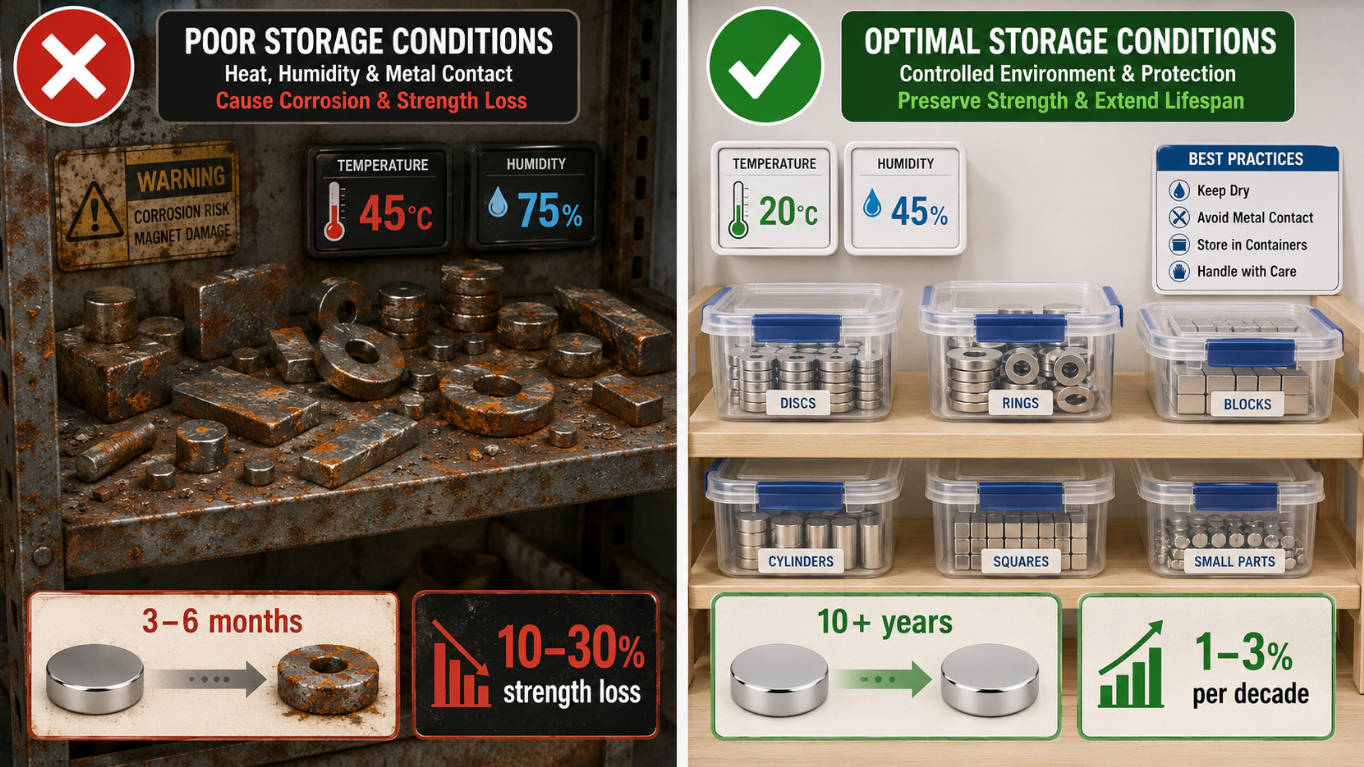
Moisture represents the primary enemy of rare earth magnets, causing surface oxidation that progressively weakens magnetic performance and structural integrity. Uncoated NdFeB magnets exposed to relative humidity above 65% develop visible rust within 3-6 months, with corresponding magnetic losses of 10-30% depending on exposure duration. [reddit]
Implement these humidity control measures:
– Maintain storage areas below 50% relative humidity using dehumidifiers in coastal or high-humidity regions [adamsmagnetic]
– Apply protective oil coating to unplated magnetic surfaces during extended storage periods (exceeding 3 months) [reddit]
– Store magnets in sealed containers with desiccant packs when shipping or long-term warehousing is required [rochestermagnet]
– Inspect nickel or zinc-plated magnets quarterly for coating damage, as even minor coating breaches allow moisture penetration leading to internal corrosion [supermagneticshop]
Our manufacturing experience shows that proper humidity control extends magnetic rod service life by 200-300% compared to uncontrolled storage environments.
Chemical and Atmospheric Exposure
Acidic, alkaline, and organic solvent vapors chemically attack magnetic coatings and degrade the underlying magnetic material. Facilities processing chemicals, conducting metal finishing operations, or storing cleaning solvents should segregate magnetic equipment in isolated storage areas with independent ventilation systems. [reddit]
Avoid storage proximity to:
– Battery charging stations emitting hydrogen gas
– Electroplating operations releasing acidic fumes
– Paint booths and solvent storage areas
– Saltwater or marine environments causing accelerated corrosion [adamsmagnetic]
Optimal Physical Storage Configurations
Spacing and Pole Orientation
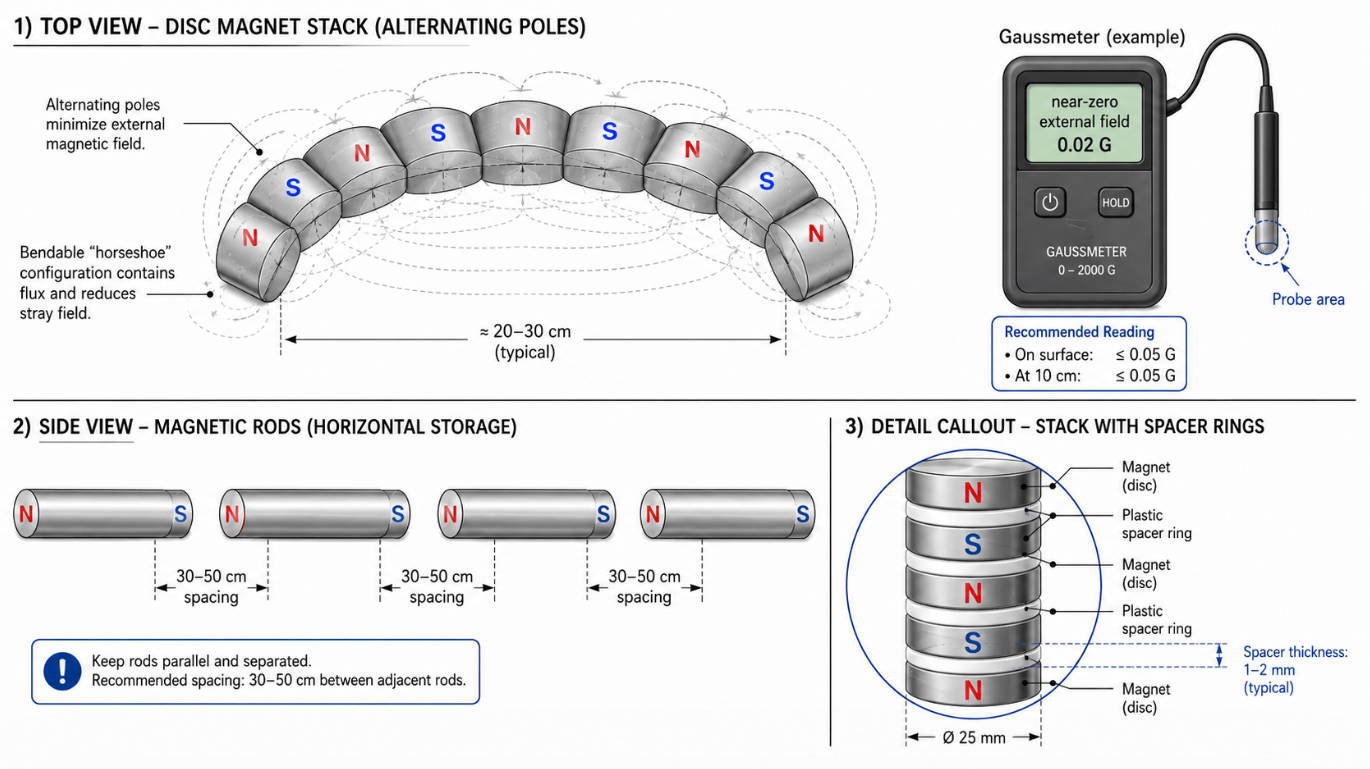
Storing multiple magnets requires strategic pole arrangement to minimize unintended magnetic field interactions and facilitate safe handling. When stacking disc or block magnets, alternate pole orientations so north poles face opposite directions, creating a column that can be bent to form a horseshoe configuration. This arrangement reduces the external magnetic field to nearly zero, preventing attraction to nearby ferrous objects and simplifying later separation. [supermagnete]
For magnetic rods and cylindrical magnets, maintain minimum spacing of 30-50cm between units depending on their gauss rating. High-strength magnetic separators (8,000-12,000 gauss) require greater separation distances to prevent magnetic field overlap that could damage nearby electronic equipment or magnetically stored data. [rochestermagnet]
Container Selection and Packaging
Use oversized non-ferrous containers for magnet storage, as larger dimensions allow adequate cushioning material and prevent magnetic fields from extending beyond the package. A container should be at least 2-3 times the magnet’s diameter to ensure the magnetic field remains contained. [supermagnete]
Packaging best practices include:
– Wrap individual magnets in foam, cardboard, or corrosion-inhibiting paper (VCI paper) for rare earth magnets [rochestermagnet]
– Use plastic spacer rings to separate magnets in stacks, facilitating easier removal without pinching or breakage [supermagnete]
– Keep magnets flat rather than standing on edge to prevent accidental toppling and collision [adamsmagnetic]
– Avoid metal shelving or use shelves with sufficient vertical clearance (minimum 1.5 meters between levels) to prevent magnets from jumping toward metal surfaces during access [apexmagnets]
Magnetic Shielding for High-Volume Storage
Facilities storing large quantities of magnetic separators should implement magnetic shielding using steel sheets or mu-metal enclosures. These materials contain magnetic flux, reducing interference with nearby sensitive equipment such as computers, measurement instruments, and electronic controllers that may be affected by stray magnetic fields exceeding 50 gauss. [rochestermagnet]
We recommend designating a specific storage zone at least 5 meters from computer systems, credit card storage, and magnetically encoded inventory systems to prevent data corruption or equipment malfunction. [reddit]
Safe Handling Procedures for Industrial Magnets
Personal Protection Equipment
Large neodymium magnets generate attractive forces exceeding 200kg, capable of crushing fingers or causing severe pinch injuries when magnets slam together unexpectedly. Before handling magnetic equipment rated above 5,000 gauss, personnel must wear: [okonrecycling]
– Heavy-duty leather gloves providing pinch protection
– Safety glasses protecting against magnetic fragment projectiles if magnets chip or shatter during handling [apexmagnets]
– Steel-toed footwear preventing foot injuries if magnets are dropped [apexmagnets]
Never allow hands, fingers, or other body parts between approaching strong magnets. For magnets weighing more than 5kg or exceeding 10,000 gauss strength, use mechanical handling equipment such as non-magnetic wedges, wooden pries, or specialized magnetic handling tools designed for controlled separation. [okonrecycling]
Separation Techniques
To separate magnets that have adhered together, slide them apart laterally rather than pulling directly apart, which requires exponentially greater force and risks sudden release causing injury. Insert a plastic or wooden wedge between magnets and work it progressively deeper while sliding the top magnet sideways until separation occurs. [supermagnete]
For magnetic plates and grates, maintain a clean workspace free of ferrous debris that could become projectiles when attracted to the magnetic surface at high velocity. Iron filings, metal shavings, and tools left on workbenches near strong magnets can become hazardous projectiles traveling at speeds exceeding 5 meters per second. [reddit]

Medical and Electronic Device Safety
Maintain minimum 2-meter separation between strong magnets and individuals with pacemakers, insulin pumps, or other implanted medical devices. Magnetic fields exceeding 10 gauss can interfere with pacemaker function, potentially causing life-threatening cardiac rhythm disturbances. [reddit]
Post clear warning signage in areas storing magnetic equipment with gauss ratings above 3,000, alerting personnel with medical implants to maintain safe distances. Similarly, prohibit bringing cell phones, credit cards, hard drives, and magnetic storage media within 1 meter of exposed high-strength magnets to prevent data corruption or device damage. [apexmagnets]
Preventing Mechanical Damage and Magnetic Loss
Impact and Vibration Management
NdFeB magnets are inherently brittle ceramics that fracture easily under impact or mechanical shock. When magnets shatter, fragments become sharp projectiles that can cause eye injuries or embed in skin. Applications involving vibration or impact require special mounting designs that retain broken fragments even if the magnet fractures. [ktmagnet]
For rotating magnetic separators and high-speed applications, implement containment shields preventing fractured magnet pieces from escaping the equipment housing. We’ve documented incidents where broken magnet fragments traveling at rotational speeds exceeded 30 meters per second, penetrating sheet metal and causing equipment damage. [reddit]
External Magnetic Field Interference
Exposure to strong external magnetic fields opposing the magnet’s natural orientation can cause partial or complete demagnetization. This occurs most commonly when: [ktmagnet]
– Welding operations are performed near magnetic equipment, generating intense localized magnetic fields
– MRI machines or electromagnetic equipment operate in proximity to stored magnets
– Electrical transformers and high-current conductors create alternating magnetic fields that progressively demagnetize nearby permanent magnets [reddit]
Shield sensitive magnetic equipment from external field sources using steel enclosures or maintain separation distances of at least 3 meters from electromagnetic interference sources. [ktmagnet]
Application-Specific Storage Considerations
Magnetic Plates for Mining and Mineral Processing
Magnetic plates used in mineral processing accumulate ferrous contamination that must be removed before storage. Residual iron particles left on magnetic surfaces accelerate corrosion by creating galvanic cells where moisture collects. Clean magnetic plates thoroughly using non-metallic scrapers, followed by compressed air to remove fine particles lodged in surface texture. [buntingmagnetics]
Store cleaned magnetic plates vertically in racks preventing surface contact that could chip protective coatings. Apply a thin coating of food-grade mineral oil to uncoated sections for long-term storage exceeding 6 months. [adamsmagnetic]
Magnetic Rods for Food and Pharmaceutical Applications
Sanitary magnetic rods must maintain FDA-approved surface finishes free from corrosion or coating damage. Store these magnets in sealed polyethylene bags with desiccant, avoiding any contact with cleaning chemicals or sanitizing solutions during off-season storage. [holeep]
Before reinstallation, inspect stainless steel housings for weld integrity and surface damage using 10x magnification, as even microscopic coating breaches allow bacterial harboring in food processing applications. Replace any magnetic rods showing coating damage rather than attempting repairs, as compromised surfaces violate food safety standards. [magnattackglobal]
Magnetic Separators for Recycling Operations
Magnetic equipment used in recycling operations experiences extreme contamination from mixed waste streams containing corrosive materials. After use, pressure wash magnetic separators with pH-neutral detergent, rinse thoroughly, and dry completely using forced air before storage. [holeep]
Apply corrosion-preventive compounds to external housings and mechanical components, but avoid coating magnetic pole faces which reduces magnetic effectiveness when the equipment returns to service. [adamsmagnetic]
Long-Term Maintenance and Remagnetization
Monitoring Magnetic Strength
Industrial magnets gradually lose 1-3% of their magnetic strength per decade under ideal storage conditions, with accelerated losses under adverse environments. Implement annual magnetic field strength testing using a gaussmeter to document performance degradation. [supermagneticshop]
Establish baseline measurements when magnets are new, recording gauss readings at standardized distances (typically 1cm from the pole face). When measured strength drops below 85% of the original specification, evaluate whether remagnetization or replacement is more cost-effective. [ktmagnet]
Remagnetization Procedures
Magnets experiencing partial demagnetization from temperature exposure or external field interference can often be restored through professional remagnetization services. This process involves exposing the magnet to a powerful pulsed magnetic field (typically 2-3 times the magnet’s coercivity) that realigns magnetic domains to their maximum potential. [supermagneticshop]
Remagnetization success rates depend on the demagnetization cause—thermal damage typically achieves 90-95% strength restoration, while mechanical impact damage may only recover 60-70% due to microstructural disruption. Magnets requiring remagnetization more than twice should be replaced, as repeated magnetization cycling can reduce long-term stability. [okonrecycling]
Emergency Response and Disposal
Swallowing and Ingestion Hazards
Small neodymium magnets pose severe internal injury risks if swallowed, particularly when multiple magnets are ingested. The magnets attract through intestinal walls, causing tissue necrosis, perforation, and potentially fatal peritonitis. Store all magnets away from children and clearly label magnetic equipment with choking hazard warnings. [reddit]
If magnet ingestion occurs, seek immediate emergency medical attention without attempting to induce vomiting, which can cause additional trauma. X-ray imaging locates swallowed magnets, with surgical removal required in most cases involving multiple magnets. [reddit]
Proper Disposal Methods
Demagnetizing large magnets before disposal prevents waste handling hazards and recycling equipment damage. Professional demagnetization services use controlled heating to Curie temperature or pulsed electromagnetic fields to neutralize magnetic strength. [okonrecycling]
For disposal of neodymium magnets, place demagnetized units in steel containers preventing magnetic field exposure during transport. Many rare earth magnets contain valuable materials justifying recycling—consult specialized rare earth recycling facilities rather than discarding magnets as general waste. [okonrecycling]
Industry-Specific Applications and Storage Insights
Ceramic and Glass Manufacturing
Magnetic separators removing iron contamination from ceramic glazes and glass batches operate in environments exceeding 40°C ambient temperature. Store replacement magnetic equipment in climate-controlled areas separate from production zones, allowing magnets to acclimate gradually (over 2-3 hours) before installation to prevent thermal shock that could crack magnetic materials. [holeep]
Food Processing and Pharmaceutical Production
Sanitary magnetic separators must comply with FDA, 3-A Sanitary Standards, and HACCP protocols requiring full traceability and documentation. Maintain storage records documenting when magnetic rods were removed from service, cleaning procedures performed, and inspection results. This documentation proves compliance during regulatory audits and enables effective preventive maintenance scheduling. [magnattackglobal]
Environmental and Recycling Applications
Magnetic separators recovering ferrous metals from municipal waste and industrial recycling streams experience the harshest operating conditions—corrosive environments, impact loading, and abrasive materials. Store spare magnetic assemblies in protective enclosures preventing damage during warehouse operations, as replacement urgency in recycling facilities often leads to rough handling that could fracture magnets. [holeep]
Conclusion: Maximizing Magnetic Equipment ROI
Proper magnet storage and handling directly impacts operational efficiency, equipment longevity, and workplace safety across mining, food processing, ceramics, environmental, and manufacturing industries. By implementing the environmental controls, physical storage configurations, and handling procedures outlined in this guide, facilities can extend magnetic separator service life by 2-5 times compared to unmanaged storage practices.
At Foshan Wandaye Technology Co., Ltd., we’ve engineered magnetic separation solutions for hundreds of clients across these industries since 2002, and consistently observe that customers implementing comprehensive magnet management programs achieve 35-50% lower total cost of ownership. Whether you’re storing magnetic plates for mineral processing, magnetic rods for food safety, or complete magnetic separation systems for environmental applications, the investment in proper storage infrastructure yields substantial returns through extended equipment life, maintained performance, and enhanced workplace safety. [wdymagnetic]
Contact our engineering team for application-specific storage recommendations tailored to your magnetic separation equipment and operating environment.
Frequently Asked Questions
1. How long can industrial magnets be stored before they lose significant strength?
High-quality neodymium magnets stored under optimal conditions (controlled temperature 15-25°C, humidity below 50%, minimal external magnetic fields) lose only 1-3% of their magnetic strength per decade. However, improper storage in high-humidity (above 65%) or high-temperature (above 40°C) environments can cause 10-30% strength loss within a single year due to corrosion and thermal demagnetization. Ferrite magnets demonstrate even greater long-term stability, with negligible losses over 20+ years when stored properly. [supermagneticshop]
2. What’s the safest way to separate two strong magnets that have stuck together?
Never attempt to pull strong magnets directly apart—instead, slide them laterally across each other while inserting a non-metallic wedge (plastic or wood) between the surfaces. Start at one edge and work the wedge progressively deeper while continuing the sliding motion until the magnets separate completely. For magnets exceeding 10,000 gauss strength or weighing more than 5kg, use mechanical leverage tools or specialized magnetic handling equipment rather than manual force, which risks sudden release causing pinch injuries or magnet fracture. [apexmagnets]
3. Can magnets be stored on metal shelving without losing their strength?
While metal shelving doesn’t directly demagnetize stored magnets, it creates significant safety and handling hazards. Magnets can jump toward metal shelves unexpectedly when accessed, potentially causing injuries or equipment damage. If metal shelving must be used, ensure vertical clearance between shelves exceeds 1.5 meters and orient magnets so their strongest poles face away from metal surfaces. Non-ferrous shelving materials (wood, plastic, aluminum) eliminate these risks entirely and represent the preferred storage solution. [rochestermagnet]
4. What temperature range is safe for storing neodymium magnets used in industrial applications?
Standard-grade neodymium magnets should be stored between -40°C and 80°C, while high-temperature grades tolerate storage up to 150°C before experiencing irreversible magnetic losses. The critical threshold is the magnet’s maximum operating temperature specified by the manufacturer—exceeding this temperature causes progressive demagnetization, with 10-15% strength loss occurring within hours of exposure. For optimal longevity, maintain storage temperatures between 15-25°C and avoid locations near heat sources, direct sunlight, or equipment generating thermal loads. [duramag]
5. How should magnetic separators be prepared for long-term storage during seasonal shutdowns?
Thoroughly clean all magnetic surfaces to remove ferrous contamination, rinse with pH-neutral solutions, and dry completely using compressed air or forced-air drying. Apply a thin protective coating of food-grade mineral oil to exposed magnetic pole faces and uncoated surfaces to prevent corrosion during storage. Store magnetic assemblies in sealed containers with desiccant packs if facility humidity exceeds 50%. Document the storage date, magnetic strength measurements, and condition assessment to facilitate reinstallation planning and performance monitoring. For sanitary applications, maintain complete traceability documentation to satisfy regulatory compliance requirements. [magnattackglobal]
References
1. Great Mag Tech – How to Store Magnets And How to Use Them [Link]
2. Supermagnete – How do I properly store strong magnets? [Link]
3. Adams Magnetic Products – How to Handle & Store Magnets for Optimal Performance [Link]
4. Apex Magnets – A Basic Guide to Packing and Storing Magnets [Link]
5. Rochester Magnet – Tips to Purchase and Properly Store Neodymium Magnets [Link]
6. Apex Magnets – Magnet Storing Tips, According To Magnet Type [Link]
7. Wandaye Magnetics – Magnetic Separator Machine Manufacturer [Link]
8. Duramag – Magnet Handling and Storage: Best Practices [Link]
9. Supermagnetic Shop – Loss of Magnetization and Demagnetization of Permanent Magnets [Link]
10. Holeep – What industries utilize magnetic separator machines? [Link]
11. Magnattack Global – A Guide to the Benefits of Industrial Magnetic Separators [Link]
12. KT Magnet – How to Prevent NdFeB Magnets from Demagnetizing? [Link]
13. Okon Recycling – Demagnetizing a Large Magnet: Learn the Process [Link]
14. Bunting Magnetics – Magnetic Separators For Mineral Processing [Link]
15. Foshan Wandaye Technology – Separating Metal When Recycling Wood [Link]
Hot Tags: Magnets Stored, Manufacturers, Customized, Custom, Suppliers, Buy, Cheap, Quality, Advanced, Durable, in Stock, Made in China, Price, Quotation