Content Menu
● How to Evaluate a High‑Quality Iron Separator Supplier
● Malaysia’s Role in the Global Iron Separator Supply Chain
● Transparent Selection Criteria for This Top List
● Top Iron Separator Manufacturers and Suppliers in Malaysia
>> 1. Kumar Magnet Industries – Regional Magnetic Separator Supplier
>> 2. Magnet Security and Automation Sdn Bhd – Malaysian Separator Integrator
>> 3. Baite Magnet Technology – Vertical High Gradient Solutions in Malaysia
>> 4. Local Malaysian Fabrication and Process Integrator Cluster
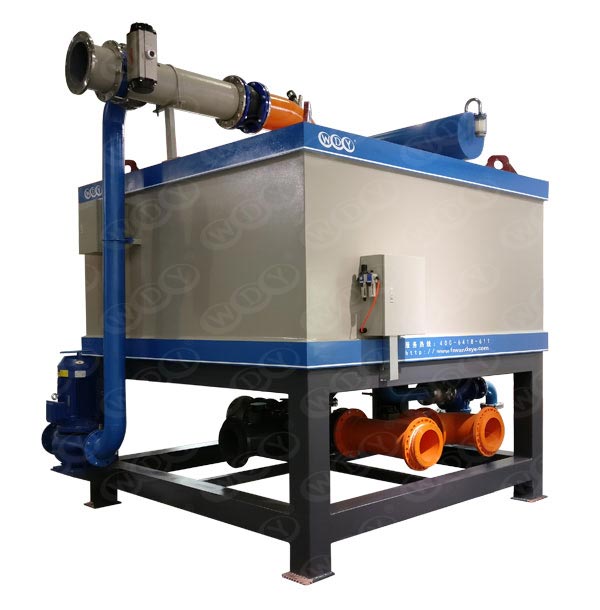
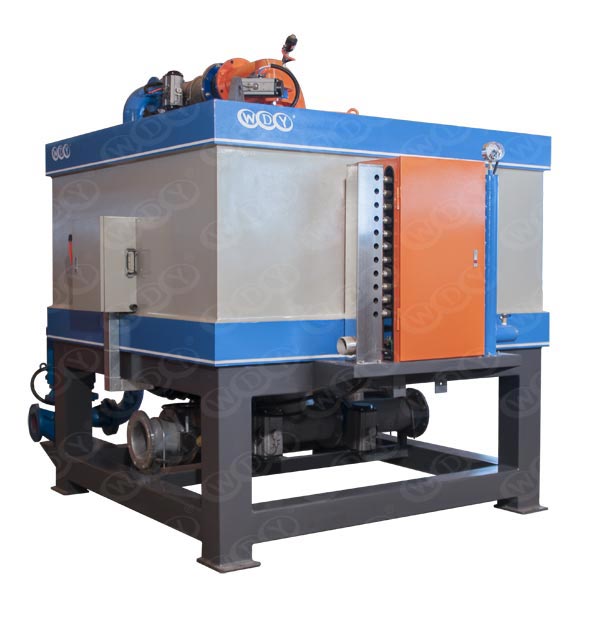
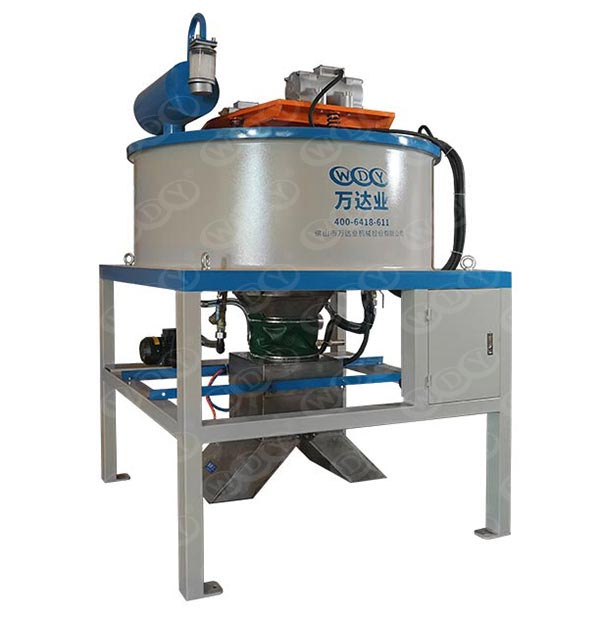
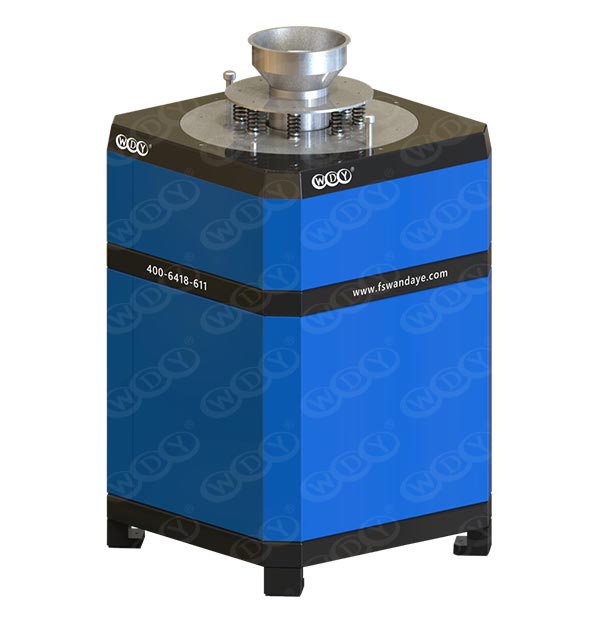
>> 5. Foshan Wandaye Technology Co., Ltd. – Flexible R&D‑Driven OEM Partner
● Comparison of Capacity, MOQ, and Certifications
● Technical Considerations for Iron Separator Procurement
● Industry Pain Points and How to Avoid Them
● Insider “Avoid‑the‑Trap” Guide: The “Pilot Batch Gap”
● Buyer’s Guide: Practical Steps for Sourcing in Malaysia
>> Step 1: Build your long‑list and pre‑qualify
>> Step 2: Define requirements and request proposals
>> Step 3: Verify certifications and factory practices
>> Step 4: Sample testing and pilot runs
>> Step 5: Contracting, logistics, and after‑sales
● Conclusion and Call to Action
● FAQ – Advanced Procurement Questions
>> 1 How can I verify whether a supplier’s ISO 9001 certification is still valid?
>> 2 What documentation should I request to compare different iron separator suppliers fairly?
>> 3 How do I ensure magnetic performance will remain stable over the equipment’s lifetime?
>> 4 What is the best way to integrate iron separators into existing lines without major downtime?
>> 5 How should I evaluate global OEM partners like Wandaye when my plant is in Malaysia?
How to Evaluate a High‑Quality Iron Separator Supplier
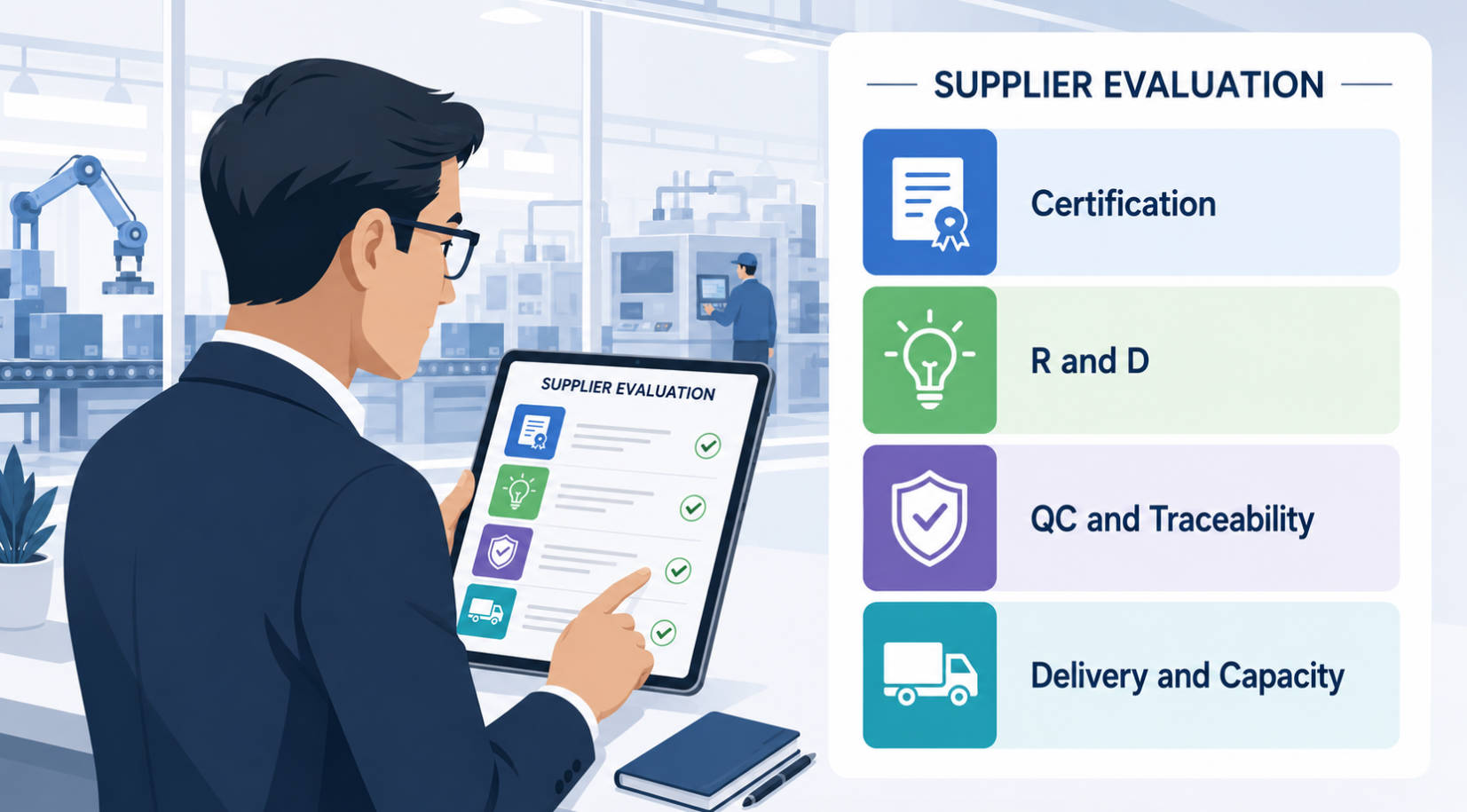
For professional buyers, selecting an iron separator supplier is a strategic decision that impacts product purity, plant uptime, and compliance risk over many years. Rather than focusing solely on unit price, you should systematically assess four core dimensions. [researchandmarkets]
1. Factory certification and compliance
– Use ISO 9001 as a basic entry filter, and treat additional ISO 14001 and ISO 45001 certifications as evidence of more mature environmental and safety management. [accio]
– For export‑oriented projects, confirm that the supplier can support CE and, where relevant, RoHS requirements, especially for equipment used in food, pharma, and battery lines. [accio]
2. R&D capability and engineering depth
– Prioritise suppliers with in‑house design teams capable of sizing and configuring magnetic circuits for different media (slurry, powder, bulk solids) and particle sizes. [fairfieldmarketresearch]
– Look for evidence such as patents, technical whitepapers, or published case studies on high‑gradient separators, powder magnetic separation, and contamination control. [en.fswandaye]
3. Quality control and traceability
– Mature manufacturers operate structured QC systems across incoming inspection, in‑process checks, and final testing, often aligned with ISO 9001 procedures. [hyperbots]
– Ask how they measure and document magnetic flux, material composition, weld integrity, and whether they maintain traceable records for each production batch. [hyperbots]
4. Capacity, delivery reliability, and project execution
– Evaluate whether the plant’s capacity and standard lead times align with your forecast volumes and ramp‑up plans. [strategicmarketresearch]
– For large or customised projects, review their track record in on‑time delivery and experience with turnkey line integration, commissioning, and after‑sales service. [en.fswandaye]
Malaysia’s Role in the Global Iron Separator Supply Chain
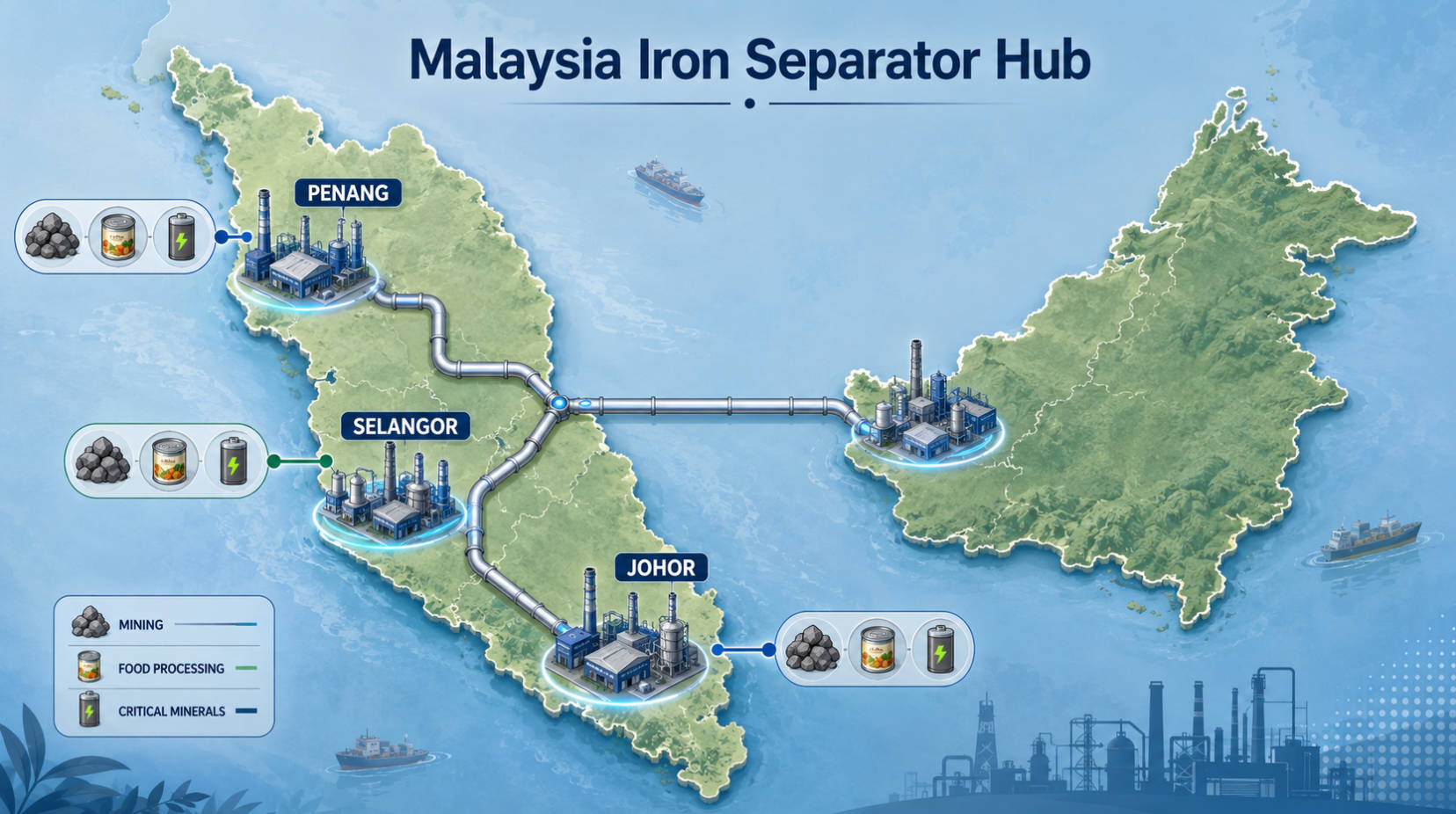
Malaysia sits within Asia Pacific, the region that accounts for around 45% of global magnetic separator revenues thanks to its concentration of mining, steel, and recycling activity. The country’s industrial base is strengthened by downstream investments in critical minerals separation, magnet manufacturing, and recycling under national and bilateral policy frameworks. [indexbox]
For buyers, Malaysia offers a combination of export‑friendly infrastructure, established industrial parks, and proximity to major demand centres in ASEAN, China, and India. This makes Malaysian manufacturers and integrators attractive partners for regional projects, while cross‑border collaborations with technology‑rich suppliers in China and other Asia‑Pacific hubs often deliver additional performance and cost advantages. [matrade.gov]
Transparent Selection Criteria for This Top List
To create a useful shortlist for procurement managers, this article relies on transparent, objective selection criteria rather than marketing claims. [researchandmarkets]
– Proven manufacturing and export track record
Companies must have several years of experience in designing or manufacturing iron separators or magnetic separation systems, with evidence of regional or international exports. [fairfieldmarketresearch]
– Quality and compliance readiness
ISO 9001 certification is treated as a baseline, with preference given to suppliers that also show environmental or occupational safety certifications and documented CE/RoHS capabilities where relevant. [accio]
– Application coverage and product depth
Selected suppliers serve at least two major sectors among mining, cement, ceramics and glass, food and pharma, plastics and rubber, and battery or critical materials. [researchandmarkets]
– OEM/ODM experience and engineering support
Priority is given to manufacturers that support OEM/ODM collaboration, from custom design and sampling to documentation and long‑term technical support. [wdymagnetic]
– Evidence‑based reputation
Public information such as project references, international distributor networks, or listings on industrial platforms is taken into account to gauge market recognition. [kumarmagnetind]
Top Iron Separator Manufacturers and Suppliers in Malaysia
Below is a curated list of key manufacturers and partners relevant to buyers sourcing iron separators in or for the Malaysian market. It combines local producers with regional technology partners that actively serve Malaysian customers. [kumarmagnet]
1. Kumar Magnet Industries – Regional Magnetic Separator Supplier
Overview and history
Kumar Magnet Industries is an India‑based manufacturer supplying magnetic separators, suspension magnets, and magnetic destoners to customers in Malaysia through its export network. The company has been active since the early 1990s and has steadily expanded its footprint across Asia and the Middle East. [kumarmagnetind]
Core strengths and products
Kumar’s portfolio covers high‑intensity roller type magnetic separators, drum separators, and overband magnets used in grain, minerals, and industrial processing lines. The company highlights customised solutions and offers OEM supply of magnetic modules to equipment builders. [kumarmagnet]
Markets and OEM/ODM capability
Main markets include South and Southeast Asia, with Malaysia being a key destination for high‑intensity roller separators and magnetic destoners. Kumar supports OEM branding for select customers and can adapt designs to local plant standards. [kumarmagnetind]
2. Magnet Security and Automation Sdn Bhd – Malaysian Separator Integrator
Overview and history
Magnet Security and Automation Sdn Bhd is listed among Malaysia‑based separator suppliers, focusing primarily on integrating metal separation and handling solutions into local installations. The company operates as a system provider rather than a high‑volume component manufacturer. [trademo]
Core strengths and products
It offers magnetic separation and automation solutions tailored to factory layouts, integrating magnetic separators, conveyors, and control systems for industrial clients. Their strength lies in on‑site service and adaptation of imported equipment to Malaysian plant conditions. [trademo]
Markets and OEM/ODM capability
The firm serves mainly domestic Malaysian customers with project‑based solutions and cooperates with overseas manufacturers for key components. OEM and ODM collaboration typically centres on co‑branding or integrating foreign magnetic modules into locally installed systems. [trademo]
3. Baite Magnet Technology – Vertical High Gradient Solutions in Malaysia
Overview and history
Baite Magnet Technology, founded in 2003, is a Chinese mining equipment manufacturer that supplies vertical high‑gradient magnetic separators to customers in Malaysia. It has built a reputation for mining‑focused magnetic solutions and long‑term cooperation with regional clients. [baitemining]
Core strengths and products
Baite’s product line includes vertical high‑gradient separators, drum separators, and other mining equipment for iron ore, ilmenite, and related minerals. The company focuses on heavy‑duty design and performance in demanding mining environments. [baitemining]
Markets and OEM/ODM capability
Baite’s main markets are mining regions in Asia and Africa, with Malaysia representing a key export destination for mineral processing projects. It supports OEM arrangements for mining houses and EPC contractors, including custom configurations and performance guarantees. [baitemining]
4. Local Malaysian Fabrication and Process Integrator Cluster
Overview and history
Malaysia hosts a cluster of medium‑sized fabrication shops and process engineering firms that assemble and integrate iron separators into broader process lines. These companies often act as the “last mile” partner for international technology suppliers. [linkedin]
Core strengths and products
Typical offerings include fabricated housings, chutes, frames, and piping systems combined with imported magnetic modules to form complete iron removal stages in cement, food, and chemical plants. Many of these firms also handle on‑site installation, commissioning, and maintenance. [goudsmitmagnetics]
Markets and OEM/ODM capability
Their primary market is domestic Malaysia and nearby ASEAN countries, serving plant owners and EPCs that prefer local support with global‑sourced core technology. OEM collaboration focuses on integrating and branding solutions for local project portfolios. [linkedin]
5. Foshan Wandaye Technology Co., Ltd. – Flexible R&D‑Driven OEM Partner
Overview and history
Foshan Wandaye Technology Co., Ltd. (often branded as Wandaye Magnetics) is a specialised manufacturer of magnetic separation equipment, integrating R&D, engineering design, production line installation, and commissioning services. The company’s roots date back to the early 2000s, and it became a listed company on China’s National Equities Exchange and Quotations (NEEQ) in 2015 under stock code 833886. [en.fswandaye]
Core strengths and products
Wandaye focuses on high‑gradient electromagnetic slurry machines, powder magnetic separators, permanent magnetic separators, vertical ring separators, magnetic plates, iron‑removal cabinets, and magnetic rods. These products serve industries including mining, ceramics, electricity, building materials, glass, environmental protection, rubber, plastics, medicine, food, and positive/negative electrode materials. [en.fswandaye]
Positioning for Malaysian buyers
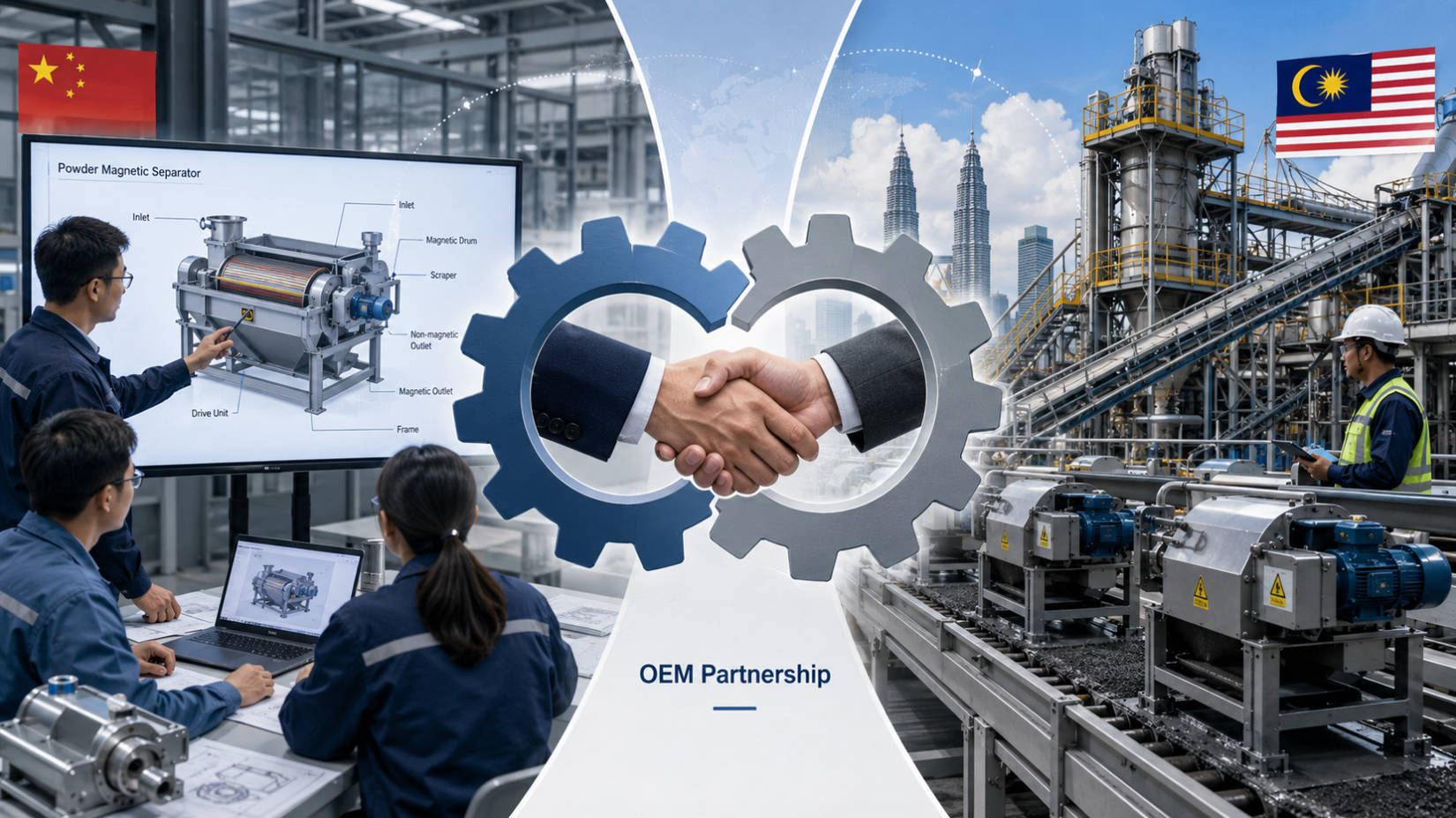
From a Malaysian buyer’s perspective, Wandaye represents a high value, R&D‑driven OEM partner rather than a purely catalogue‑driven mass supplier. The company is particularly attractive to mid‑sized brands and integrators who require customised solutions, sample testing, and iterative engineering collaboration. [wdymagnetic]
Markets and OEM/ODM capability
Wandaye exports globally and frequently collaborates with ASEAN integrators and EPCs that need flexible production capacity and engineering support. OEM and ODM services include customised magnetic circuit design, material selection (e.g., stainless grades, linings), and line‑level optimisation for powder and slurry applications. [tradeindia]
Comparison of Capacity, MOQ, and Certifications
The table below summarises the typical positioning of the suppliers listed above for faster comparison by procurement managers. [en.fswandaye]
| Supplier | Typical capacity | Typical OEM/ODM MOQ | Certifications and compliance focus | Main markets and strengths |
|---|---|---|---|---|
| Kumar Magnet Industries | Medium to high volume for roller and drum separators used in grains and minerals. kumarmagnetind | Moderate MOQ; often several units per model for customised projects. kumarmagnetind | ISO 9001‑driven quality system; supports CE‑ready designs for select models. kumarmagnetind | South and Southeast Asia; high‑intensity applications and customised modules. kumarmagnetind |
| Magnet Security and Automation Sdn Bhd | Project‑based capacity; focuses on integrating equipment into local lines. trademo | Flexible; can handle one‑off or small series for specific plants. trademo | Project‑specific compliance; often aligns imported equipment with local standards. trademo | Malaysia; on‑site integration, automation, and after‑sales service. trademo |
| Baite Magnet Technology | High capacity for mining‑grade vertical high‑gradient and drum separators. baitemining | Higher MOQ aligned with large mining projects. baitemining | ISO‑aligned systems; focused on mining safety and performance standards. baitemining | Mining projects in Asia and Africa, including Malaysian mineral processing. baitemining |
| Local Malaysian Fabrication and Process Integrator Cluster | Moderate fabrication capacity; strong in frames, housings, and skids. linkedin | Very flexible; small MOQs matched to project scope. linkedin | Compliance follows imported core components; focus on local safety and building codes. linkedin | Malaysian and ASEAN plants needing local fabrication and lifecycle support. linkedin |
| Foshan Wandaye Technology Co., Ltd. | Large capacity across powder and slurry magnetic separators, serving multiple sectors. en.fswandaye | Flexible; supports smaller MOQs for customised OEM/ODM projects and pilot lines. en.fswandaye | Operates under ISO‑aligned quality management; can support CE and sector‑specific requirements by project. accio | Global exports, strong presence in Asia Pacific; high‑performance and customised solutions for OEMs and integrators. en.fswandaye |
Technical Considerations for Iron Separator Procurement
Beyond supplier identity, technical configuration strongly influences the success of iron separator projects. [fairfieldmarketresearch]
1. Magnetic material and intensity
– The global magnetic separator market increasingly favours high‑intensity separators for critical minerals and fine powder applications. [researchandmarkets]
– Procurement teams should check magnet type (e.g., NdFeB grade), maximum flux density, and temperature performance to ensure suitability for their process. [fairfieldmarketresearch]
2. Product form and process type
– Wet drum separators dominate large‑scale iron ore beneficiation due to their throughput and robustness, while powder separators and magnetic grids are critical for fine powders and bulk solids. [researchandmarkets]
– For positive/negative electrode materials and ceramics, high‑gradient or high‑intensity designs are typically required to capture ultra‑fine contaminants. [wdymagnetic]
3. Construction materials and sanitary design
– For food, pharma, and some battery applications, stainless steel construction and hygienic design (smooth surfaces, cleanable joints) are essential to pass audits and avoid contamination. [goudsmitmagnetics]
– In abrasive or high‑temperature processes, wear‑resistant linings and suitable magnet encapsulation help extend service life. [en.fswandaye]
4. Automation and monitoring
– Market reports highlight increased adoption of automated separation systems with sensors and controls to maintain consistent performance. [strategicmarketresearch]
– Buyers should consider control integration, alarm systems, and data logging capabilities, especially in regulated or high‑value processes. [researchandmarkets]
Industry Pain Points and How to Avoid Them
Procurement managers sourcing iron separators commonly encounter several recurring problems. [hyperbots]
– Material downgrading and hidden design changes
Some suppliers deliver strong pilot units but subsequently reduce magnet grade or quantity to cut costs, causing performance drift over time. Mitigation: freeze magnet specifications and flux density requirements in contracts and verify against test reports with each batch. [accio]
– Outdated or invalid certifications
ISO certificates may be expired, limited in scope, or issued by non‑accredited bodies. Mitigation: verify certificates using IAF or accreditation‑body databases and request recent audit summaries before awarding major contracts. [proconsultancyuae]
– Inadequate process matching
Off‑the‑shelf separators originally designed for bulk minerals are sometimes applied directly to fine powders or food lines, resulting in poor efficiency or hygiene issues. Mitigation: share detailed process data and insist on application‑specific engineering support and, where possible, pilot tests. [goudsmitmagnetics]
– Underestimated lifecycle costs
Buyers sometimes focus on upfront price while neglecting maintenance, cleaning downtime, and spare parts availability. Mitigation: evaluate total cost of ownership, including consumables, cleaning frequency, and expected service life. [strategicmarketresearch]
Insider “Avoid‑the‑Trap” Guide: The “Pilot Batch Gap”
Within the industry, experienced buyers often talk about the “pilot batch gap”—a situation where the trial unit delivered for testing is built to a higher standard than the subsequent production batch. [accio]
To minimise this risk:
– Contractually lock the baseline
Define clear, measurable baseline parameters (magnet grade, number of magnet blocks, flux density at defined points, material grades, surface finish) directly in the contract and technical annexes. [hyperbots]
– Audit early‑stage batches
Plan at least one intrusive inspection or third‑party audit during early batches, especially for large framework orders, to confirm consistency with pilot specifications. [proconsultancyuae]
– Tie future orders to performance data
Include performance metrics and feedback loops in the agreement so that future orders are contingent on stable separation efficiency and acceptable complaint rates. [fairfieldmarketresearch]
Mature suppliers, including technology‑focused OEM partners like Wandaye, are generally comfortable with this level of transparency because it aligns their process discipline with buyer expectations. [wdymagnetic]
Buyer’s Guide: Practical Steps for Sourcing in Malaysia
Step 1: Build your long‑list and pre‑qualify
– Use trade databases and platforms to identify Malaysian manufacturers and regional suppliers actively exporting separators, then filter by ISO 9001 certification and relevant sector experience. [kumarmagnetind]
– Consider regional OEM partners such as Wandaye when you need more advanced technology or specialised powder separation capabilities. [en.fswandaye]
Step 2: Define requirements and request proposals
– Prepare a clear data sheet covering material type, particle size distribution, throughput, operating temperature, and contamination level. [fairfieldmarketresearch]
– Request not only pricing but also proposed configurations, expected separation efficiency, and footprint, so that different suppliers can be fairly compared. [researchandmarkets]
Step 3: Verify certifications and factory practices
– Implement a formal ISO verification process: check certificate numbers in accreditation databases, confirm expiry dates, and review audit scope. [proconsultancyuae]
– Where possible, conduct on‑site or third‑party audits focusing on QC processes, test equipment, and traceability systems. [proconsultancyuae]
Step 4: Sample testing and pilot runs
– For new or critical applications, arrange lab or pilot‑scale testing with candidate suppliers to validate separation performance under realistic conditions. [fairfieldmarketresearch]
– Use these tests to compare flux stability, contamination reduction rates, and pressure or flow impact across vendors. [researchandmarkets]
Step 5: Contracting, logistics, and after‑sales
– Clearly define Incoterms, packing requirements (e.g., wooden crates, corrosion protection), and responsibilities for commissioning and training. [matrade.gov]
– Confirm spare parts availability, response times, and remote support capabilities—especially if you rely on cross‑border OEM partners. [en.fswandaye]
Conclusion and Call to Action
Malaysia’s position within Asia Pacific’s broader magnetic separator ecosystem gives buyers access to both local integrators and technologically advanced regional OEM partners. By combining Malaysian fabrication and process expertise with high‑performance solutions from specialists like Foshan Wandaye Technology Co., Ltd., procurement managers can achieve a balance of cost, performance, and compliance tailored to their process needs. [strategicmarketresearch]
If you are planning to source or upgrade iron separators for your Malaysian operations, start by mapping your process risks, defining a structured supplier evaluation checklist, and engaging two to three shortlisted manufacturers for comparative proposals and pilot tests. This structured approach reduces uncertainty, exposes hidden risks early, and lays the foundation for long‑term, performance‑based partnerships rather than purely transactional purchases. [accio]
FAQ – Advanced Procurement Questions
1 How can I verify whether a supplier’s ISO 9001 certification is still valid?
You should verify ISO 9001 certifications via three steps: check the certificate number in an accredited database (e.g., IAF or local accreditation body), confirm the expiry date and scope, and, where possible, request recent audit reports or summaries. Implement an annual or semi‑annual verification cycle for key suppliers to ensure that certifications remain current. [proconsultancyuae]
2 What documentation should I request to compare different iron separator suppliers fairly?
Request at least a technical data sheet, process suitability statement, test reports or performance guarantees, layout drawings, and compliance documentation (ISO certificates, CE/food safety support). Standardising these documents across vendors enables apples‑to‑apples comparison of performance, footprint, and lifecycle risk. [fairfieldmarketresearch]
3 How do I ensure magnetic performance will remain stable over the equipment’s lifetime?
Ask suppliers to specify magnet type, demagnetisation curves, maximum operating temperature, and recommended inspection intervals, and to provide guidance on periodic flux checks. Incorporate these parameters into your maintenance plans and include performance validation clauses in the contract. [hyperbots]
4 What is the best way to integrate iron separators into existing lines without major downtime?
Work with suppliers or integrators who can provide as‑built surveys, 3D layouts, and staged installation plans, and consider modular units that can be installed during planned shutdowns. For complex retrofits, pilot installations or temporary bypass lines can help minimise downtime during commissioning. [linkedin]
5 How should I evaluate global OEM partners like Wandaye when my plant is in Malaysia?
Focus on their track record in similar applications, ability to support CE or sector‑specific compliance, export and logistics experience, and local integration partners. For Wandaye, assess powder and slurry separator references, OEM collaboration cases, and the depth of engineering and after‑sales support they can provide through regional networks. [en.fswandaye]
References
1. About Us | Foshan Wandaye Machinery Equipment Co., Ltd. (company profile and product range).[Link]
2. Magnetic Separator | Magnetic Separation Equipment | Foshan Wandaye Technology Co., Ltd.[Link]
3. Wandaye Magnetics – Company overview and industry applications.[Link]
4. Magnetic Separator Market Size, Share & Trends Report 2026 – Fairfield Market Research.[Link]
5. Magnetic Separator Market Report 2026 – Research and Markets.[Link]
6. Strategic Market Research – Global Magnetic Separator Market Overview.[Link]
7. ISO Standards for Manufacturing: Compliance & Certification Guide.[Link]
8. How to Confirm ISO Certification Validity Guide.[Link]
9. What is ISO Certification Verification? – Hyperbots Glossary.[Link]
Hot Tags: Iron Separator, Manufacturers, Customized, Custom, Suppliers, Buy, Cheap, Quality, Advanced, Durable, in Stock, Made in China, Price, Quotation