Content Menu
>> Permanent Suspended Magnets
>> Electromagnetic Suspended Magnets
>> Overband (Self‑Cleaning) Suspended Magnets
● Where Suspended Magnets Are Used
>> Ceramics, Glass and Building Materials
>> Recycling and Waste Management
>> Food, Pharma and Chemical Materials
● Benefits of Using Suspended Magnets
● How Suspended Magnets Compare to Other Magnetic Separators
● Expert Checklist: How to Choose the Right Suspended Magnet
● Practical Installation and Maintenance Tips
● Why Magnetic Separation Is More Critical Than Ever
● Where a Specialist Manufacturer Adds Real Value
● Call to Action: Design a Cleaner, Safer Line
● FAQs About Suspended Magnets
>> 1. What is the main purpose of a suspended magnet?
>> 2. How do I know if I need a permanent or electromagnetic suspended magnet?
>> 3. Can suspended magnets remove very fine metal particles?
>> 4. Where should I install a suspended magnet on my conveyor?
>> 5. How often should a suspended magnet be cleaned or inspected?
As someone who has spent years working with permanent magnetic separators in mining, ceramics, new energy and food-grade production lines, I can say suspended magnets are often the quiet heroes that decide whether a plant runs smoothly or bleeds money through downtime and contamination. In this guide, I will walk you through how suspended magnets work, how they compare to other magnetic separation solutions, and how to select, install and maintain them for long-term performance. [minejxsc]
What Is a Suspended Magnet?
A suspended magnet (also called an overhead or overband magnet) is a magnetic separator installed above a conveyor or chute to continuously remove ferrous contaminants such as iron pieces, bolts, nails and worn machine parts from bulk materials. By extracting these metallic impurities in real time, it protects downstream crushers, mills, classifiers and packaging equipment while also improving product purity and safety. [imt-inc]
From my experience in engineering and commissioning lines for ceramics, lithium battery materials, plastics, glass and food ingredients, a well‑designed suspended magnet is one of the highest‑ROI safety and quality investments you can make. It becomes even more critical when you process high‑value powders or operate in regulatory‑sensitive sectors like food, pharmaceuticals and battery materials. [magnattackglobal]
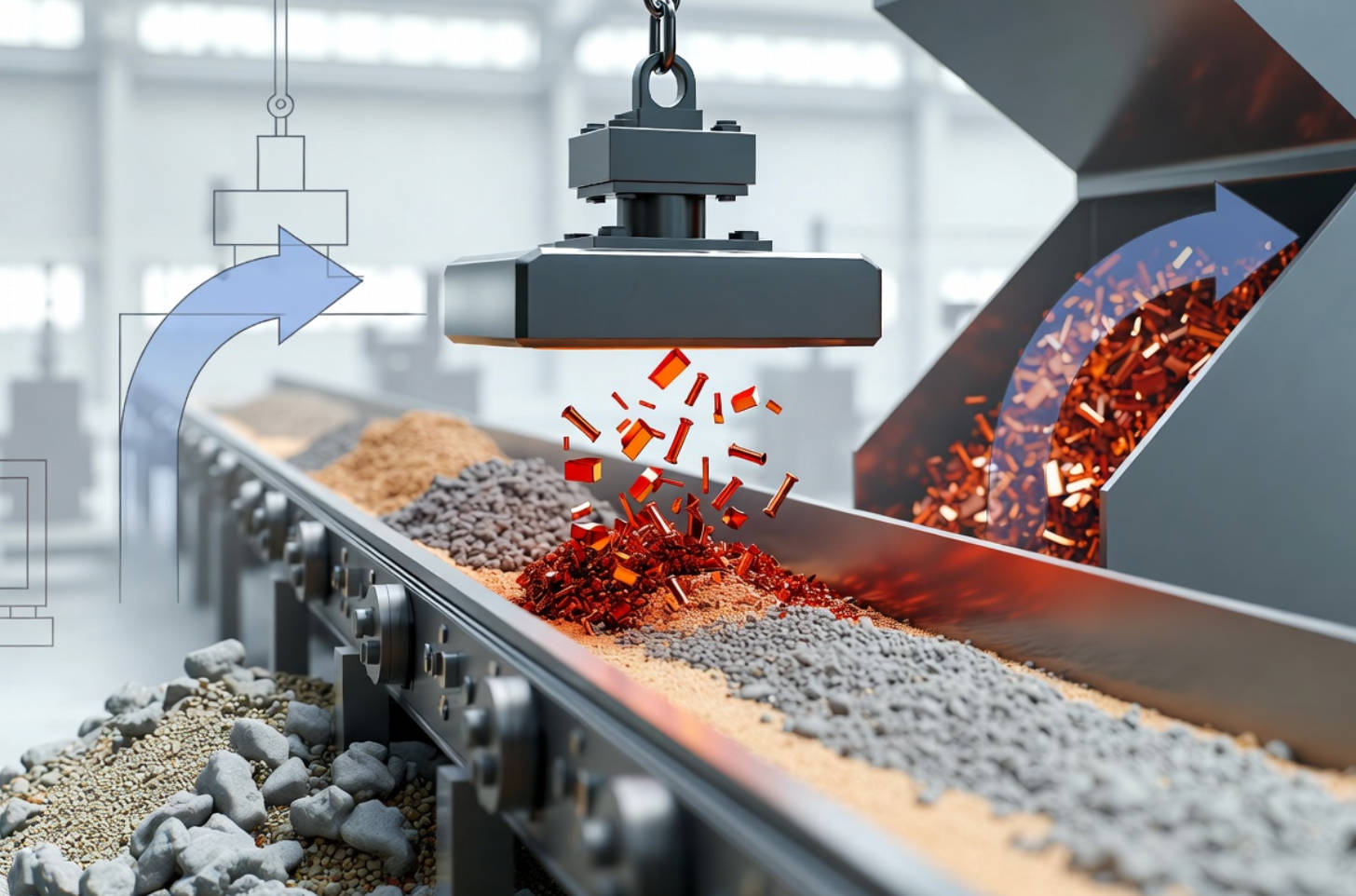
How Suspended Magnets Work
At its core, a suspended magnet creates a high‑intensity magnetic zone above the conveyor that pulls ferrous particles out of the material flow. As material passes through this zone, magnetic pieces are attracted upward, held against the magnet face, and then discharged manually or via a self‑cleaning belt. [eriez]
Key working principles:
– Magnetic principles
Suspended magnets exploit the fact that ferrous materials like iron and steel are strongly attracted when they enter a magnetic field, while most minerals, plastics and organic materials are not. This contrast makes it possible to separate metal from non‑metal without chemicals or added water. [minejxsc]
– Magnetic circuit design
The internal yoke and pole shoes are engineered to concentrate flux at the magnet face, forming a focused “magnetic field window” that extends down into the conveyed material. This design helps capture both large tramp metal and smaller shards at realistic belt speeds. [buntingmagnetics]
– Material separation and discharge
Ferrous contaminants are lifted out of the burden and either held on the face for periodic manual cleaning, or automatically carried out of the product stream by a cross‑belt cleaning system. Automatic self‑cleaning models are preferred where contamination loads are high or lines run continuously. [buntingmagnetics]
Types of Suspended Magnets
Permanent Suspended Magnets
Permanent suspended magnets use high‑energy materials such as ferrite or rare‑earth (e.g. neodymium) magnets to generate a constant magnetic field with no external power supply. They offer excellent energy efficiency, compact size and low operating costs, which is why they are common in mining, ceramics and aggregate plants with relatively stable process conditions. [magnetics]
Typical advantages:
– No power consumption for magnetization
– Simple installation and low maintenance
– Stable field strength over long periods when properly designed and cooled [eriez]
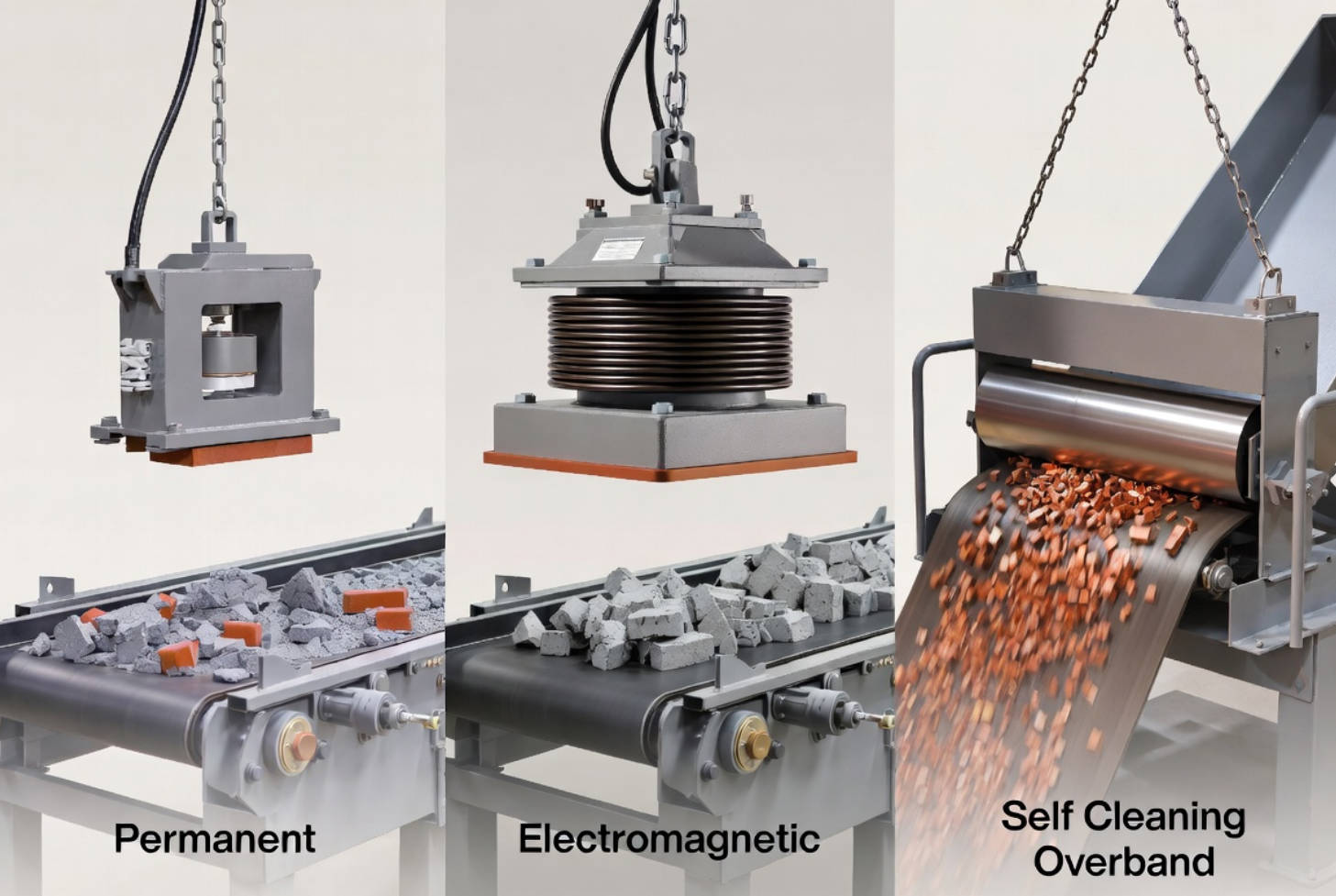
Electromagnetic Suspended Magnets
Electromagnetic suspended magnets generate a field by passing current through a coil, allowing on‑off control and some adjustability of field strength. They are often used where contamination levels fluctuate, where deep magnetic penetration is required, or where automatic demagnetization is desirable. [buntingmagnetics]
Key benefits:
– Adjustable magnetic intensity via current control
– Ability to switch off for maintenance or when magnetic separation is not needed
– Suitable for deeper burden layers or higher belt speeds [buntingmagnetics]
Overband (Self‑Cleaning) Suspended Magnets
Overband magnets add a moving cleaning belt over a suspended magnet, continuously carrying captured metal out of the magnetic field into a discharge chute. This configuration is ideal for harsh environments such as quarrying, construction waste and high‑throughput mining where manual cleaning is impractical. [imt-inc]
Where Suspended Magnets Are Used
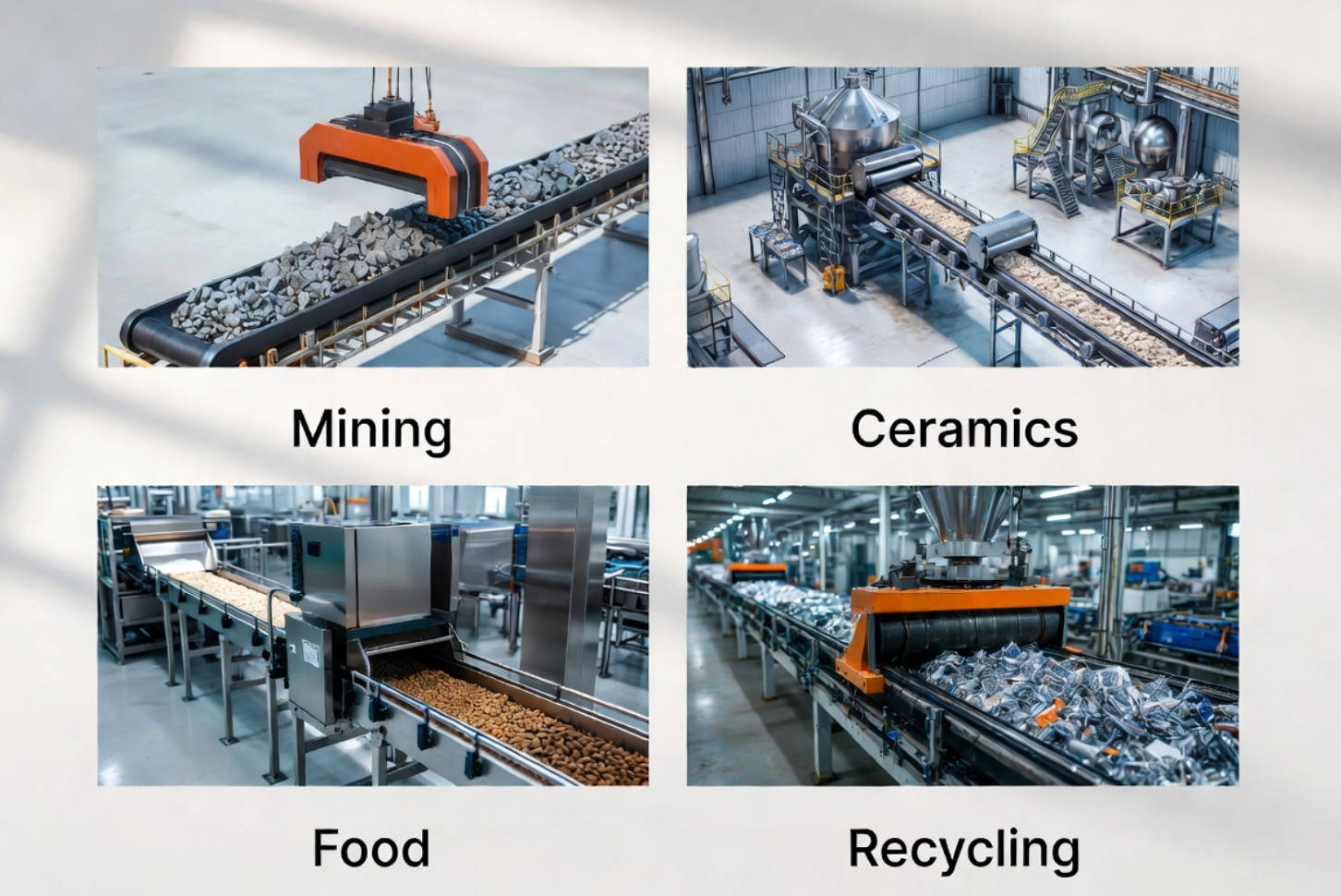
Suspended magnets are standard equipment in many industries that Foshan Wandaye serves, including mining, ceramics, new energy materials, plastics, food and glass. Below are some of the most important use cases. [minejxsc]
Mining and Quarrying
In mining and quarrying, suspended magnets are installed over primary and secondary conveyors to remove tramp iron before it can damage crushers, screens or mills. They also help improve ore quality by removing unwanted metal debris from coal, limestone, iron ore and non‑metallic minerals. [magnetics]
Ceramics, Glass and Building Materials
Ceramic body, glaze materials, silica sand, feldspar and glass batch are extremely sensitive to metallic contamination, which can cause black spots, pinholes or electrical defects in insulators. Permanent suspended magnets and high‑gradient separators are widely used above belt feeders and raw‑material conveyors to keep ferrous contamination at near‑zero levels. [minejxsc]
Recycling and Waste Management
In recycling plants, suspended magnets are positioned over belts carrying shredded scrap, municipal solid waste or construction and demolition waste to extract iron and steel from mixed materials. This both recovers valuable metals and upgrades the quality of downstream non‑ferrous and non‑metallic streams. [okonrecycling]
Food, Pharma and Chemical Materials
Food and pharmaceutical processors rely on magnets to comply with strict safety and contamination standards. While grate and pipeline magnets are common for final polishing, suspended magnets are used upstream to catch larger ferrous objects coming from raw materials, packaging damage or equipment wear. [magnattackglobal]
Benefits of Using Suspended Magnets
From an operator’s perspective, the value of a good suspended magnet shows up in fewer breakdowns, cleaner product and safer shifts. [imt-inc]
Main benefits include:
– Higher efficiency and less downtime
By continuously removing tramp iron, suspended magnets prevent plugging, belt damage and catastrophic crusher failures, which are often among the costliest downtime events in a plant. This translates into higher throughput and more stable production schedules. [grandviewresearch]
– Lower maintenance and repair costs
Protecting mills, crushers, pulverizers and packers from metal damage significantly extends their service life. Over the life of a production line, the cost of a suspended magnet is typically far lower than the cumulative cost of unprotected equipment failures. [grandviewresearch]
– Improved product purity and compliance
In sectors like food, lithium battery materials and fine ceramics, even small ferrous particles are unacceptable. Magnetic separation is a frontline defense that supports compliance with food safety schemes and quality standards in advanced material industries. [minejxsc]
– Sustainability and resource efficiency
Magnetic separation is a dry, chemical‑free, energy‑efficient process that supports circular economy targets by recovering scrap metal and reducing landfilled waste. Permanent magnets in particular offer this benefit with nearly zero running energy consumption. [okonrecycling]
How Suspended Magnets Compare to Other Magnetic Separators
Below is a practical comparison that I often walk through with engineering teams when we design a new line.
Common Magnetic Separation Solutions in Processing Lines
| Equipment type | Typical position | Best for | Key advantages | Limitations |
|---|---|---|---|---|
| Suspended / overband magnet | Above conveyor or chute | Tramp iron removal from bulk solids | Handles large pieces, continuous, protects equipment imt-inc | Less suited for ultra‑fine polishing |
| Drum magnetic separator | Head pulley or separate drum station | Continuous separation of magnetic ore or ferrous fraction | Good for high‑capacity mineral processing and recycling minejxsc | Requires more space and mechanical integration |
| Plate or grate magnet | Chutes, hoppers, gravity lines | Fine ferrous contamination in powders and granules | High capture efficiency for small particles minejxsc | Usually manual cleaning, limited capacity |
| Liquid line magnet | Pipelines and slurry lines | Wet slurries and viscous liquids | Ensures food and chemical product purity minejxsc | Requires hygienic design and regular CIP |
| High‑gradient separator | Specialized stages | Weakly magnetic minerals and ultra‑fine particles | High intensity separation for advanced materials finance.yahoo | Higher CAPEX and more complex operation |
This is why, in many projects, we combine suspended magnets for primary protection with other separator types for final polishing and quality control. [magnattackglobal]
Expert Checklist: How to Choose the Right Suspended Magnet
From both field experience and industry guidance, choosing a suspended magnet should be a data‑driven engineering decision, not just “buy the strongest magnet”. [buntingmagnetics]
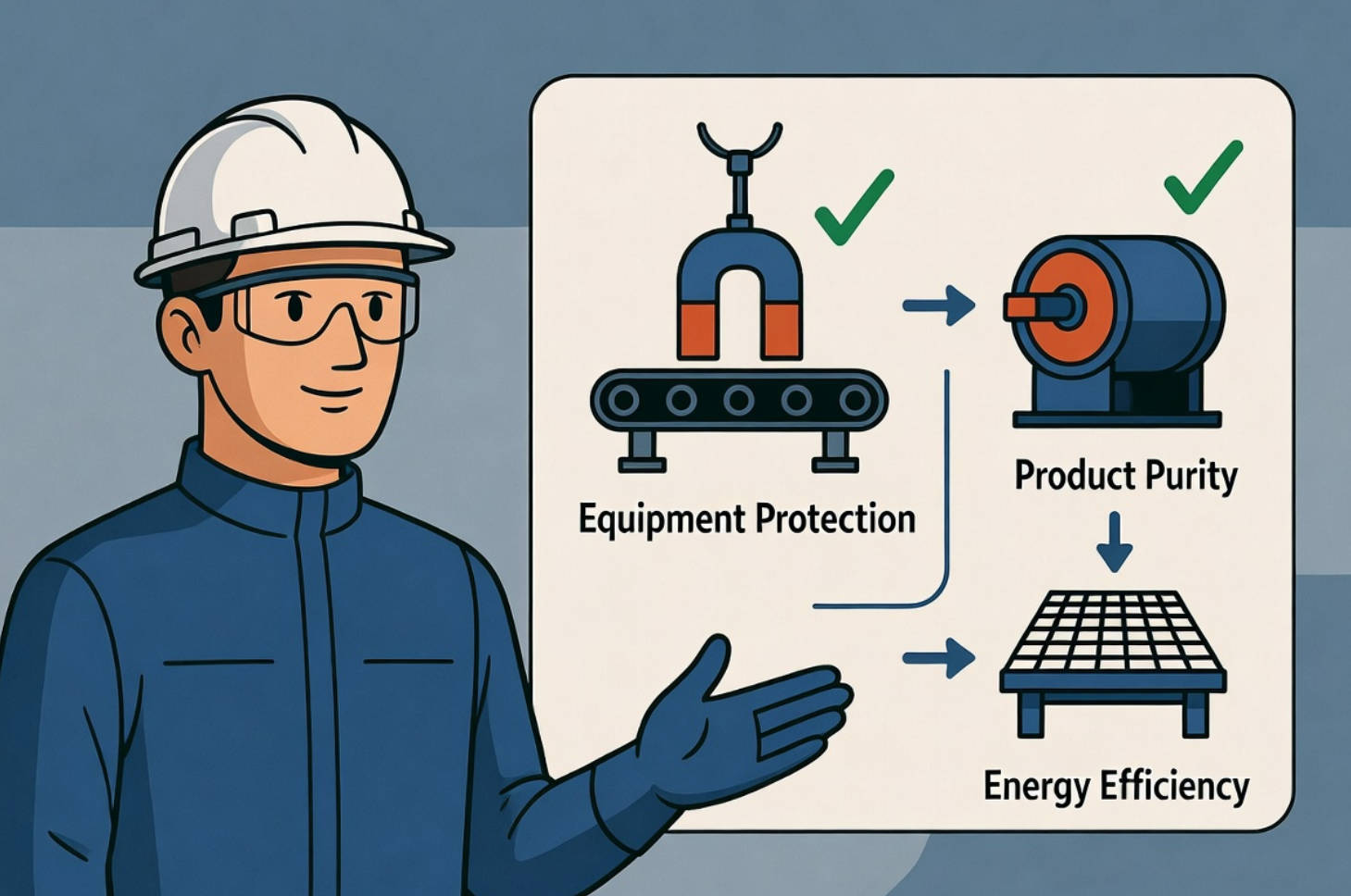
Here is a structured 7‑step checklist you can use with your engineering team:
1. Define your separation objective
Decide whether your priority is equipment protection, product purity, metal recovery value, or a combination of these. [magnattackglobal]
2. Characterize the material and contamination
– Material: dry, damp, or slurry; bulk density; particle size distribution
– Contamination: typical size (e.g. M6 bolts vs. fine steel wires), shape, frequency [minejxsc]
3. Assess process conditions
Look at belt speed, burden depth, throughput, temperature and surrounding dust or corrosive atmospheres. [minejxsc]
4. Choose permanent vs. electromagnetic
– Permanent: stable conditions, moderate belt speed, focus on energy saving and low maintenance
– Electromagnetic: variable conditions, deeper burden, need for field adjustability or remote control [eriez]
5. Select manual‑cleaning vs. self‑cleaning
For high contamination loads or 24/7 lines, a self‑cleaning overband is usually the only practical choice. [buntingmagnetics]
6. Check installation space and layout
Confirm available height above the belt, access for maintenance, and the possibility of cross‑belt vs. in‑line mounting. [eriez]
7. Evaluate lifecycle cost and ROI
Consider not only purchase price but also saved downtime, extended equipment life, lower recalls and compliance risk. [grandviewresearch]
Working with a specialist manufacturer that understands mining, ceramics, battery materials and food‑grade applications will help you optimize each of these steps and avoid the common mistake of overspecifying gauss while underspecifying real‑world performance. [buntingmagnetics]
Practical Installation and Maintenance Tips
Based on commissioning and troubleshooting work in the field, I recommend treating suspended magnets as critical assets rather than passive accessories. [minejxsc]
Best practices:
– Install at the right height and angle
Too high and capture efficiency drops; too low and you risk physical contact with material or hardware. Follow the manufacturer’s specified suspension height and consider cross‑belt mounting for better metal discharge in many applications. [buntingmagnetics]
– Maintain a “metal‑free zone” under the magnet
Avoid any structural steel in the magnetic field window (cross‑members, guards, etc.) to prevent flux loss and unwanted metal build‑up. [buntingmagnetics]
– Implement routine inspection and cleaning
Even for self‑cleaning units, set a checklist: belt tracking, motor condition, fasteners, magnet face condition, and any unusual buildup. For manual‑cleaning models, define a cleaning frequency based on measured contamination rates. [szhmmag]
– Document performance and incidents
Track captured metal volume over time and log any equipment damage or product complaints tied to metal contamination. This data becomes invaluable when you justify upgrades or fine‑tune your separation strategy. [magnattackglobal]
Why Magnetic Separation Is More Critical Than Ever
The global magnetic separator market was estimated at around 1.07 billion USD in 2024 and is expected to reach approximately 1.64 billion USD by 2033, driven by growth in mining, recycling and high‑purity material processing. Emerging trends include wider use of high‑gradient and superconducting technologies for precision separation, and a shift toward dry separation methods that reduce water consumption and environmental impact. [finance.yahoo]
For manufacturers and processors in sectors like lithium battery materials, advanced ceramics and food, this means magnetic separation has moved from a “nice‑to‑have” to a core risk‑management and quality‑assurance function. [finance.yahoo]
Where a Specialist Manufacturer Adds Real Value
A multi‑disciplinary manufacturer that integrates R&D, engineering design, production line installation and commissioning can help you do more than just buy a magnet. The real value shows up when your supplier:
– Audits your complete process and contamination risks
– Customizes magnet strength, size and installation layout
– Integrates suspended magnets with other separators (drums, plates, high‑gradient units)
– Provides on‑site start‑up, training and long‑term optimization support [magnetics]
In high‑stakes environments like mining concentrators, lithium cathode/anode material plants, high‑end ceramics and food factories, this kind of end‑to‑end partnership is often what differentiates average performance from world‑class reliability.
Call to Action: Design a Cleaner, Safer Line
If you are planning a new line or upgrading an existing system in mining, ceramics, new energy, food, plastics or glass, this is the right time to re‑evaluate your magnetic separation strategy. Work with a specialist suspended magnet manufacturer to audit your process, define your contamination risks, and engineer a permanent magnetic separator solution that delivers long‑term protection, compliance and ROI. [buntingmagnetics]
FAQs About Suspended Magnets
1. What is the main purpose of a suspended magnet?
The primary purpose of a suspended magnet is to remove ferrous contaminants from bulk materials on a conveyor or chute, protecting downstream equipment and improving product quality. It acts as a continuous, contact‑free safety filter that operates in real time during production. [imt-inc]
2. How do I know if I need a permanent or electromagnetic suspended magnet?
If your material, belt speed and contamination level are stable and you want low energy consumption with simple maintenance, a permanent suspended magnet is usually the better choice. If you need field adjustability, deeper penetration or remote on‑off control, an electromagnetic model may be more appropriate. [buntingmagnetics]
3. Can suspended magnets remove very fine metal particles?
Suspended magnets are excellent for tramp iron and larger pieces, and can capture some fine particles depending on field strength, distance and belt burden. For ultra‑fine ferrous particles, they are often combined with grate, drum or high‑gradient separators for final polishing. [minejxsc]
4. Where should I install a suspended magnet on my conveyor?
Most commonly, suspended magnets are installed either across the belt near the head pulley or in‑line above the discharge, where material is more spread and easier to penetrate magnetically. The optimal position depends on belt speed, burden depth, available height and downstream equipment layout. [magnattackglobal]
5. How often should a suspended magnet be cleaned or inspected?
Self‑cleaning overband magnets remove captured metal continuously, but still require periodic inspection of the belt, motor and mounting hardware. Manual‑cleaning models should be cleaned according to actual contamination rates, with at least routine visual checks incorporated into daily or weekly maintenance schedules. [szhmmag]
References
1. Great Magtech – “What is a Suspended Magnet? – Knowledge” (2023). [Link]
2. JXSC – “The Role of Magnetic Separation in Diverse Industries” (2025). [Link] [minejxsc]
3. Eriez – “Suspended Magnets – Product Brochure MSB-300” (Technical PDF). [Link] [eriez]
4. Bunting – “Magnetic Metal Free Areas under Overband Magnets” (2024). [Link] [buntingmagnetics]
5. Magnattack / Industry guidance – “Choosing the Right Magnetic Separation Equipment” (2026). [Link] [magnattackglobal]
6. JXSC – “Mastering Magnetic Separation in Mineral Processing” (2025). [Link] [minejxsc]
7. Grand View Research – “Magnetic Separator Market Size | Industry Report, 2033”. [Link] [grandviewresearch]
8. Market/technology insight – “High Gradient Magnetic Separators Market Report 2026”. [Link] [finance.yahoo]
9. Industrial Magnetics / Mining magnets – “Use of Industrial Magnets in the Mining Industry”. [Link] [imt-inc]
10. Bunting – “Five Magnetic Separator Myths” (Updated 2026). [Link] [buntingmagnetics]
Hot Tags: Suspended Magnet, Electromagnet, Manufacturers, Customized, Custom, Suppliers, Buy, Cheap, Quality, Advanced, Durable, in Stock, Made in China, Price, Quotation